Cardano has moved to resolve a governance bottleneck by ratifying an on-chain vote to restore its Constitutional Committee (CC) to functional capacity, a proceduralCardano has moved to resolve a governance bottleneck by ratifying an on-chain vote to restore its Constitutional Committee (CC) to functional capacity, a procedural

Cardano Breaks Governance Deadlock With New Constitutional Committee

2025/12/18 11:00
3 min read
For feedback or concerns regarding this content, please contact us at [email protected]

Cardano has moved to resolve a governance bottleneck by ratifying an on-chain vote to restore its Constitutional Committee (CC) to functional capacity, a procedural step that matters because the CC is required to evaluate constitutionality and ratify many categories of governance actions, including upgrades, budgets, and parameter changes.

Intersect, which coordinates parts of Cardano’s governance process, said on X: “On the 7th day of GA… We hit the Epoch’s end. DReps at 80%. Stake pools supporting- It looks like we have a new CC. Ratified. Thank you to everyone who reviewed, voted, and wrote rationales,Santa has been notified.”

Why The Cardano Governance Was Stuck

Cardano’s governance model is tripartite: delegate representatives (DReps), stake pool operators (SPOs), and the Constitutional Committee. The CC plays a gatekeeping role: it judges whether on-chain actions are constitutional and ratifies decisions needed for the network to adapt.

That mechanism stalled after an unexpected mid-term departure left the CC below its minimum operational size. The Cardano Atlantic Council retired mid-term in epoch 597, opening a seat and reducing the committee below quorum. The consequence was that the Cardano CC could not ratify key actions, even as the chain continued to operate normally at the protocol level.

The vote asked DReps and SPOs to ratify a newly elected CC member and restore the committee to full capacity. The candidate, Cardano Curia, was selected off-chain through a DRep vote using the Ekklesia tool, with on-chain ratification required to formalize the result.

The governance materials described the restoration as bringing the CC back to seven members and activating a clarified alternate-member process to handle future vacancies with less disruption. Approval thresholds were set at 67% from DReps and 51% support from SPOs. Intersect’s update indicates those thresholds were met as the epoch ended.

Why This Was Treated As Urgent

The vote was framed as more than housekeeping because an undersized CC effectively blocks major governance flows. Without quorum: Treasury withdrawals couldn’t proceed, the Critical Integrations Budget could not pass, hard forks could not be ratified, delaying network upgrades and several categories of governance actions were blocked, leaving only a limited subset able to move forward.

There was also a timing element: delays risk actions expiring, which would force a repeat of the voting process and extend the governance backlog. With the restoration ratified, Cardano’s governance process can resume normal throughput — reopening the path for upgrades, budget approvals, and protocol changes that depend on a functioning Constitutional Committee.

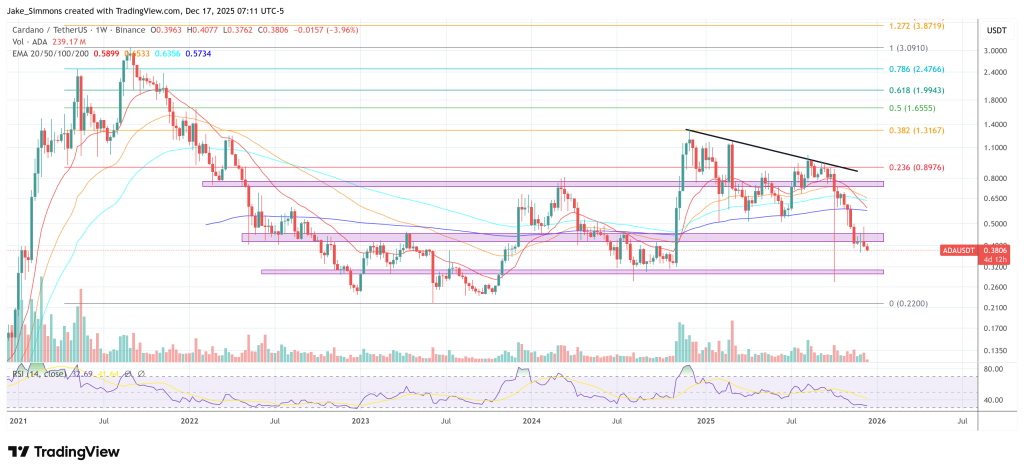
At press time, Cardano traded at $0.38.
Cardano price chart
Market Opportunity
Canton Network Logo
Canton Network Price(CC)
$0.15126
$0.15126$0.15126
+2.55%
USD
Canton Network (CC) Live Price Chart
Disclaimer: The articles reposted on this site are sourced from public platforms and are provided for informational purposes only. They do not necessarily reflect the views of MEXC. All rights remain with the original authors. If you believe any content infringes on third-party rights, please contact [email protected] for removal. MEXC makes no guarantees regarding the accuracy, completeness, or timeliness of the content and is not responsible for any actions taken based on the information provided. The content does not constitute financial, legal, or other professional advice, nor should it be considered a recommendation or endorsement by MEXC.

You May Also Like

Colombians can soon save in stablecoins with new MoneyGram App

Colombians can soon save in stablecoins with new MoneyGram App

                                                                               Colombians will soon be able to receive and store USDC through MoneyGram’s new crypto app, which is launching soon in app stores.                     MoneyGram’s digital payments app is set to launch in Colombia, offering locals a way to save in US dollar stablecoins as the Colombian peso continues to weaken.MoneyGram’s crypto service is powered by the Stellar network and leverages Crossmint for self-custody, enabling users to store the USDC (USDC) stablecoin and transfer it overseas nearly instantly. In a statement on Wednesday, MoneyGram said Colombia is the “ideal launch market” as Colombian families receive more than 22 times the money they send abroad.Read more

Share
Coinstats2025/09/18 10:15
MYX Finance price surges again as funding rate points to a crash

MYX Finance price surges again as funding rate points to a crash

MYX Finance price went parabolic again as the recent short-squeeze resumed. However, the formation of a double-top pattern and the funding rate point to an eventual crash in the coming days. MYX Finance (MYX) came in the spotlight earlier this…
Share
Crypto.news2025/09/18 02:57
Cryptos Signal Divergence Ahead of Fed Rate Decision

Cryptos Signal Divergence Ahead of Fed Rate Decision

The post Cryptos Signal Divergence Ahead of Fed Rate Decision appeared on BitcoinEthereumNews.com. Crypto assets send conflicting signals ahead of the Federal Reserve’s September rate decision. On-chain data reveals a clear decrease in Bitcoin and Ethereum flowing into centralized exchanges, but a sharp increase in altcoin inflows. The findings come from a Tuesday report by CryptoQuant, an on-chain data platform. The firm’s data shows a stark divergence in coin volume, which has been observed in movements onto centralized exchanges over the past few weeks. Bitcoin and Ethereum Inflows Drop to Multi-Month Lows Sponsored Sponsored Bitcoin has seen a dramatic drop in exchange inflows, with the 7-day moving average plummeting to 25,000 BTC, its lowest level in over a year. The average deposit per transaction has fallen to 0.57 BTC as of September. This suggests that smaller retail investors, rather than large-scale whales, are responsible for the recent cash-outs. Ethereum is showing a similar trend, with its daily exchange inflows decreasing to a two-month low. CryptoQuant reported that the 7-day moving average for ETH deposits on exchanges is around 783,000 ETH, the lowest in two months. Other Altcoins See Renewed Selling Pressure In contrast, other altcoin deposit activity on exchanges has surged. The number of altcoin deposit transactions on centralized exchanges was quite steady in May and June of this year, maintaining a 7-day moving average of about 20,000 to 30,000. Recently, however, that figure has jumped to 55,000 transactions. Altcoins: Exchange Inflow Transaction Count. Source: CryptoQuant CryptoQuant projects that altcoins, given their increased inflow activity, could face relatively higher selling pressure compared to BTC and ETH. Meanwhile, the balance of stablecoins on exchanges—a key indicator of potential buying pressure—has increased significantly. The report notes that the exchange USDT balance, around $273 million in April, grew to $379 million by August 31, marking a new yearly high. CryptoQuant interprets this surge as a reflection of…
Share
BitcoinEthereumNews2025/09/18 01:01