Daily market key data review and trend analysis, produced by PANews.Daily market key data review and trend analysis, produced by PANews.

Trading time: The altcoin market rebounded and rose across the board, and Bitcoin encountered resistance in the supply-intensive area at $97,000

2025/04/25 13:47
5 min read
For feedback or concerns regarding this content, please contact us at [email protected]

Trading time: The altcoin market rebounded and rose across the board, and Bitcoin encountered resistance in the supply-intensive area at $97,000

1. Market observation

Keywords: SOL, ETH, BTC

The macroeconomic environment is undergoing an important transformation. Cleveland Fed President Hammack said that the Fed is less likely to cut interest rates in May, but if clear economic data is obtained before June, it may take action to cut interest rates as early as June. She reiterated that the Fed intends to keep interest rates stable until it has a better understanding of the Trump administration's policies. On the same day, Fed Governor Waller also said that tariffs are unlikely to trigger sustained inflation and that we should be wary of overreacting. He also emphasized that action will be taken if the labor market declines sharply. This is the first time that the Fed has given a specific time for rate cuts since Trump took office. The next Fed meeting will be held on May 6-7, and the market generally expects that the status quo will be maintained at that time.

Bitcoin is currently fluctuating around $94,000. Glassnode analysis points out that if Bitcoin wants to break through the $100,000 mark, it must first overcome the dense supply area of about 392,000 Bitcoins at $97,000. Crypto analysis company Swissblock also holds a similar view, believing that Bitcoin faces obvious resistance in the $94,000 to $95,000 range, and expects the market to pull back to the $89,000 to $90,000 range to accumulate further upward momentum, but based on the structural strength of Bitcoin, these pullbacks should be seen as buying opportunities rather than trend reversals.

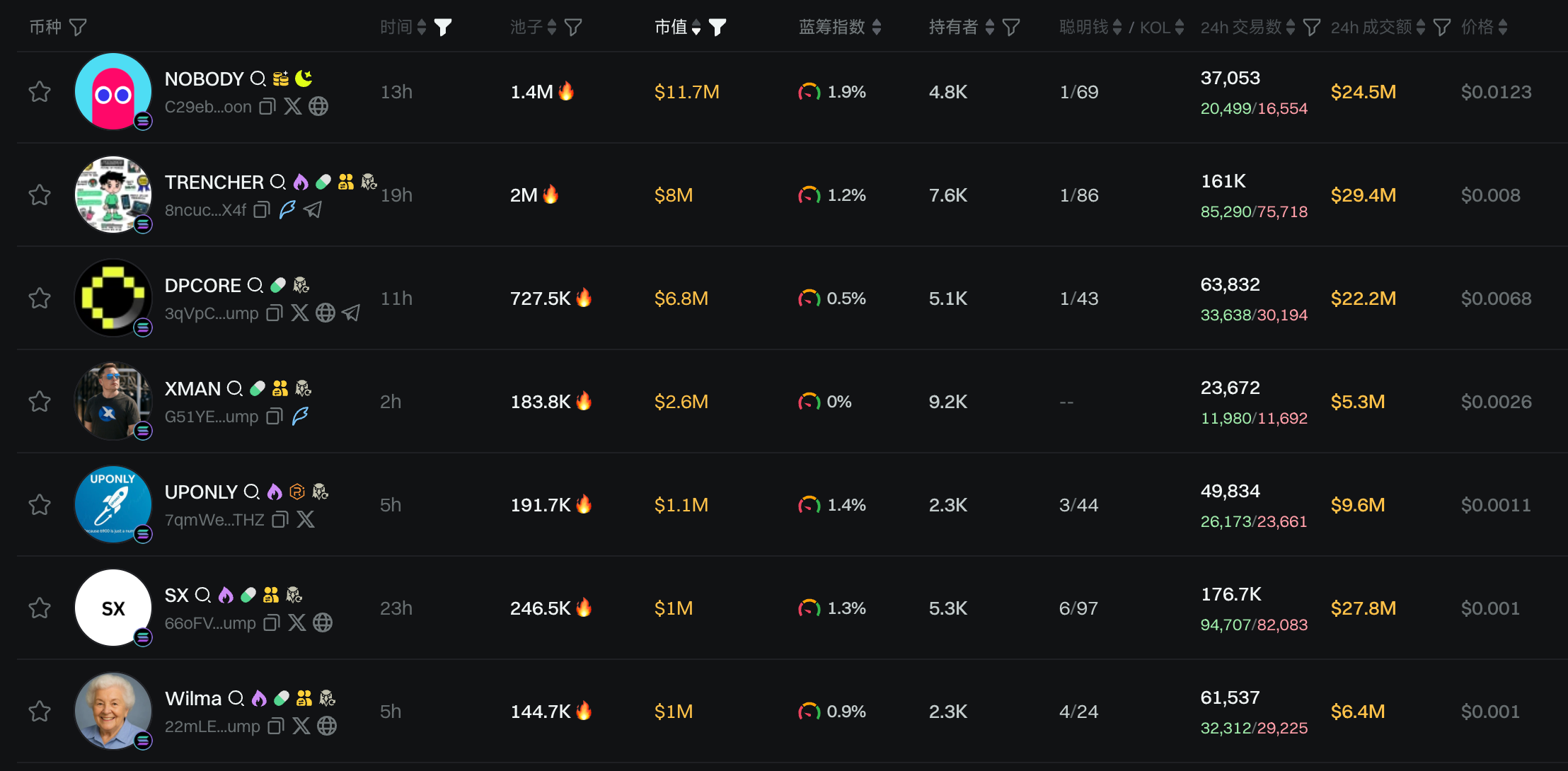
More and more listed companies are increasing their holdings of Solana. Currently, the listed companies holding more SOL include Sol Strategies (holding about 270,000 SOL), Upexi (holding SOL reserves worth $100 million), DeFi Development Corporation (formerly Janover, holding about 320,000 SOL) and SOL Global Investments (holding 260,000 SOL). It is worth noting that SOL is much more attractive to listed companies than ETH. In addition, the activity on the Solana chain has rebounded significantly, and the trading volume has increased significantly. After breaking through $150, SOL is expected to challenge the $180 mark. Many projects in the ecosystem have performed well. DARK rose by more than 30% in 24 hours after being forwarded by Solana officials, and its market value exceeded $40 million; DPCORE and NOBODY reached a maximum market value of $10 million and $30 million in 24 hours. At the same time, the altcoin market generally rose, and the AI sector and SUI ecosystem performed outstandingly.
Trading time: The altcoin market rebounded and rose across the board, and Bitcoin encountered resistance in the supply-intensive area at $97,000

2. Key data (as of 12:00 HKT on April 25)

(Data sources: Coinglass, Upbit, Coingecko, SoSoValue, Tomars, GMGN)

  • Bitcoin: $93,213.44 (-0.46% YTD), daily spot volume $31.745 billion

  • Ethereum: $1,765.13 (-46.94% YTD), with daily spot volume of $14.265 billion

  • Fear of Greed Index: 60 (Greed)

  • Average GAS: BTC 1.01 sat/vB, ETH 0.67 Gwei

  • Market share: BTC 63.3%, ETH 7.3%

  • Upbit 24-hour trading volume ranking: ARDR, XRP, AERGO, TRUMP, BTC

  • 24-hour BTC long-short ratio: 1.0157

  • Sector gains and losses: DePIN sector rose 5.82%, AI sector rose 4.93%

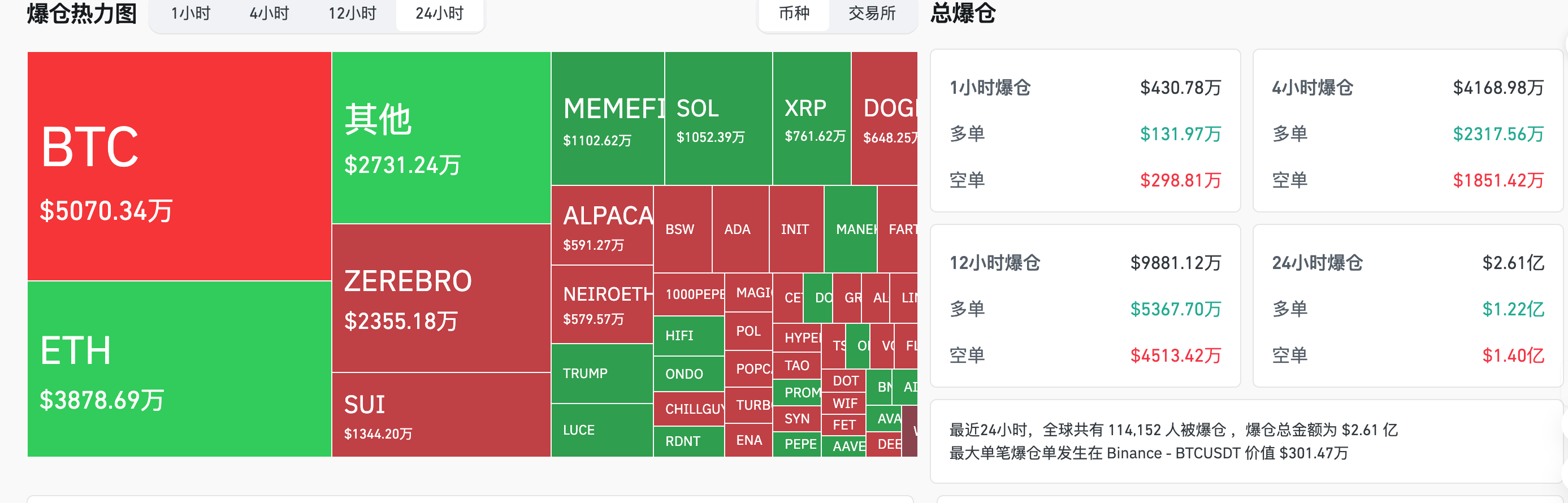
  • 24-hour liquidation A total of 114,152 people were liquidated worldwide, with a total liquidation amount of US$261 million, including BTC liquidation of US$50.7 million, ETH liquidation of US$38.78 million, and ZEREBRO liquidation of US$23.55 million

  • BTC medium- and long-term trend channel: upper channel line ($89,325.60), lower channel line ($87,556.78)

  • ETH medium and long-term trend channel: upper channel line ($1688.80), lower channel line ($1655.36)

*Note: When the price is higher than the upper and lower edges, it is a medium- to long-term bullish trend; otherwise, it is a bearish trend. When the price passes through the cost range repeatedly within the range or in the short term, it is a bottoming or topping state.
Trading time: The altcoin market rebounded and rose across the board, and Bitcoin encountered resistance in the supply-intensive area at $97,000

3. ETF flows (as of April 24 EST)

  • Bitcoin ETF: $442 million

  • Ethereum ETF: $63.49 million

4. Today’s Outlook

  • The U.S. SEC held its third crypto policy roundtable, focusing on custody issues

  • Binance will adjust the collateral ratio of some assets such as ZEC and TWT in the unified account on April 25

  • Boshi Ethereum has been approved and can participate in staking activities from now on

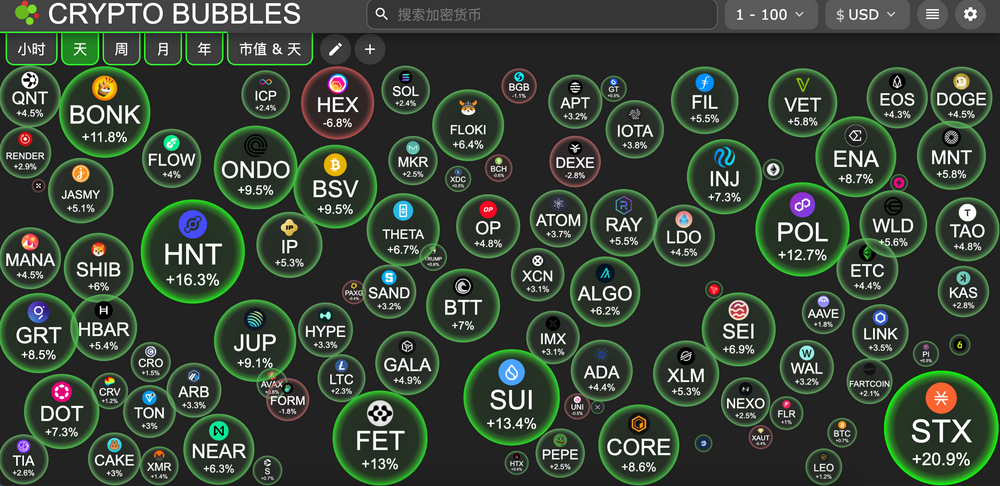
The biggest gains among the top 500 stocks by market value today: XYO up 40.58%, CETUS up 36.53%, INIT up 34.94%, KEEP up 28.41%, and PENGU up 25.66%.
Trading time: The altcoin market rebounded and rose across the board, and Bitcoin encountered resistance in the supply-intensive area at $97,000

5. Hot News

  • El Salvador added 1 Bitcoin, bringing its total holdings to 6,157.18

  • ARK raises Bitcoin's 2030 bull market target price to $2.4 million

  • Deloitte report: Global real estate tokenization market may reach $4 trillion by 2035

  • Mantle (MNT) is included in the Coinbase asset roadmap

  • Cumberland deposited 2,261 BTC to CEX, worth over $200 million

  • US SEC meets with Ondo Finance to discuss compliant issuance of tokenized securities

  • FLock.io announced a partnership with Alibaba Cloud to create an AI model. FLOCK's 24-hour increase was nearly 48%.

  • CME Group announces plans to launch XRP futures on May 19, pending regulatory review

  • Polygon launches aggregator program, successful projects will airdrop 5%-15% of native tokens to POL stakers

  • Ether.fi transforms into a new DeFi bank and launches cash card in the United States

  • Fed's Hammack: Fed may take action in June if economic data is clear

  • Securitize Launches New Crypto Index Fund, Backed by $400 Million from Mantle

  • Solana’s Early Backer RockawayX Launches New $125 Million Fund

  • The top 10 whales at the Trump dinner lost $1.26 million, and the top whale is suspected to belong to Wintermute

  • Deribit: $8 billion of BTC and ETH options are about to expire, and BTC’s biggest pain point is $85,000

  • SNX is included in the trading warning list by DAXA, Upbit suspends its deposit service for evaluation

  • Binance will delist ALPACA, PDA, VIB and WING on May 2

  • DeFi Development Corporation Increases Its Holdings to $9.9 Million in Solana

  • Twenty One announces it will launch with over 42,000 BTC in holdings

  • SOL Strategies secures up to $500 million in convertible note financing to buy more SOL

Market Opportunity
Areon Network Logo
Areon Network Price(AREA)
$0.0172
$0.0172$0.0172
-6.77%
USD
Areon Network (AREA) Live Price Chart
Disclaimer: The articles reposted on this site are sourced from public platforms and are provided for informational purposes only. They do not necessarily reflect the views of MEXC. All rights remain with the original authors. If you believe any content infringes on third-party rights, please contact [email protected] for removal. MEXC makes no guarantees regarding the accuracy, completeness, or timeliness of the content and is not responsible for any actions taken based on the information provided. The content does not constitute financial, legal, or other professional advice, nor should it be considered a recommendation or endorsement by MEXC.

You May Also Like

Adoption Leads Traders to Snorter Token

Adoption Leads Traders to Snorter Token

The post Adoption Leads Traders to Snorter Token appeared on BitcoinEthereumNews.com. Largest Bank in Spain Launches Crypto Service: Adoption Leads Traders to Snorter Token Sign Up for Our Newsletter! For updates and exclusive offers enter your email. Leah is a British journalist with a BA in Journalism, Media, and Communications and nearly a decade of content writing experience. Over the last four years, her focus has primarily been on Web3 technologies, driven by her genuine enthusiasm for decentralization and the latest technological advancements. She has contributed to leading crypto and NFT publications – Cointelegraph, Coinbound, Crypto News, NFT Plazas, Bitcolumnist, Techreport, and NFT Lately – which has elevated her to a senior role in crypto journalism. Whether crafting breaking news or in-depth reviews, she strives to engage her readers with the latest insights and information. Her articles often span the hottest cryptos, exchanges, and evolving regulations. As part of her ploy to attract crypto newbies into Web3, she explains even the most complex topics in an easily understandable and engaging way. Further underscoring her dynamic journalism background, she has written for various sectors, including software testing (TEST Magazine), travel (Travel Off Path), and music (Mixmag). When she’s not deep into a crypto rabbit hole, she’s probably island-hopping (with the Galapagos and Hainan being her go-to’s). Or perhaps sketching chalk pencil drawings while listening to the Pixies, her all-time favorite band. This website uses cookies. By continuing to use this website you are giving consent to cookies being used. Visit our Privacy Center or Cookie Policy. I Agree Source: https://bitcoinist.com/banco-santander-and-snorter-token-crypto-services/
Share
BitcoinEthereumNews2025/09/17 23:45
The Role of Reference Points in Achieving Equilibrium Efficiency in Fair and Socially Just Economies

The Role of Reference Points in Achieving Equilibrium Efficiency in Fair and Socially Just Economies

This article explores how a simple change in the reference point can achieve a Pareto-efficient equilibrium in both free and fair economies and those with social justice.
Share
Hackernoon2025/09/17 22:30
Unlocking Massive Value: Curve Finance Revenue Sharing Proposal for CRV Holders

Unlocking Massive Value: Curve Finance Revenue Sharing Proposal for CRV Holders

BitcoinWorld Unlocking Massive Value: Curve Finance Revenue Sharing Proposal for CRV Holders The dynamic world of decentralized finance (DeFi) is constantly evolving, bringing forth new opportunities and innovations. A significant development is currently unfolding at Curve Finance, a leading decentralized exchange (DEX). Its founder, Michael Egorov, has put forth an exciting proposal designed to offer a more direct path for token holders to earn revenue. This initiative, centered around a new Curve Finance revenue sharing model, aims to bolster the value for those actively participating in the protocol’s governance. What is the “Yield Basis” Proposal and How Does it Work? At the core of this forward-thinking initiative is a new protocol dubbed Yield Basis. Michael Egorov introduced this concept on the CurveDAO governance forum, outlining a mechanism to distribute sustainable profits directly to CRV holders. Specifically, it targets those who stake their CRV tokens to gain veCRV, which are essential for governance participation within the Curve ecosystem. Let’s break down the initial steps of this innovative proposal: crvUSD Issuance: Before the Yield Basis protocol goes live, $60 million in crvUSD will be issued. Strategic Fund Allocation: The funds generated from the sale of these crvUSD tokens will be strategically deployed into three distinct Bitcoin-based liquidity pools: WBTC, cbBTC, and tBTC. Pool Capping: To ensure balanced risk and diversified exposure, each of these pools will be capped at $10 million. This carefully designed structure aims to establish a robust and consistent income stream, forming the bedrock of a sustainable Curve Finance revenue sharing mechanism. Why is This Curve Finance Revenue Sharing Significant for CRV Holders? This proposal marks a pivotal moment for CRV holders, particularly those dedicated to the long-term health and governance of Curve Finance. Historically, generating revenue for token holders in the DeFi space can often be complex. The Yield Basis proposal simplifies this by offering a more direct and transparent pathway to earnings. By staking CRV for veCRV, holders are not merely engaging in governance; they are now directly positioned to benefit from the protocol’s overall success. The significance of this development is multifaceted: Direct Profit Distribution: veCRV holders are set to receive a substantial share of the profits generated by the Yield Basis protocol. Incentivized Governance: This direct financial incentive encourages more users to stake their CRV, which in turn strengthens the protocol’s decentralized governance structure. Enhanced Value Proposition: The promise of sustainable revenue sharing could significantly boost the inherent value of holding and staking CRV tokens. Ultimately, this move underscores Curve Finance’s dedication to rewarding its committed community and ensuring the long-term vitality of its ecosystem through effective Curve Finance revenue sharing. Understanding the Mechanics: Profit Distribution and Ecosystem Support The distribution model for Yield Basis has been thoughtfully crafted to strike a balance between rewarding veCRV holders and supporting the wider Curve ecosystem. Under the terms of the proposal, a substantial portion of the value generated by Yield Basis will flow back to those who contribute to the protocol’s governance. Returns for veCRV Holders: A significant share, specifically between 35% and 65% of the value generated by Yield Basis, will be distributed to veCRV holders. This flexible range allows for dynamic adjustments based on market conditions and the protocol’s performance. Ecosystem Reserve: Crucially, 25% of the Yield Basis tokens will be reserved exclusively for the Curve ecosystem. This allocation can be utilized for various strategic purposes, such as funding ongoing development, issuing grants, or further incentivizing liquidity providers. This ensures the continuous growth and innovation of the platform. The proposal is currently undergoing a democratic vote on the CurveDAO governance forum, giving the community a direct voice in shaping the future of Curve Finance revenue sharing. The voting period is scheduled to conclude on September 24th. What’s Next for Curve Finance and CRV Holders? The proposed Yield Basis protocol represents a pioneering approach to sustainable revenue generation and community incentivization within the DeFi landscape. If approved by the community, this Curve Finance revenue sharing model has the potential to establish a new benchmark for how decentralized exchanges reward their most dedicated participants. It aims to foster a more robust and engaged community by directly linking governance participation with tangible financial benefits. This strategic move by Michael Egorov and the Curve Finance team highlights a strong commitment to innovation and strengthening the decentralized nature of the protocol. For CRV holders, a thorough understanding of this proposal is crucial for making informed decisions regarding their staking strategies and overall engagement with one of DeFi’s foundational platforms. FAQs about Curve Finance Revenue Sharing Q1: What is the main goal of the Yield Basis proposal? A1: The primary goal is to establish a more direct and sustainable way for CRV token holders who stake their tokens (receiving veCRV) to earn revenue from the Curve Finance protocol. Q2: How will funds be generated for the Yield Basis protocol? A2: Initially, $60 million in crvUSD will be issued and sold. The funds from this sale will then be allocated to three Bitcoin-based pools (WBTC, cbBTC, and tBTC), with each pool capped at $10 million, to generate profits. Q3: Who benefits from the Yield Basis revenue sharing? A3: The proposal states that between 35% and 65% of the value generated by Yield Basis will be returned to veCRV holders, who are CRV stakers participating in governance. Q4: What is the purpose of the 25% reserve for the Curve ecosystem? A4: This 25% reserve of Yield Basis tokens is intended to support the broader Curve ecosystem, potentially funding development, grants, or other initiatives that contribute to the platform’s growth and sustainability. Q5: When is the vote on the Yield Basis proposal? A5: A vote on the proposal is currently underway on the CurveDAO governance forum and is scheduled to run until September 24th. If you found this article insightful and valuable, please consider sharing it with your friends, colleagues, and followers on social media! Your support helps us continue to deliver important DeFi insights and analysis to a wider audience. To learn more about the latest DeFi market trends, explore our article on key developments shaping decentralized finance institutional adoption. This post Unlocking Massive Value: Curve Finance Revenue Sharing Proposal for CRV Holders first appeared on BitcoinWorld.
Share
Coinstats2025/09/18 00:35