BNB price is eyeing a retest of a key support trendline as it continues to remain in a downtrend. A break below the said pattern could trigger a 15% drop in BNBBNB price is eyeing a retest of a key support trendline as it continues to remain in a downtrend. A break below the said pattern could trigger a 15% drop in BNB

BNB price risks 15% correction as it nears crucial support trendline with bearish signals mounting

BNB price is eyeing a retest of a key support trendline as it continues to remain in a downtrend. A break below the said pattern could trigger a 15% drop in BNB price ahead.

Summary
  • BNB price fell 11% below its December high.
  • Declining transactions and futures activity on the network continue to weigh on investor sentiment for the token.
  • BNB is eyeing a break below a key trendline support, which could lead to a deeper correction over the coming days.

According to data from crypto.news, BNB (BNB) price dropped 11% down from its monthly high of $923.8 to a low of $821.7 last Friday, Dec. 19. While the 4th leading cryptocurrency by market cap has since recovered slightly to $849.2 at press time, it still remains 38% below its year-to-date high reached in October.

BNB price has declined as user activity on the BNB Chain continues to slow down. Per data from BscScan, the number of transactions on the blockchain has dropped nearly 47% since its October highs to 16.1 million at press time.
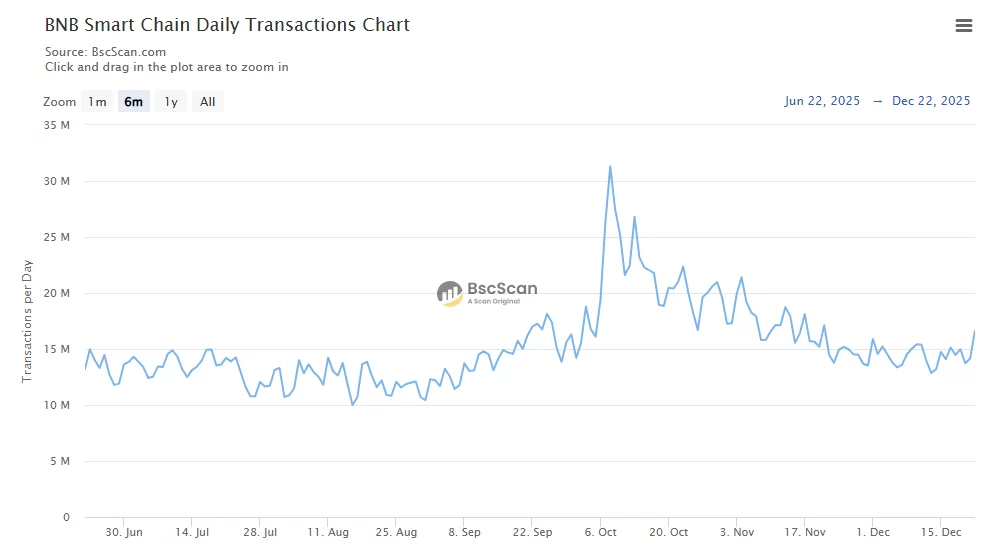
Total number of transactions has declined since October.

A drop in transactions over a network typically indicates lower engagement from users and developers, which in turn could reduce demand for the token among investors.

Further, derivative traders have also been unwinding their positions in the token. Data from CoinGlass shows BNB futures open interest has dropped from $2.97 billion in October to $1.27 billion at the time of writing.

Such a steep decline in open interest suggests that traders are actively closing their positions and reducing leveraged exposure, which could continue to put pressure on BNB prices at least in the short term.

The bearish on-chain stats come even as BNB’s longer-term fundamentals continue to improve. The BNB Chain is seeing greater adoption in the real-world asset market. Notably, BlackRock’s tokenized treasury fund is now supported on the network. Such a development increases institutional demand and enhances the overall credibility of the ecosystem.

Meanwhile, BNB’s auto-burn mechanism has also been quietly and consistently reducing its circulating supply, driving scarcity and strengthening the longer-term value proposition for BNB price.

BNB price analysis

On the daily chart, BNB price is approaching a key support trendline that has historically acted as a springboard for rebounds each time it was tested since April this year.
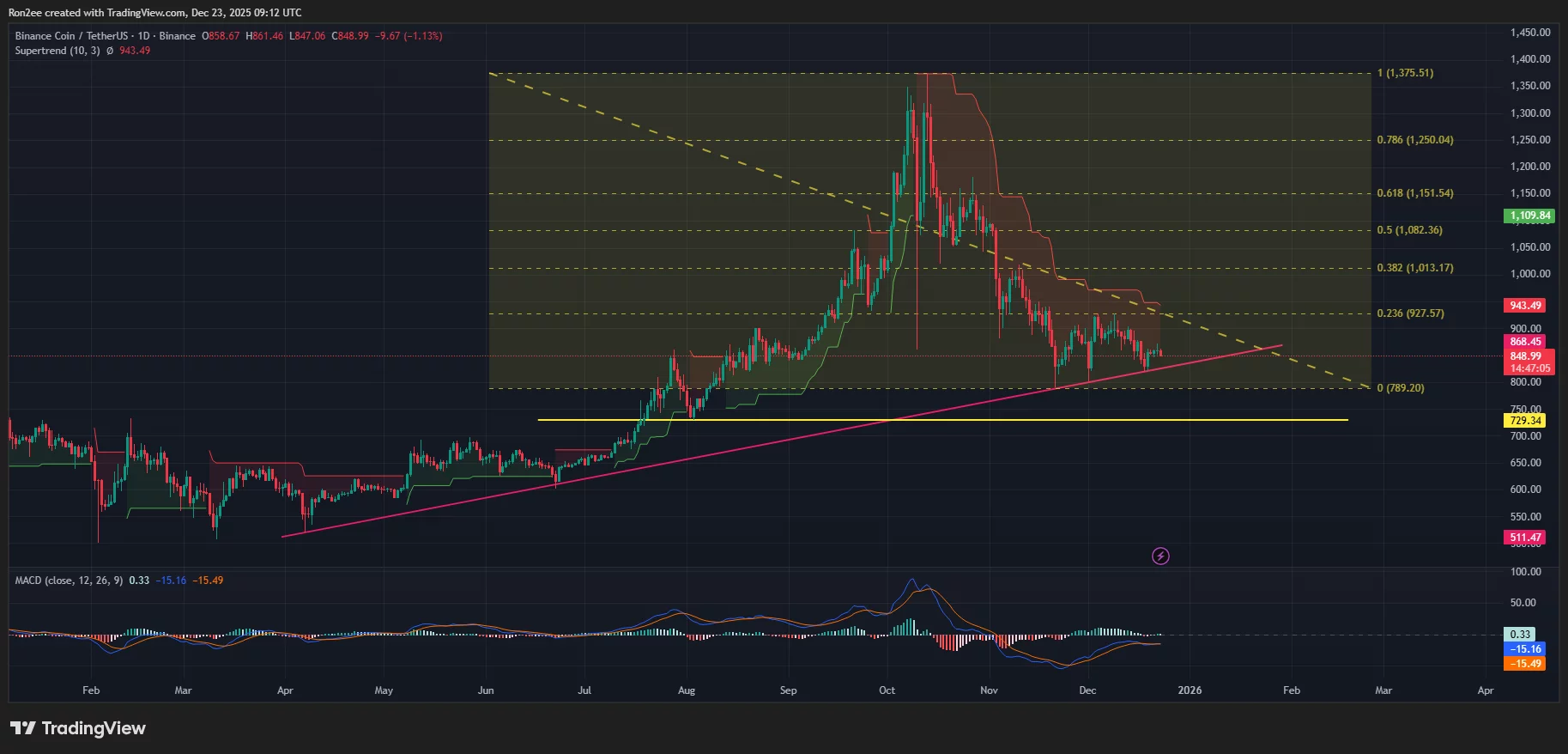
BNB price, Supertrend, and MACD chart.

At press time, BNB price is just 2.7% shy of dipping below this crucial support trendline.

Technical indicators are also suggesting a bearish outlook. The MACD lines have dropped below the zero level, a telltale sign of weakening momentum. Meanwhile, BNB price has also slipped below the Supertrend line, which has flashed red and indicates that the bearish trend remains intact.

Hence, a break below the support threshold could push BNB price down toward $729.3, its August second low, and a level that stands nearly 15% below the current price.

On the contrary, $927.5, which aligns with the 23.6% Fibonacci retracement level, acts as the key resistance to watch. A strong break above this could signal a shift in momentum and potentially pave the way for a recovery phase in the upcoming sessions.

Disclosure: This article does not represent investment advice. The content and materials featured on this page are for educational purposes only.


Market Opportunity
Binance Coin Logo
Binance Coin Price(BNB)
$842.94
$842.94$842.94
-2.86%
USD
Binance Coin (BNB) Live Price Chart
Disclaimer: The articles reposted on this site are sourced from public platforms and are provided for informational purposes only. They do not necessarily reflect the views of MEXC. All rights remain with the original authors. If you believe any content infringes on third-party rights, please contact [email protected] for removal. MEXC makes no guarantees regarding the accuracy, completeness, or timeliness of the content and is not responsible for any actions taken based on the information provided. The content does not constitute financial, legal, or other professional advice, nor should it be considered a recommendation or endorsement by MEXC.

You May Also Like

The Channel Factories We’ve Been Waiting For

The Channel Factories We’ve Been Waiting For

The post The Channel Factories We’ve Been Waiting For appeared on BitcoinEthereumNews.com. Visions of future technology are often prescient about the broad strokes while flubbing the details. The tablets in “2001: A Space Odyssey” do indeed look like iPads, but you never see the astronauts paying for subscriptions or wasting hours on Candy Crush.  Channel factories are one vision that arose early in the history of the Lightning Network to address some challenges that Lightning has faced from the beginning. Despite having grown to become Bitcoin’s most successful layer-2 scaling solution, with instant and low-fee payments, Lightning’s scale is limited by its reliance on payment channels. Although Lightning shifts most transactions off-chain, each payment channel still requires an on-chain transaction to open and (usually) another to close. As adoption grows, pressure on the blockchain grows with it. The need for a more scalable approach to managing channels is clear. Channel factories were supposed to meet this need, but where are they? In 2025, subnetworks are emerging that revive the impetus of channel factories with some new details that vastly increase their potential. They are natively interoperable with Lightning and achieve greater scale by allowing a group of participants to open a shared multisig UTXO and create multiple bilateral channels, which reduces the number of on-chain transactions and improves capital efficiency. Achieving greater scale by reducing complexity, Ark and Spark perform the same function as traditional channel factories with new designs and additional capabilities based on shared UTXOs.  Channel Factories 101 Channel factories have been around since the inception of Lightning. A factory is a multiparty contract where multiple users (not just two, as in a Dryja-Poon channel) cooperatively lock funds in a single multisig UTXO. They can open, close and update channels off-chain without updating the blockchain for each operation. Only when participants leave or the factory dissolves is an on-chain transaction…
Share
BitcoinEthereumNews2025/09/18 00:09
Nasdaq-listed iPower reaches $30 million convertible note financing agreement to launch DAT strategy.

Nasdaq-listed iPower reaches $30 million convertible note financing agreement to launch DAT strategy.

PANews reported on December 23 that, according to Globenewswire, Nasdaq-listed e-commerce and supply chain platform iPower announced it has reached a $30 million
Share
PANews2025/12/23 22:19
SelectCam AI Launches Flagship AI-Powered Video Telematics Solutions for Global Fleet Safety

SelectCam AI Launches Flagship AI-Powered Video Telematics Solutions for Global Fleet Safety

SHENZHEN, China–(BUSINESS WIRE)–SelectCam AI, a China-based, product-driven technology company, today announced the launch of its flagship AI video telematics solutions
Share
AI Journal2025/12/23 21:48



