VanEck is setting expectations for Bitcoin in 2026 with a tone that’s closer to the risk committee than crypto Twitter: the next year looks more like consolidationVanEck is setting expectations for Bitcoin in 2026 with a tone that’s closer to the risk committee than crypto Twitter: the next year looks more like consolidation

Bitcoin Prediction: VanEck Warns 2026 Won’t Be A Melt-Up Or A Crash

VanEck is setting expectations for Bitcoin in 2026 with a tone that’s closer to the risk committee than crypto Twitter: the next year looks more like consolidation than a dramatic regime shift.

In its Dec. 18 note, “Plan for 2026: Predictions from Our Portfolio Managers,” Matthew Sigel, VanEck’s head of digital assets research, argues that the signal set heading into 2026 is “mixed but constructive.” The framework is deliberately restrained: volatility has come down, leverage has been washed out in stages, and on-chain activity is still soft but not deteriorating the way it tends to during deeper cyclical breaks.

“Realized volatility has… dropped by roughly half. That implies a proportional drawdown of about 40%. The market has already absorbed roughly 35%.”

Sigel anchors part of the call in cycle structure. He writes that Bitcoin’s historical four-year rhythm, which has tended to peak in the immediate post-election window, “remains intact following the early October 2025 high.” If that template is still operative, 2026 is less likely to be a clean continuation year.

Bitcoin Prediction For 2026: What To Expect

“That pattern suggests 2026 is more likely a consolidation year. Not a melt-up. Not a collapse.” The more interesting part is the “why,” because VanEck isn’t leaning on a single factor. Sigel describes three lenses shaping the outlook, and they are not uniformly supportive. “Global liquidity is mixed. Likely rate cuts provide support. US liquidity is tightening somewhat.”

He ties that tightening to a specific macro dynamic: “AI-driven capex fears” colliding with a more fragile funding market and pushing credit spreads wider. Put differently, even if policy rates drift lower, the broader cost-of-capital environment can still work against risk-taking at the margin — especially where refinancing needs are persistent and investor selectivity is rising.

Against that backdrop, the portfolio guidance is measured. VanEck favors a “disciplined 1 to 3% Bitcoin allocation,” built through dollar-cost averaging, with adds during leverage-driven dislocations and trims into speculative excess. It’s positioning for a market that oscillates, not one that trends cleanly.

Sigel also flags a topic that has shifted from niche to mainstream inside the Bitcoin community: quantum security. VanEck doesn’t present it as an imminent risk to the chain, but it does treat it as an organizing question that could draw serious attention.

“Quantum security has become an active topic. It’s not an immediate threat. A coordinated response could resemble the first blocksize debates.”

That last line matters more than it sounds. The blocksize era wasn’t only a technical dispute; it was a public process that pulled in new stakeholders, forced trade-offs into the open, and hardened long-term norms. VanEck’s suggestion is that, if quantum planning becomes a sustained coordination exercise, it could have a similar “transparent and technically rich” dynamic, messy, visible, and ultimately strengthening engagement.

Where VanEck is most constructive for 2026 is not necessarily spot BTC, but the capital cycle around Bitcoin mining. Sigel argues the strongest opportunity sits in what he calls the “capital-intensive pivot” as operators try to finance both hash-rate expansion and AI/HPC infrastructure simultaneously.

That combination is stretching balance sheets and widening dispersion across the sector: miners with hyperscaler partnerships can raise straight debt on comparatively favorable terms, while weaker names are pushed toward dilutive converts or selling BTC into weakness.

“This creates the cleanest consolidation setup since 2020 to 2021. The best risk-reward is in miners transitioning into energy-backed compute platforms. Credible HPC economics, advantaged power, and financing paths that avoid serial dilution.”

A second opportunity set is digital payments and stablecoin settlement, but VanEck is selective. Sigel sees stablecoins moving into real B2B payment flows, improving working capital management and lowering cross-border settlement costs.

“The more investable angle may sit in fintech and e-commerce platforms that can unlock margin leverage by shifting supplier payments, payouts, and cross-border settlement onto stablecoins. High-throughput chains will support much of this activity, and a few tokens tied to genuine usage may benefit, but we believe the most durable opportunity may lie in the operating companies enabling adoption rather than in broad token exposure,” Sigel writes.

The overall message is not bearish, and it is not euphoric. It is, in a very deliberate way, a call for discipline: expect range-bound conditions, look for dislocations, and focus on parts of the ecosystem where balance-sheet stress and real-world adoption can create asymmetry.

At press time, Bitcoin traded at $87,423.
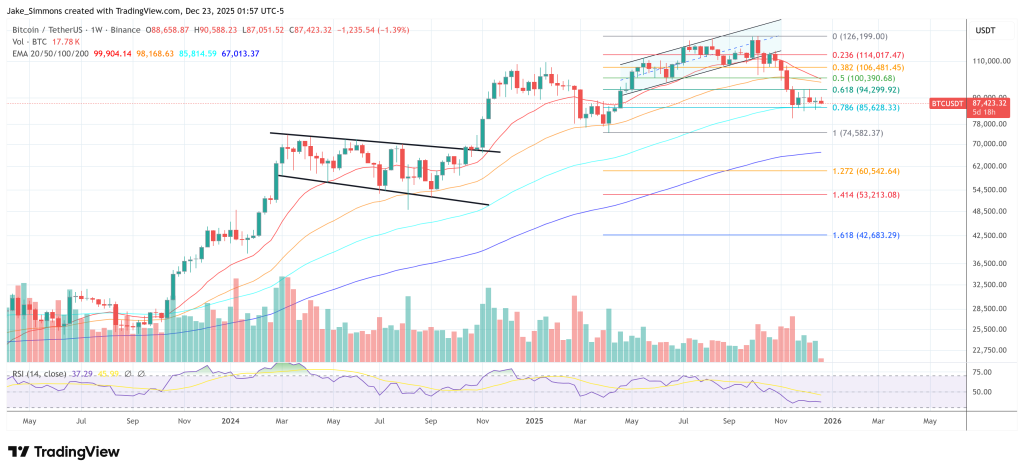
Bitcoin price chart

Featured image created with DALL.E, chart from TradingView.com

Market Opportunity
Threshold Logo
Threshold Price(T)
$0.00882
$0.00882$0.00882
+0.91%
USD
Threshold (T) Live Price Chart
Disclaimer: The articles reposted on this site are sourced from public platforms and are provided for informational purposes only. They do not necessarily reflect the views of MEXC. All rights remain with the original authors. If you believe any content infringes on third-party rights, please contact [email protected] for removal. MEXC makes no guarantees regarding the accuracy, completeness, or timeliness of the content and is not responsible for any actions taken based on the information provided. The content does not constitute financial, legal, or other professional advice, nor should it be considered a recommendation or endorsement by MEXC.

You May Also Like

Crypto News: Donald Trump-Aligned Fed Governor To Speed Up Fed Rate Cuts?

Crypto News: Donald Trump-Aligned Fed Governor To Speed Up Fed Rate Cuts?

The post Crypto News: Donald Trump-Aligned Fed Governor To Speed Up Fed Rate Cuts? appeared on BitcoinEthereumNews.com. In recent crypto news, Stephen Miran swore in as the latest Federal Reserve governor on September 16, 2025, slipping into the board’s last open spot right before the Federal Open Market Committee kicks off its two-day rate discussion. Traders are betting heavily on a 25-basis-point trim, which would bring the federal funds rate down to 4.00%-4.25%, based on CME FedWatch Tool figures from September 15, 2025. Miran, who’s been Trump’s top economic advisor and a supporter of his trade ideas, joins a seven-member board where just three governors come from Democratic picks, according to the Fed’s records updated that same day. Crypto News: Miran’s Background and Quick Path to Confirmation The Senate greenlit Miran on September 15, 2025, with a tight 48-47 vote, following his nomination on September 2, 2025, as per a recent crypto news update. His stint runs only until January 31, 2026, stepping in for Adriana D. Kugler, who stepped down in August 2025 for reasons not made public. Miran earned his economics Ph.D. from Harvard and worked at the Treasury back in Trump’s first go-around. Afterward, he moved to Hudson Bay Capital Management as an economist, then looped back to the White House in December 2024 to head the Council of Economic Advisers. There, he helped craft Trump’s “reciprocal tariffs” approach, aimed at fixing trade gaps with China and the EU. He wouldn’t quit his White House gig, which irked Senator Elizabeth Warren at the September 7, 2025, confirmation hearings. That limited time frame means Miran gets to cast a vote straight away at the FOMC session starting September 16, 2025. The full board now features Chair Jerome H. Powell (Trump pick, term ends 2026), Vice Chair Philip N. Jefferson (Biden, to 2036), and folks like Lisa D. Cook (Biden, to 2028) and Michael S. Barr…
Share
BitcoinEthereumNews2025/09/18 03:14
UK Looks to US to Adopt More Crypto-Friendly Approach

UK Looks to US to Adopt More Crypto-Friendly Approach

The post UK Looks to US to Adopt More Crypto-Friendly Approach appeared on BitcoinEthereumNews.com. The UK and US are reportedly preparing to deepen cooperation on digital assets, with Britain looking to copy the Trump administration’s crypto-friendly stance in a bid to boost innovation.  UK Chancellor Rachel Reeves and US Treasury Secretary Scott Bessent discussed on Tuesday how the two nations could strengthen their coordination on crypto, the Financial Times reported on Tuesday, citing people familiar with the matter.  The discussions also involved representatives from crypto companies, including Coinbase, Circle Internet Group and Ripple, with executives from the Bank of America, Barclays and Citi also attending, according to the report. The agreement was made “last-minute” after crypto advocacy groups urged the UK government on Thursday to adopt a more open stance toward the industry, claiming its cautious approach to the sector has left the country lagging in innovation and policy.  Source: Rachel Reeves Deal to include stablecoins, look to unlock adoption Any deal between the countries is likely to include stablecoins, the Financial Times reported, an area of crypto that US President Donald Trump made a policy priority and in which his family has significant business interests. The Financial Times reported on Monday that UK crypto advocacy groups also slammed the Bank of England’s proposal to limit individual stablecoin holdings to between 10,000 British pounds ($13,650) and 20,000 pounds ($27,300), claiming it would be difficult and expensive to implement. UK banks appear to have slowed adoption too, with around 40% of 2,000 recently surveyed crypto investors saying that their banks had either blocked or delayed a payment to a crypto provider.  Many of these actions have been linked to concerns over volatility, fraud and scams. The UK has made some progress on crypto regulation recently, proposing a framework in May that would see crypto exchanges, dealers, and agents treated similarly to traditional finance firms, with…
Share
BitcoinEthereumNews2025/09/18 02:21
Mobile Mechanic Houston vs. Traditional Auto Repair Shops: Which Is Better?

Mobile Mechanic Houston vs. Traditional Auto Repair Shops: Which Is Better?

Houston cars have two choices: mobile mechanics and traditional shops. Both have their own advantages and disadvantages. Mobile mechanic Houston and auto repair
Share
Techbullion2025/12/24 00:19