Gnosis Chain validators that do not follow Balancer funds’ hard fork may face penalties in the following days, the official account warns. The post Gnosis ChainGnosis Chain validators that do not follow Balancer funds’ hard fork may face penalties in the following days, the official account warns. The post Gnosis Chain

Gnosis Chain Warns of Validator Penalty Post Balancer Hack Recovery Hard Fork

Gnosis Chain GNO $122.2 24h volatility: 1.1% Market cap: $322.30 M Vol. 24h: $5.82 M executed, on December 22, a governance-approved hard fork to recover around $9.4 million of the frozen funds from the Balancer hack.

Passed one day of the execution, the Gnosis official account warned “remaining validators” to upgrade and “avoid penalties.”

On December 12, Gnosis’ head of infrastructure Philippe Schommers explained in a governance forum post that “contributors, validators and other stakeholders have been working on a hard fork” to recover funds previously frozen on the Gnosis Chain.

The freezing happened following a validators-approved soft fork in November 2025, addressing part of the funds identified as belonging to the Balancer exploit’s attacker.
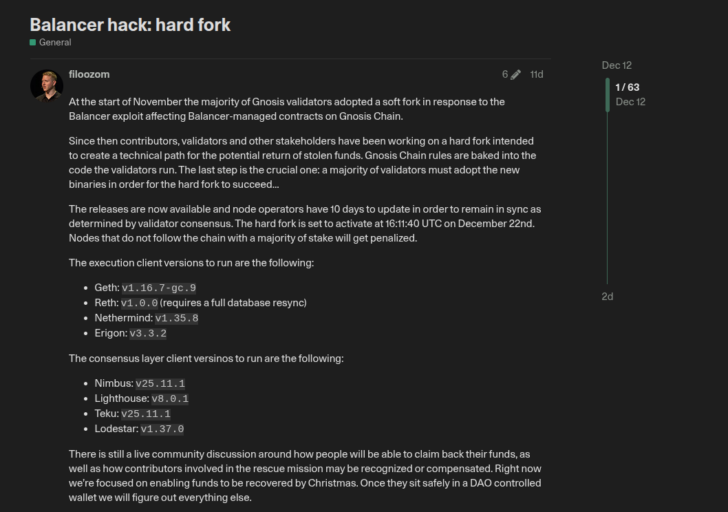
Balance hack: hard fork proposal on Dec. 12, 2025. | Source: Gnosis Governance Forum

As planned, Gnosis node operators had ten days to upgrade, executing the hard fork that allowed for the funds’ seizure.

Earlier this year, the Sui SUI $1.43 24h volatility: 2.5% Market cap: $5.35 B Vol. 24h: $535.90 M network faced a setback following the CETUS hack.

The Sui Foundation, Cetus Protocol, and OtterSec gained community approval to use a special signature to seize the attacker’s funds, recovering part of the losses.

Following this series of developments, the Gnosis Chain has now posted a warning on X to all “remaining” validators to upgrade their nodes accordingly.

Not upgrading would result in penalties, executed via the GNO token. The penalties can range from not receiving staking rewards to potentially leading to slashing in extreme cases of prolonged non-participation or if interpreted as disruptive behavior.

Divided Reactions

Despite the reported approval, Gnosis’s decision has divided opinions, with some praising transparency and others criticizing the breach of immutability.

Ignas DeFi commented on the matter, mentioning this hard fork sets precedents for future decisions.

“But this fork sets a big precedent: Do we hard fork for every hack? Only if losses > 5% of TVL? Why not 3%? Can app devs start assuming the chain will step in if they mess up, lowering security standards?” He noted that “The hard fork and the debate will end up setting hard-fork precedent rules for other chains to follow”.

In one of his related posts, however, he explained that the soft fork already broke Gnosis’ neutrality and claimed that other chains took similar decisions around the Balancer hack.

“We’ve already seen similar censorship interventions elsewhere,” Ignas said, pointing out “Berachain and Sonic after the same Balancer hack, and Sui after the $162M Cetus exploit.”

The Balance V2 Hack and Gnosis

The referenced incident involved a Balancer V2 Protocol exploit that drained approximately $128 millionacross affected pools. This was not a chain-specific hack, but a protocol exploit that affected multiple chains, including Gnosis.

Harry Donnelly, founder and CEO of Circuit, called Balancer’s breach “a serious warning” for the DeFi ecosystem, noting that this was “one of the most trusted names in the space” and “an early pioneer with a culture of compliance, backed by rigorous audits and open disclosure,” according to a report by The Defiant.

next

The post Gnosis Chain Warns of Validator Penalty Post Balancer Hack Recovery Hard Fork appeared first on Coinspeaker.


Market Opportunity
Notcoin Logo
Notcoin Price(NOT)
$0,000514
$0,000514$0,000514
+1,66%
USD
Notcoin (NOT) Live Price Chart
Disclaimer: The articles reposted on this site are sourced from public platforms and are provided for informational purposes only. They do not necessarily reflect the views of MEXC. All rights remain with the original authors. If you believe any content infringes on third-party rights, please contact [email protected] for removal. MEXC makes no guarantees regarding the accuracy, completeness, or timeliness of the content and is not responsible for any actions taken based on the information provided. The content does not constitute financial, legal, or other professional advice, nor should it be considered a recommendation or endorsement by MEXC.

You May Also Like

“Oversold” Solana Mirroring Previous Bottoms

“Oversold” Solana Mirroring Previous Bottoms

The post “Oversold” Solana Mirroring Previous Bottoms appeared on BitcoinEthereumNews.com. Advertisement &nbsp &nbsp Major cryptocurrency Solana is currently wandering
Share
BitcoinEthereumNews2025/12/24 04:00
XRP Takes Hit as Whales Sell 1 Billion Coins, But Pro-Ripple Attorney Says XRP Will ‘Shock the World in 2026’

XRP Takes Hit as Whales Sell 1 Billion Coins, But Pro-Ripple Attorney Says XRP Will ‘Shock the World in 2026’

XRP is under pressure as broad market weakness and aggressive whale selling push the crypto into a deeper short-term decline. According to CoinMarketCap data, XRP
Share
Coinstats2025/12/24 03:56
UK crypto holders brace for FCA’s expanded regulatory reach

UK crypto holders brace for FCA’s expanded regulatory reach

The post UK crypto holders brace for FCA’s expanded regulatory reach appeared on BitcoinEthereumNews.com. British crypto holders may soon face a very different landscape as the Financial Conduct Authority (FCA) moves to expand its regulatory reach in the industry. A new consultation paper outlines how the watchdog intends to apply its rulebook to crypto firms, shaping everything from asset safeguarding to trading platform operation. According to the financial regulator, these proposals would translate into clearer protections for retail investors and stricter oversight of crypto firms. UK FCA plans Until now, UK crypto users mostly encountered the FCA through rules on promotions and anti-money laundering checks. The consultation paper goes much further. It proposes direct oversight of stablecoin issuers, custodians, and crypto-asset trading platforms (CATPs). For investors, that means the wallets, exchanges, and coins they rely on could soon be subject to the same governance and resilience standards as traditional financial institutions. The regulator has also clarified that firms need official authorization before serving customers. This condition should, in theory, reduce the risk of sudden platform failures or unclear accountability. David Geale, the FCA’s executive director of payments and digital finance, said the proposals are designed to strike a balance between innovation and protection. He explained: “We want to develop a sustainable and competitive crypto sector – balancing innovation, market integrity and trust.” Geale noted that while the rules will not eliminate investment risks, they will create consistent standards, helping consumers understand what to expect from registered firms. Why does this matter for crypto holders? The UK regulatory framework shift would provide safer custody of assets, better disclosure of risks, and clearer recourse if something goes wrong. However, the regulator was also frank in its submission, arguing that no rulebook can eliminate the volatility or inherent risks of holding digital assets. Instead, the focus is on ensuring that when consumers choose to invest, they do…
Share
BitcoinEthereumNews2025/09/17 23:52


