Bybit has announced that it will discontinue services for Japanese residents and gradually implement account restrictions starting in 2026 as part of its effortsBybit has announced that it will discontinue services for Japanese residents and gradually implement account restrictions starting in 2026 as part of its efforts

Bybit to Exit Japan in 2026 Over Regulatory Compliance Issues

Bybit has announced that it will discontinue services for Japanese residents and gradually implement account restrictions starting in 2026 as part of its efforts to comply with local regulations.

The exchange, currently the world’s second-largest by trading volume, notified affected users via email and urged those who believe the classification is incorrect to complete Identity Verification Level 2 by January 22, 2026, or face being deemed a Japanese resident.

The decision follows months of mounting regulatory pressure from Japan’s Financial Services Agency, which has intensified oversight of unlicensed crypto platforms operating in the country.

Bybit had already suspended new user registrations from Japan in October, citing the need to review local regulatory requirements and to evaluate compliance with the standards set by Japanese authorities.

Long-Running Compliance Battle With FSA

Japan’s crackdown on unregistered exchanges dates back to 2017 legislation requiring FSA-issued permits for platforms serving Japanese residents.

The regulator sent formal warnings to Bybit in November 2024 and March 2023, claiming the exchange conducted crypto business with Japanese counterparties without proper authorization.

While existing services remained operational following the October registration pause, the latest announcement marks a complete withdrawal from the market.

Apple reportedly blocked Japanese users from downloading Bybit’s app in February, returning indefinite “Connecting…” messages or “Cannot connect to iTunes Store” errors when they attempted to access it from the Japanese App Store.

The FSA has consistently argued that platforms like Bybit court Japanese clients through Japanese-language interfaces and customer support, despite lacking domestic licenses.

Downloads from Google Play appeared unaffected at the time, though regulatory pressure continued to mount.

Bybit apologized for any inconvenience and said affected users will receive additional updates on the remediation process in subsequent communications.

Global Repositioning Amid Regional Regulatory Shifts

Beyond Japan, Bybit has faced regulatory hurdles across Asia as it expanded into more crypto-friendly jurisdictions.

The Monetary Authority of Singapore ordered unlicensed digital token service providers to cease overseas activities by June, prompting Bybit to reportedly explore relocating staff to Dubai and Hong Kong, where licensing frameworks offer greater regulatory clarity.

In fact, last month, Cryptonews reported that the exchange is in talks to acquire Korbit, South Korea’s fourth-largest crypto exchange, to ease its regulatory pathway into the country.

While there are frictions in some countries, Dubai’s Virtual Asset Regulatory Authority has recently granted licenses to over 20 firms, including Bybit.

Despite regional setbacks, Bybit launched its EU-dedicated platform, Bybit.eu, in July after securing a Markets in Crypto-Assets Regulation license from Austria’s Financial Market Authority.

The fully licensed Crypto-Asset Service Provider now operates across 29 European Economic Area countries, reaching approximately 450 million users, and has its headquarters in Vienna.

Mazurka Zeng, Managing Director and CEO, called the launch “a long-term commitment to Europe” that balances technology with robust regulatory standards.

The exchange plans to open regional offices across France, Germany, Spain, and Italy while offering 24/7 multilingual customer support.

Japan’s Broader Regulatory Overhaul

Japan’s tightening stance extends well beyond individual exchange enforcement actions.

The FSA is preparing sweeping reforms that would outlaw insider trading in cryptocurrencies, require exchanges to hold dedicated reserves against customer losses, and lower crypto profit taxes to a flat 20% from the current 55% top rate.

The regulator aims to submit amendments to the Financial Instruments and Exchange Act in 2026, reclassifying digital assets from “means of settlement” to “financial products” comparable to stocks and bonds.

The reserve requirement proposal would mirror frameworks long used in Japan’s securities industry, with platforms setting aside capital to compensate users for hacks or operational failures following high-profile incidents, including DMM Bitcoin’s $312 million theft in May 2024 and Bybit’s own $1.46 billion hack in February 2025.

The FSA is also considering allowing banks to hold cryptocurrencies for investment purposes and permitting bank groups to register as licensed exchanges, reversing a 2020 restriction.

Japan’s crypto adoption continues growing despite stricter oversight. According to the Financial Services Agency, over 12 million registered accounts as of February 2025, and deposits exceeding ¥5 trillion.
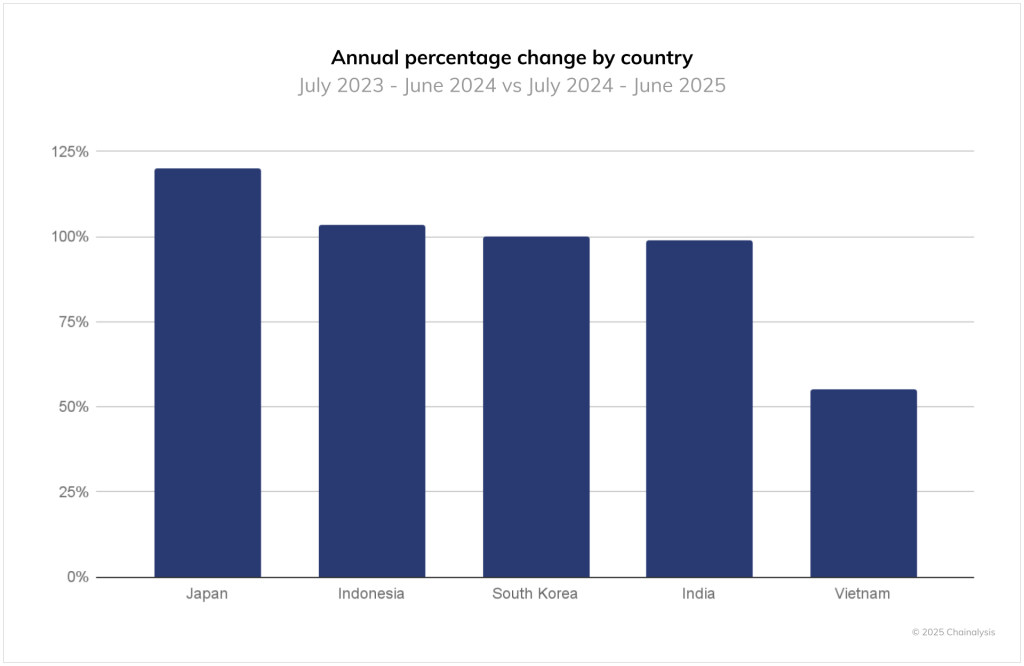
Bybit Exit Japan - Annual Percentage Change by Country Chart from ChainalysisSource: Chainalysis

In fact, Chainalysis reported a 120% year-over-year increase in on-chain value received.

Disclaimer: The articles reposted on this site are sourced from public platforms and are provided for informational purposes only. They do not necessarily reflect the views of MEXC. All rights remain with the original authors. If you believe any content infringes on third-party rights, please contact [email protected] for removal. MEXC makes no guarantees regarding the accuracy, completeness, or timeliness of the content and is not responsible for any actions taken based on the information provided. The content does not constitute financial, legal, or other professional advice, nor should it be considered a recommendation or endorsement by MEXC.

You May Also Like

Unprecedented Surge: Gold Price Hits Astounding New Record High

Unprecedented Surge: Gold Price Hits Astounding New Record High

BitcoinWorld Unprecedented Surge: Gold Price Hits Astounding New Record High While the world often buzzes with the latest movements in Bitcoin and altcoins, a traditional asset has quietly but powerfully commanded attention: gold. This week, the gold price has once again made headlines, touching an astounding new record high of $3,704 per ounce. This significant milestone reminds investors, both traditional and those deep in the crypto space, of gold’s enduring appeal as a store of value and a hedge against uncertainty. What’s Driving the Record Gold Price Surge? The recent ascent of the gold price to unprecedented levels is not a random event. Several powerful macroeconomic forces are converging, creating a perfect storm for the precious metal. Geopolitical Tensions: Escalating conflicts and global instability often drive investors towards safe-haven assets. Gold, with its long history of retaining value during crises, becomes a preferred choice. Inflation Concerns: Persistent inflation in major economies erodes the purchasing power of fiat currencies. Consequently, investors seek assets like gold that historically maintain their value against rising prices. Central Bank Policies: Many central banks globally are accumulating gold at a significant pace. This institutional demand provides a strong underlying support for the gold price. Furthermore, expectations around interest rate cuts in the future also make non-yielding assets like gold more attractive. These factors collectively paint a picture of a cautious market, where investors are looking for stability amidst a turbulent economic landscape. Understanding Gold’s Appeal in Today’s Market For centuries, gold has held a unique position in the financial world. Its latest record-breaking performance reinforces its status as a critical component of a diversified portfolio. Gold offers a tangible asset that is not subject to the same digital vulnerabilities or regulatory shifts that can impact cryptocurrencies. While digital assets offer exciting growth potential, gold provides a foundational stability that appeals to a broad spectrum of investors. Moreover, the finite supply of gold, much like Bitcoin’s capped supply, contributes to its perceived value. The current market environment, characterized by economic uncertainty and fluctuating currency values, only amplifies gold’s intrinsic benefits. It serves as a reliable hedge when other asset classes, including stocks and sometimes even crypto, face downward pressure. How Does This Record Gold Price Impact Investors? A soaring gold price naturally raises questions for investors. For those who already hold gold, this represents a significant validation of their investment strategy. For others, it might spark renewed interest in this ancient asset. Benefits for Investors: Portfolio Diversification: Gold often moves independently of other asset classes, offering crucial diversification benefits. Wealth Preservation: It acts as a robust store of value, protecting wealth against inflation and economic downturns. Liquidity: Gold markets are highly liquid, allowing for relatively easy buying and selling. Challenges and Considerations: Opportunity Cost: Investing in gold means capital is not allocated to potentially higher-growth assets like equities or certain cryptocurrencies. Volatility: While often seen as stable, gold prices can still experience significant fluctuations, as evidenced by its rapid ascent. Considering the current financial climate, understanding gold’s role can help refine your overall investment approach. Looking Ahead: The Future of the Gold Price What does the future hold for the gold price? While no one can predict market movements with absolute certainty, current trends and expert analyses offer some insights. Continued geopolitical instability and persistent inflationary pressures could sustain demand for gold. Furthermore, if global central banks continue their gold acquisition spree, this could provide a floor for prices. However, a significant easing of inflation or a de-escalation of global conflicts might reduce some of the immediate upward pressure. Investors should remain vigilant, observing global economic indicators and geopolitical developments closely. The ongoing dialogue between traditional finance and the emerging digital asset space also plays a role. As more investors become comfortable with both gold and cryptocurrencies, a nuanced understanding of how these assets complement each other will be crucial for navigating future market cycles. The recent surge in the gold price to a new record high of $3,704 per ounce underscores its enduring significance in the global financial landscape. It serves as a powerful reminder of gold’s role as a safe haven asset, a hedge against inflation, and a vital component for portfolio diversification. While digital assets continue to innovate and capture headlines, gold’s consistent performance during times of uncertainty highlights its timeless value. Whether you are a seasoned investor or new to the market, understanding the drivers behind gold’s ascent is crucial for making informed financial decisions in an ever-evolving world. Frequently Asked Questions (FAQs) Q1: What does a record-high gold price signify for the broader economy? A record-high gold price often indicates underlying economic uncertainty, inflation concerns, and geopolitical instability. Investors tend to flock to gold as a safe haven when they lose confidence in traditional currencies or other asset classes. Q2: How does gold compare to cryptocurrencies as a safe-haven asset? Both gold and some cryptocurrencies (like Bitcoin) are often considered safe havens. Gold has a centuries-long history of retaining value during crises, offering tangibility. Cryptocurrencies, while newer, offer decentralization and can be less susceptible to traditional financial system failures, but they also carry higher volatility and regulatory risks. Q3: Should I invest in gold now that its price is at a record high? Investing at a record high requires careful consideration. While the price might continue to climb due to ongoing market conditions, there’s also a risk of a correction. It’s crucial to assess your personal financial goals, risk tolerance, and consider diversifying your portfolio rather than putting all your capital into a single asset. Q4: What are the main factors that influence the gold price? The gold price is primarily influenced by global economic uncertainty, inflation rates, interest rate policies by central banks, the strength of the U.S. dollar, and geopolitical tensions. Demand from jewelers and industrial uses also play a role, but investment and central bank demand are often the biggest drivers. Q5: Is gold still a good hedge against inflation? Historically, gold has proven to be an effective hedge against inflation. When the purchasing power of fiat currencies declines, gold tends to hold its value or even increase, making it an attractive asset for preserving wealth during inflationary periods. To learn more about the latest crypto market trends, explore our article on key developments shaping Bitcoin’s price action. This post Unprecedented Surge: Gold Price Hits Astounding New Record High first appeared on BitcoinWorld.
Share
Coinstats2025/09/18 02:30
Ripple CTO Explains How The XRP Ledger ‘Will Take Over The World’

Ripple CTO Explains How The XRP Ledger ‘Will Take Over The World’

On a Token Relations webinar for the XRP ecosystem on Dec. 20, Ripple CTO David Schwartz was asked the sort of question that usually produces a tidy dashboard answer
Share
Bitcoinist2025/12/24 06:00
Pump.fun (PUMP) Has Spiked by 200%: Can the Rally Survive?

Pump.fun (PUMP) Has Spiked by 200%: Can the Rally Survive?

Between July and now, the price of Pumpfun (PUMP) has spiked by more than 200%. The rally has been strong, and the sentiment is still high. However, do we expect to continue seeing these highs, or is the price showing signs of crashing already? We will consider this by taking insights from a video by
Share
Coinstats2025/09/18 01:30







