Since the sharp pullback in the price of Bitcoin from its all-time high of $126,000, speculations about a bear market phase have significantly stirred up in theSince the sharp pullback in the price of Bitcoin from its all-time high of $126,000, speculations about a bear market phase have significantly stirred up in the

Bitcoin’s Cooling Network May Be Confirming The Market’s Present State – Here’s What To Know

2025/12/24 04:00
3 min read
For feedback or concerns regarding this content, please contact us at [email protected]

Since the sharp pullback in the price of Bitcoin from its all-time high of $126,000, speculations about a bear market phase have significantly stirred up in the community. After weeks of steady downside price action, several key on-chain indicators are beginning to show that BTC has flipped into a bear market phase.

Network Activity Slows Down Amid Waning Bitcoin Price Action

With Bitcoin’s price persistently demonstrating bearish performance, on-chain activity appears to have undergone a crucial shift. What appeared to be a typical decline is now exposing more profound shifts in on-chain activity, long-term holdings, and traders’ behavior.

Presently, Bitcoin’s network activity is entering a noticeably calmer phase, which provides a clear picture of the market’s current status. In the quick-take post, GugaOnChain revealed the BTC Bull-Bear Cycle indicator and the MA_30D below the MA_365D (-0.52%), both of which confirm that the BTC market remains in a bear market. 

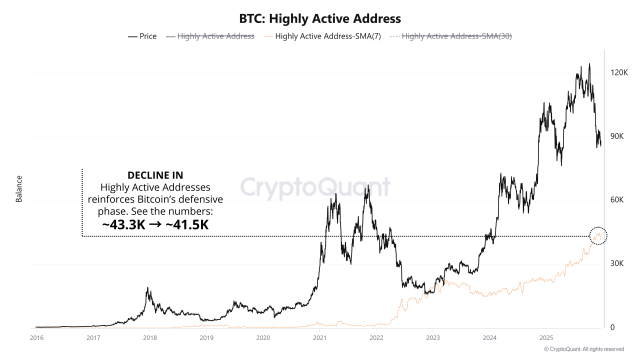
However, the platform’s analysis of the current market state is mainly centered on the Bitcoin Highly Active Address metric. This key metric points to a slowdown in the BTC Network. A look at the chart reveals a steady drop in the highly active BTC addresses, reinforcing lower speculative activity and suggesting that higher volatility lies ahead.

Following the sharp pullback, highly active BTC addresses have declined from 43,300 to 41,500, indicating that large players are exiting the market, consistent with a defensive phase. Historically, whenever highly active addresses shrike, it signals a retreat by traders and institutions, which supports the transition into quiet accumulation phases that lead to future volatility.
Bitcoin

Furthermore, the data shows that the total number of transactions on the network has fallen from 460,000 to 438,000 over the past few days. GugaOnChain highlighted that when there is a lower transaction count, there is a reduction in speculative use.

It is worth noting that dropping transaction counts were an obvious symptom of waning speculative interest in previous down cycles, and the Bitcoin network operated at reduced volumes until fresh catalysts emerged. 

Another aspect that has experienced a decline is the network fees. Data shows that the fees fell from 233,000 to 230,000, suggesting a less congested network. During previous bear markets, lower fees often coincided with periods of weaker demand, showing that users were not vying for block space and fostering a low-pressure environment.

How Does The Current Trend Go Against The 2018 Market Cycle

According to the platform, the current data from the metric is similar to that observed in the 2018 bear market. During the period, there were also fewer active addresses, fading transactions, lower fees, and the retreat of major players, as seen in the current state of the market.

However, the Bitcoin user base today is larger, with over 800,000 compared to the 600,000 in 2018; a sign of structural resilience. Meanwhile, low activity frequently precedes increased volatility, just as it did in the past.

GugaOnChain stated that the indicators confirm a defensive scenario, and future comparisons with 2018 indicate that periods of low activity typically precede more volatility. Nonetheless, the larger user base of today indicates increased ecological resilience.


Bitcoin
Market Opportunity
Bitcoin Logo
Bitcoin Price(BTC)
$67,176.17
$67,176.17$67,176.17
-1.03%
USD
Bitcoin (BTC) Live Price Chart
Disclaimer: The articles reposted on this site are sourced from public platforms and are provided for informational purposes only. They do not necessarily reflect the views of MEXC. All rights remain with the original authors. If you believe any content infringes on third-party rights, please contact [email protected] for removal. MEXC makes no guarantees regarding the accuracy, completeness, or timeliness of the content and is not responsible for any actions taken based on the information provided. The content does not constitute financial, legal, or other professional advice, nor should it be considered a recommendation or endorsement by MEXC.

You May Also Like

Zcash is Predicted to Reach $215.89 By Mar 12, 2026

Zcash is Predicted to Reach $215.89 By Mar 12, 2026

The post Zcash is Predicted to Reach $215.89 By Mar 12, 2026 appeared on BitcoinEthereumNews.com. Disclaimer: This is not investment advice. The information provided
Share
BitcoinEthereumNews2026/03/08 08:09
Why Is Crypto Down in 2026? Binance Leverage Hits Exhaustion Lows as Pepeto Lines Up a Moonshot

Why Is Crypto Down in 2026? Binance Leverage Hits Exhaustion Lows as Pepeto Lines Up a Moonshot

Here is something the fear headlines are not telling you. The Binance estimated leverage ratio dropped to 0.146 in early March 2026, its lowest reading since April
Share
Techbullion2026/03/08 08:18
Headwind Helps Best Wallet Token

Headwind Helps Best Wallet Token

The post Headwind Helps Best Wallet Token appeared on BitcoinEthereumNews.com. Google has announced the launch of a new open-source protocol called Agent Payments Protocol (AP2) in partnership with Coinbase, the Ethereum Foundation, and 60 other organizations. This allows AI agents to make payments on behalf of users using various methods such as real-time bank transfers, credit and debit cards, and, most importantly, stablecoins. Let’s explore in detail what this could mean for the broader cryptocurrency markets, and also highlight a presale crypto (Best Wallet Token) that could explode as a result of this development. Google’s Push for Stablecoins Agent Payments Protocol (AP2) uses digital contracts known as ‘Intent Mandates’ and ‘Verifiable Credentials’ to ensure that AI agents undertake only those payments authorized by the user. Mandates, by the way, are cryptographically signed, tamper-proof digital contracts that act as verifiable proof of a user’s instruction. For example, let’s say you instruct an AI agent to never spend more than $200 in a single transaction. This instruction is written into an Intent Mandate, which serves as a digital contract. Now, whenever the AI agent tries to make a payment, it must present this mandate as proof of authorization, which will then be verified via the AP2 protocol. Alongside this, Google has also launched the A2A x402 extension to accelerate support for the Web3 ecosystem. This production-ready solution enables agent-based crypto payments and will help reshape the growth of cryptocurrency integration within the AP2 protocol. Google’s inclusion of stablecoins in AP2 is a massive vote of confidence in dollar-pegged cryptocurrencies and a huge step toward making them a mainstream payment option. This widens stablecoin usage beyond trading and speculation, positioning them at the center of the consumption economy. The recent enactment of the GENIUS Act in the U.S. gives stablecoins more structure and legal support. Imagine paying for things like data crawls, per-task…
Share
BitcoinEthereumNews2025/09/18 01:27