In the first half of 2025, the blockchain industry suffered over $2.37 billion in losses due to security incidents, with the DeFi sector hit the hardest. Scams targeting individual users have also proliferated, with AI enabling increasingly sophisticated schemes. According…In the first half of 2025, the blockchain industry suffered over $2.37 billion in losses due to security incidents, with the DeFi sector hit the hardest. Scams targeting individual users have also proliferated, with AI enabling increasingly sophisticated schemes. According…

$2.4B lost in 2025 H1 crypto hacks — exchanges and DeFi hit hardest: report

In the first half of 2025, the blockchain industry suffered over $2.37 billion in losses due to security incidents, with the DeFi sector hit the hardest. Scams targeting individual users have also proliferated, with AI enabling increasingly sophisticated schemes.

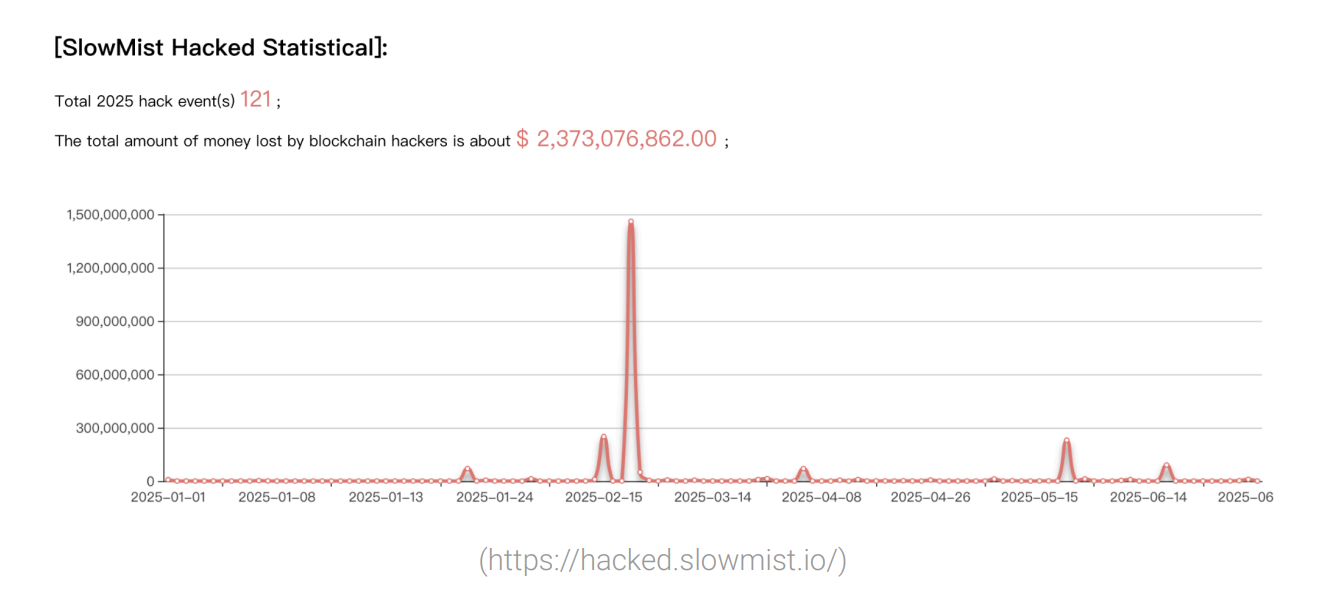
According to SlowMist’s mid-year “Blockchain Security and AML Report,” the blockchain industry saw approximately $2.37 billion in losses across 121 security incidents in the first half of 2025. This represents an almost 66% increase in financial losses compared to the same period in 2024, despite a decline in the number of incidents.
$2.4B lost in 2025 H1 crypto hacks — exchanges and DeFi hit hardest: report - 1

DeFi continues to be the most targeted sector, accounting for 76.03% of all incidents and approximately $470 million in losses. However, CEX platforms experienced $1.883 billion in losses from just 11 incidents, indicating high-value targets for attackers.

Account compromises were the leading cause of security incidents, followed by smart contract vulnerabilities.

Beyond direct attacks on projects, SlowMist’s report highlighted several fraud tactics targeting individual users that have characterized the first half of 2025:

Phishing Using EIP-7702

Attackers are exploiting new features of the EIP-7702 contract delegation mechanism that was introduced with Ethereum’s Pectra upgrade. On May 24, a user lost $146,551 after falling victim to a phishing attack that misused MetaMask’s EIP-7702 delegation feature. The scam, carried out by the Inferno Drainer group, tricked the user into authorizing a legitimate-looking contract, which then exploited bulk token approvals to drain funds.

Deepfakes

The rapid advancement of generative AI has ushered in a new wave of “trust-based scams.” In early 2025, a fake Zoom meeting using deepfakes led to the theft of all crypto assets from Mehdi Farooq, a partner at Hypersphere Ventures, after attackers impersonated known contacts and tricked him into downloading malware. Other high-profile cases include AI-generated videos of Elon Musk and Singapore officials promoting fake investment schemes.

Telegram Fake Safeguard Scams

These scams trick users into executing malicious code from their clipboard. Victims were lured through fake X accounts impersonating crypto influencers, then redirected to Telegram groups where “Tap to verify” links activated trojan-laced PowerShell commands. These attacks led to full device compromise, allowing remote access tools steal wallet files, private keys, and even control Telegram accounts across both Windows and macOS systems.

Malicious Browser Extensions

Disguised as “Web3 security tools” or exploiting automatic update mechanisms, these fake extensions hijack download links to install malicious software and steal mnemonic phrases, private keys, or login credentials. One high-profile case involved the “Osiris” extension, where attackers hijacked a legitimate developer’s Chrome Web Store account through a phishing-based OAuth exploit, pushing a stealthy malicious update to over 2.6 million users.

LinkedIn Recruitment Phishing

In 2025, LinkedIn-based phishing surged as attackers posed as blockchain startups to lure engineers into downloading malware disguised as technical tests. Scammers shared professional-looking project briefs and design documents, eventually sending victims to repositories containing heavily encrypted malicious payloads. Once executed, these backdoors steal host information, credentials, SSH private keys, and system Keychain data.

Social Engineering Attacks

Social engineering scams surged in early 2025, with the most high-profile case involving Coinbase. In this incident, attackers bribed overseas customer support staff to leak user data, then impersonated Coinbase reps using spoofed phone numbers and phishing messages to lure victims into transferring funds to wallets controlled by scammers. According to SlowMist, such coordinated attacks resulted in over $100 million in total user losses.

Backdoor Supply Chain Attacks via Low-Cost AI Tools

Developers seeking “unlimited access to advanced AI models” via unofficial channels risk installing malicious npm packages that deeply tamper with local applications. SlowMist flagged a case where a startup lost hundreds of thousands due to malicious code generated by such a tool, which installed backdoors via npm packages. Over 4,200 developers, mostly on macOS, were affected, allowing attackers remote control and credential theft.

Unrestricted Large Language Models

SlowMist’s report highlights several LLMs that have been “jailbroken” to bypass the ethical restrictions of their original versions. WormGPT specializes in generating malware-related content and phishing emails, while FraudGPT can produce fake crypto project materials and clones phishing pages. DarkBERT, trained on dark web data, enables highly targeted social engineering campaigns. GhostGPT can create deepfake scams impersonating exchange execs, among other malicious uses.


Market Opportunity
DeFi Logo
DeFi Price(DEFI)
$0.000606
$0.000606$0.000606
-1.94%
USD
DeFi (DEFI) Live Price Chart
Disclaimer: The articles reposted on this site are sourced from public platforms and are provided for informational purposes only. They do not necessarily reflect the views of MEXC. All rights remain with the original authors. If you believe any content infringes on third-party rights, please contact [email protected] for removal. MEXC makes no guarantees regarding the accuracy, completeness, or timeliness of the content and is not responsible for any actions taken based on the information provided. The content does not constitute financial, legal, or other professional advice, nor should it be considered a recommendation or endorsement by MEXC.

You May Also Like

Building a DEXScreener Clone: A Step-by-Step Guide

Building a DEXScreener Clone: A Step-by-Step Guide

DEX Screener is used by crypto traders who need access to on-chain data like trading volumes, liquidity, and token prices. This information allows them to analyze trends, monitor new listings, and make informed investment decisions. In this tutorial, I will build a DEXScreener clone from scratch, covering everything from the initial design to a functional app. We will use Streamlit, a Python framework for building full-stack apps.
Share
Hackernoon2025/09/18 15:05
Which DOGE? Musk's Cryptic Post Explodes Confusion

Which DOGE? Musk's Cryptic Post Explodes Confusion

A viral chart documenting a sharp decline in U.S. federal employment during President Trump's second term has sparked unexpected confusion in cryptocurrency markets
Share
Coinstats2025/12/20 01:13
Google's AP2 protocol has been released. Does encrypted AI still have a chance?

Google's AP2 protocol has been released. Does encrypted AI still have a chance?

Following the MCP and A2A protocols, the AI Agent market has seen another blockbuster arrival: the Agent Payments Protocol (AP2), developed by Google. This will clearly further enhance AI Agents' autonomous multi-tasking capabilities, but the unfortunate reality is that it has little to do with web3AI. Let's take a closer look: What problem does AP2 solve? Simply put, the MCP protocol is like a universal hook, enabling AI agents to connect to various external tools and data sources; A2A is a team collaboration communication protocol that allows multiple AI agents to cooperate with each other to complete complex tasks; AP2 completes the last piece of the puzzle - payment capability. In other words, MCP opens up connectivity, A2A promotes collaboration efficiency, and AP2 achieves value exchange. The arrival of AP2 truly injects "soul" into the autonomous collaboration and task execution of Multi-Agents. Imagine AI Agents connecting Qunar, Meituan, and Didi to complete the booking of flights, hotels, and car rentals, but then getting stuck at the point of "self-payment." What's the point of all that multitasking? So, remember this: AP2 is an extension of MCP+A2A, solving the last mile problem of AI Agent automated execution. What are the technical highlights of AP2? The core innovation of AP2 is the Mandates mechanism, which is divided into real-time authorization mode and delegated authorization mode. Real-time authorization is easy to understand. The AI Agent finds the product and shows it to you. The operation can only be performed after the user signs. Delegated authorization requires the user to set rules in advance, such as only buying the iPhone 17 when the price drops to 5,000. The AI Agent monitors the trigger conditions and executes automatically. The implementation logic is cryptographically signed using Verifiable Credentials (VCs). Users can set complex commission conditions, including price ranges, time limits, and payment method priorities, forming a tamper-proof digital contract. Once signed, the AI Agent executes according to the conditions, with VCs ensuring auditability and security at every step. Of particular note is the "A2A x402" extension, a technical component developed by Google specifically for crypto payments, developed in collaboration with Coinbase and the Ethereum Foundation. This extension enables AI Agents to seamlessly process stablecoins, ETH, and other blockchain assets, supporting native payment scenarios within the Web3 ecosystem. What kind of imagination space can AP2 bring? After analyzing the technical principles, do you think that's it? Yes, in fact, the AP2 is boring when it is disassembled alone. Its real charm lies in connecting and opening up the "MCP+A2A+AP2" technology stack, completely opening up the complete link of AI Agent's autonomous analysis+execution+payment. From now on, AI Agents can open up many application scenarios. For example, AI Agents for stock investment and financial management can help us monitor the market 24/7 and conduct independent transactions. Enterprise procurement AI Agents can automatically replenish and renew without human intervention. AP2's complementary payment capabilities will further expand the penetration of the Agent-to-Agent economy into more scenarios. Google obviously understands that after the technical framework is established, the ecological implementation must be relied upon, so it has brought in more than 60 partners to develop it, almost covering the entire payment and business ecosystem. Interestingly, it also involves major Crypto players such as Ethereum, Coinbase, MetaMask, and Sui. Combined with the current trend of currency and stock integration, the imagination space has been doubled. Is web3 AI really dead? Not entirely. Google's AP2 looks complete, but it only achieves technical compatibility with Crypto payments. It can only be regarded as an extension of the traditional authorization framework and belongs to the category of automated execution. There is a "paradigm" difference between it and the autonomous asset management pursued by pure Crypto native solutions. The Crypto-native solutions under exploration are taking the "decentralized custody + on-chain verification" route, including AI Agent autonomous asset management, AI Agent autonomous transactions (DeFAI), AI Agent digital identity and on-chain reputation system (ERC-8004...), AI Agent on-chain governance DAO framework, AI Agent NPC and digital avatars, and many other interesting and fun directions. Ultimately, once users get used to AI Agent payments in traditional fields, their acceptance of AI Agents autonomously owning digital assets will also increase. And for those scenarios that AP2 cannot reach, such as anonymous transactions, censorship-resistant payments, and decentralized asset management, there will always be a time for crypto-native solutions to show their strength? The two are more likely to be complementary rather than competitive, but to be honest, the key technological advancements behind AI Agents currently all come from web2AI, and web3AI still needs to keep up the good work!
Share
PANews2025/09/18 07:00