Institutional money has changed how crypto trades. Bitcoin and Ethereum now respond to economic news in ways that mirror traditional assets. Reports on the CPI, inflation, and interest rates move prices. This shift means macroeconomic indicators are no longer optional for crypto traders. They are part of the core playbook. This article explains how official data on inflation, central bank rates, and crypto-specific indicators like Bitcoin dominance can help anticipate market trends. The analysis draws on macro releases, crypto charts, and research from large trading desks. The goal is not to predict exact moves but to offer a practical guide to understanding how broader economic trends shape crypto performance. Inflation and Bitcoin: CPI’s Growing Grip on Crypto Inflation started rising sharply in early 2022. The Consumer Price Index , reported by the Bureau of Labor Statistics, reached nine percent year-over-year in June. Bitcoin fell six percent within three days of that release. Investors moved out of risk assets, expecting tighter financial conditions. This pattern continued through 2023 and 2024. When CPI came in lower than forecasts, Bitcoin often rebounded. For example, in November 2022, the month-over-month print was 0.1 percent against a forecast of 0.3 percent. Bitcoin gained nearly four percent within two days. CPI for all items rises 0.1% in May; shelter up #BLSData https://t.co/dJyJeKmvth — BLS-Labor Statistics (@BLS_gov) June 11, 2025 This repeated reaction suggests Bitcoin now trades more like tech stocks. It does not act like a hedge against inflation in the short term. Instead, it follows interest rate expectations. If inflation readings push the Federal Reserve toward cuts, traders often rotate into crypto. If inflation jumps, traders exit fast. CPI for May 2025 showed price growth slowing toward the Federal Reserve’s target. If that trend continues, investors may add risk again. However, if energy costs or wages lift inflation above forecasts, expectations may shift back toward tightening. Traders will likely adjust positions in Bitcoin and Ethereum based on these releases. CPI releases now act as drivers of short-term price direction. Fed Rates and Ethereum: Liquidity Cycles in Action The Federal Reserve began raising interest rates in March 2022. That cycle lasted until mid-2023, with the target range reaching 5.25 to 5.5 percent. Each increase indicated tighter liquidity. Ethereum often fell in the days following these announcements, mirroring declines in growth-focused equities. Ethereum Price 2022 (Source: CoinMarketCap) Ethereum’s sensitivity to rate decisions became clear in several key moments. After the June 2022 hike of 75 basis points, ETH dropped by over eight percent within 48 hours. The same pattern repeated in September. By contrast, when the Fed paused in July 2023, ETH rebounded by nearly five percent over the next three trading sessions. However, one exception came in March 2023. The collapse of Silicon Valley Bank triggered panic in financial markets. The Fed raised rates by 25 basis points but indicated it might stop soon. That shift helped ETH recover as it climbed from under $1,400 to over $1,800 within three weeks. These events show Ethereum’s link to monetary policy. Rate hikes tighten conditions and push ETH down. Pauses or signs of easing often lead to sharp rebounds. Ethereum trades like a proxy for risk appetite in a liquidity-driven market. Bitcoin Dominance: Crypto’s Own Macro Gauge Bitcoin dominance tracks the percentage of total crypto market value held in Bitcoin. When dominance rises, it often reflects a retreat to safety. During periods of macro tightening, investors reduce exposure to smaller tokens and move capital into Bitcoin. This behavior mirrors broader risk-off patterns. U.S. Interest Rate 2015-2025 (Federal Reserve Bank) From late 2021 through 2022, Bitcoin dominance climbed from under 40 percent to nearly 48 percent. That move came during sharp inflation spikes, and a series of Fed rate increases as the market pulled back from speculative assets. Dominance rose again in mid-2023, just before the Fed indicated a pause, and fell shortly after. This pattern supports a familiar cycle. In early risk-on phases, Bitcoin leads. Once it stabilizes, capital rotates into Ethereum, then into altcoins with lower market value. Drops in dominance often mark the beginning of these rotations. The index can act as a sign of changing sentiment within the market. Bitcoin dominance reflects how crypto investors respond to broader economic shifts. It can function like a barometer—trending upward when uncertainty grows and falling when conditions favor higher risk exposure. Institutional Macro Forecasts and the Next 90 Days Institutional research over the past year has increasingly tied macro indicators to digital asset performance. In an October 2024 report, Crypto.com Research stated: “Economic growth may generally indicate a more favourable environment for cryptocurrencies, but the impact will vary depending on other market conditions.” They noted that “increasing correlation between traditional markets and cryptocurrencies means that stock market performance may potentially provide valuable insights into potential crypto trends.” Looking ahead, the next 90 days include several macro events that could affect crypto direction. The July CPI data is due on August 12, with consensus forecasting a YoY increase of 2.8 percent. The next FOMC meeting is on September 17, where markets currently price a 25 basis point cut. The August nonfarm payroll report (due September 6) and Q2 GDP revision (August 29) also stand out as volatility triggers. These dates offer key decision points. A lower CPI print could reinforce Fed easing expectations and push capital into risk assets. On the other hand, a stronger-than-expected payroll may reduce those expectations. ETF-related flows and crypto-native reactions will likely hinge on these cues, reinforcing the case that macro indicators now drive the broader crypto narrative. Conclusion: A Macro-Informed Strategy Macroeconomic indicators now play a measurable role in shaping the crypto market direction. Inflation data, central bank policy , and internal metrics like Bitcoin dominance have shown clear relationships with past price shifts in both Bitcoin and Ethereum. These signs, when aligned, can offer a grounded framework for interpreting future moves. While no model captures every turn, tracking CPI releases, FOMC decisions, and market reactions allows for more informed positioning. Macro data will not replace crypto-native analysis, but it adds a broader context that is becoming harder to ignore. Keeping an economic calendar in view may prove as useful as any technical chart.Institutional money has changed how crypto trades. Bitcoin and Ethereum now respond to economic news in ways that mirror traditional assets. Reports on the CPI, inflation, and interest rates move prices. This shift means macroeconomic indicators are no longer optional for crypto traders. They are part of the core playbook. This article explains how official data on inflation, central bank rates, and crypto-specific indicators like Bitcoin dominance can help anticipate market trends. The analysis draws on macro releases, crypto charts, and research from large trading desks. The goal is not to predict exact moves but to offer a practical guide to understanding how broader economic trends shape crypto performance. Inflation and Bitcoin: CPI’s Growing Grip on Crypto Inflation started rising sharply in early 2022. The Consumer Price Index , reported by the Bureau of Labor Statistics, reached nine percent year-over-year in June. Bitcoin fell six percent within three days of that release. Investors moved out of risk assets, expecting tighter financial conditions. This pattern continued through 2023 and 2024. When CPI came in lower than forecasts, Bitcoin often rebounded. For example, in November 2022, the month-over-month print was 0.1 percent against a forecast of 0.3 percent. Bitcoin gained nearly four percent within two days. CPI for all items rises 0.1% in May; shelter up #BLSData https://t.co/dJyJeKmvth — BLS-Labor Statistics (@BLS_gov) June 11, 2025 This repeated reaction suggests Bitcoin now trades more like tech stocks. It does not act like a hedge against inflation in the short term. Instead, it follows interest rate expectations. If inflation readings push the Federal Reserve toward cuts, traders often rotate into crypto. If inflation jumps, traders exit fast. CPI for May 2025 showed price growth slowing toward the Federal Reserve’s target. If that trend continues, investors may add risk again. However, if energy costs or wages lift inflation above forecasts, expectations may shift back toward tightening. Traders will likely adjust positions in Bitcoin and Ethereum based on these releases. CPI releases now act as drivers of short-term price direction. Fed Rates and Ethereum: Liquidity Cycles in Action The Federal Reserve began raising interest rates in March 2022. That cycle lasted until mid-2023, with the target range reaching 5.25 to 5.5 percent. Each increase indicated tighter liquidity. Ethereum often fell in the days following these announcements, mirroring declines in growth-focused equities. Ethereum Price 2022 (Source: CoinMarketCap) Ethereum’s sensitivity to rate decisions became clear in several key moments. After the June 2022 hike of 75 basis points, ETH dropped by over eight percent within 48 hours. The same pattern repeated in September. By contrast, when the Fed paused in July 2023, ETH rebounded by nearly five percent over the next three trading sessions. However, one exception came in March 2023. The collapse of Silicon Valley Bank triggered panic in financial markets. The Fed raised rates by 25 basis points but indicated it might stop soon. That shift helped ETH recover as it climbed from under $1,400 to over $1,800 within three weeks. These events show Ethereum’s link to monetary policy. Rate hikes tighten conditions and push ETH down. Pauses or signs of easing often lead to sharp rebounds. Ethereum trades like a proxy for risk appetite in a liquidity-driven market. Bitcoin Dominance: Crypto’s Own Macro Gauge Bitcoin dominance tracks the percentage of total crypto market value held in Bitcoin. When dominance rises, it often reflects a retreat to safety. During periods of macro tightening, investors reduce exposure to smaller tokens and move capital into Bitcoin. This behavior mirrors broader risk-off patterns. U.S. Interest Rate 2015-2025 (Federal Reserve Bank) From late 2021 through 2022, Bitcoin dominance climbed from under 40 percent to nearly 48 percent. That move came during sharp inflation spikes, and a series of Fed rate increases as the market pulled back from speculative assets. Dominance rose again in mid-2023, just before the Fed indicated a pause, and fell shortly after. This pattern supports a familiar cycle. In early risk-on phases, Bitcoin leads. Once it stabilizes, capital rotates into Ethereum, then into altcoins with lower market value. Drops in dominance often mark the beginning of these rotations. The index can act as a sign of changing sentiment within the market. Bitcoin dominance reflects how crypto investors respond to broader economic shifts. It can function like a barometer—trending upward when uncertainty grows and falling when conditions favor higher risk exposure. Institutional Macro Forecasts and the Next 90 Days Institutional research over the past year has increasingly tied macro indicators to digital asset performance. In an October 2024 report, Crypto.com Research stated: “Economic growth may generally indicate a more favourable environment for cryptocurrencies, but the impact will vary depending on other market conditions.” They noted that “increasing correlation between traditional markets and cryptocurrencies means that stock market performance may potentially provide valuable insights into potential crypto trends.” Looking ahead, the next 90 days include several macro events that could affect crypto direction. The July CPI data is due on August 12, with consensus forecasting a YoY increase of 2.8 percent. The next FOMC meeting is on September 17, where markets currently price a 25 basis point cut. The August nonfarm payroll report (due September 6) and Q2 GDP revision (August 29) also stand out as volatility triggers. These dates offer key decision points. A lower CPI print could reinforce Fed easing expectations and push capital into risk assets. On the other hand, a stronger-than-expected payroll may reduce those expectations. ETF-related flows and crypto-native reactions will likely hinge on these cues, reinforcing the case that macro indicators now drive the broader crypto narrative. Conclusion: A Macro-Informed Strategy Macroeconomic indicators now play a measurable role in shaping the crypto market direction. Inflation data, central bank policy , and internal metrics like Bitcoin dominance have shown clear relationships with past price shifts in both Bitcoin and Ethereum. These signs, when aligned, can offer a grounded framework for interpreting future moves. While no model captures every turn, tracking CPI releases, FOMC decisions, and market reactions allows for more informed positioning. Macro data will not replace crypto-native analysis, but it adds a broader context that is becoming harder to ignore. Keeping an economic calendar in view may prove as useful as any technical chart.

Macro Meets Crypto: Predicting Prices with CPI, Fed Rates & BTC Dominance

Institutional money has changed how crypto trades. Bitcoin and Ethereum now respond to economic news in ways that mirror traditional assets. Reports on the CPI, inflation, and interest rates move prices. This shift means macroeconomic indicators are no longer optional for crypto traders. They are part of the core playbook.

This article explains how official data on inflation, central bank rates, and crypto-specific indicators like Bitcoin dominance can help anticipate market trends. The analysis draws on macro releases, crypto charts, and research from large trading desks.

The goal is not to predict exact moves but to offer a practical guide to understanding how broader economic trends shape crypto performance.

Inflation and Bitcoin: CPI’s Growing Grip on Crypto

Inflation started rising sharply in early 2022. The Consumer Price Index, reported by the Bureau of Labor Statistics, reached nine percent year-over-year in June. Bitcoin fell six percent within three days of that release. Investors moved out of risk assets, expecting tighter financial conditions.

This pattern continued through 2023 and 2024. When CPI came in lower than forecasts, Bitcoin often rebounded. For example, in November 2022, the month-over-month print was 0.1 percent against a forecast of 0.3 percent. Bitcoin gained nearly four percent within two days.

This repeated reaction suggests Bitcoin now trades more like tech stocks. It does not act like a hedge against inflation in the short term. Instead, it follows interest rate expectations. If inflation readings push the Federal Reserve toward cuts, traders often rotate into crypto. If inflation jumps, traders exit fast.

CPI for May 2025 showed price growth slowing toward the Federal Reserve’s target. If that trend continues, investors may add risk again. However, if energy costs or wages lift inflation above forecasts, expectations may shift back toward tightening.

Traders will likely adjust positions in Bitcoin and Ethereum based on these releases. CPI releases now act as drivers of short-term price direction.

Fed Rates and Ethereum: Liquidity Cycles in Action

The Federal Reserve began raising interest rates in March 2022. That cycle lasted until mid-2023, with the target range reaching 5.25 to 5.5 percent. Each increase indicated tighter liquidity. Ethereum often fell in the days following these announcements, mirroring declines in growth-focused equities.
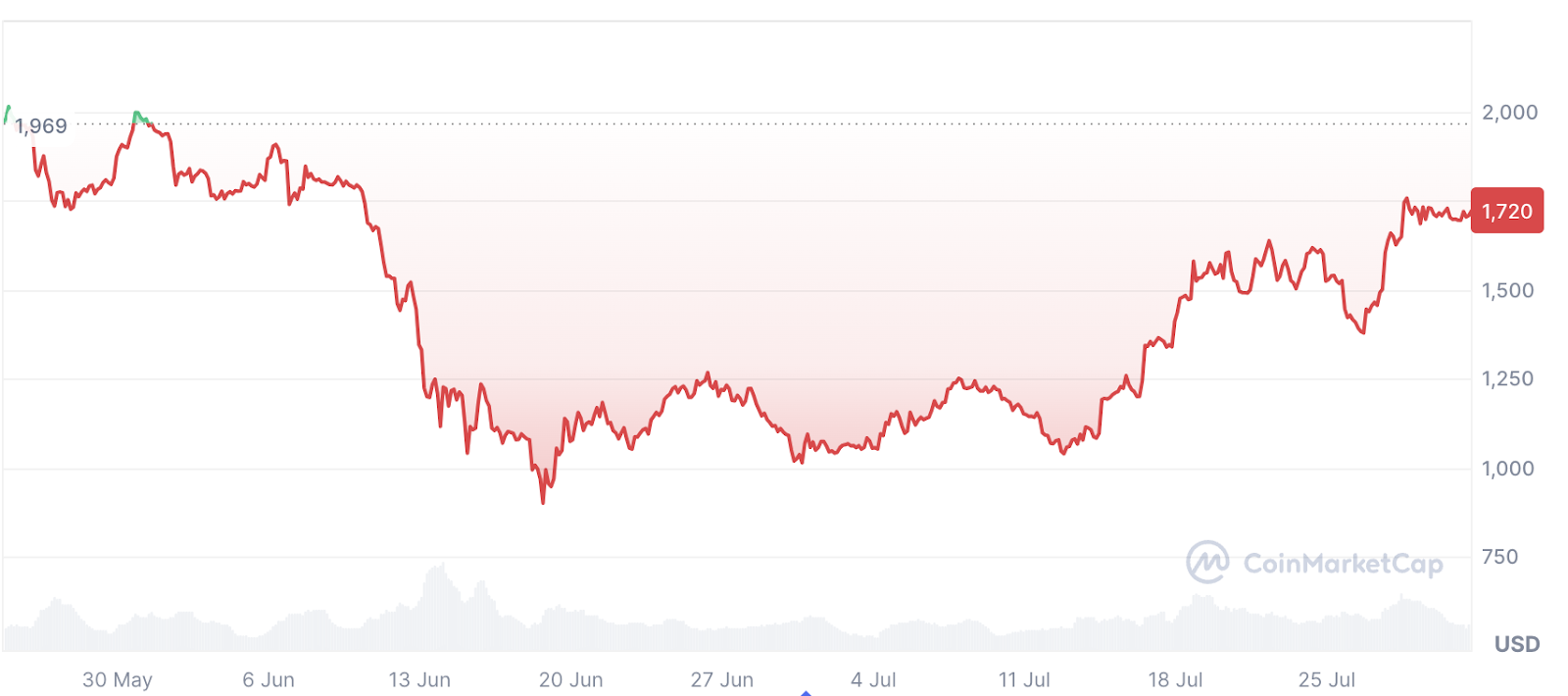
Ethereum Price 2022 (Source: CoinMarketCap)

Ethereum’s sensitivity to rate decisions became clear in several key moments. After the June 2022 hike of 75 basis points, ETH dropped by over eight percent within 48 hours. The same pattern repeated in September. By contrast, when the Fed paused in July 2023, ETH rebounded by nearly five percent over the next three trading sessions.

However, one exception came in March 2023. The collapse of Silicon Valley Bank triggered panic in financial markets. The Fed raised rates by 25 basis points but indicated it might stop soon. That shift helped ETH recover as it climbed from under $1,400 to over $1,800 within three weeks.

These events show Ethereum’s link to monetary policy. Rate hikes tighten conditions and push ETH down. Pauses or signs of easing often lead to sharp rebounds. Ethereum trades like a proxy for risk appetite in a liquidity-driven market.

Bitcoin Dominance: Crypto’s Own Macro Gauge

Bitcoin dominance tracks the percentage of total crypto market value held in Bitcoin. When dominance rises, it often reflects a retreat to safety. During periods of macro tightening, investors reduce exposure to smaller tokens and move capital into Bitcoin. This behavior mirrors broader risk-off patterns.

U.S. Interest Rate 2015-2025 (Federal Reserve Bank)

From late 2021 through 2022, Bitcoin dominance climbed from under 40 percent to nearly 48 percent. That move came during sharp inflation spikes, and a series of Fed rate increases as the market pulled back from speculative assets. Dominance rose again in mid-2023, just before the Fed indicated a pause, and fell shortly after.

This pattern supports a familiar cycle. In early risk-on phases, Bitcoin leads. Once it stabilizes, capital rotates into Ethereum, then into altcoins with lower market value. Drops in dominance often mark the beginning of these rotations. The index can act as a sign of changing sentiment within the market.

Bitcoin dominance reflects how crypto investors respond to broader economic shifts. It can function like a barometer—trending upward when uncertainty grows and falling when conditions favor higher risk exposure.

Institutional Macro Forecasts and the Next 90 Days

Institutional research over the past year has increasingly tied macro indicators to digital asset performance.

In an October 2024 report, Crypto.com Research stated: “Economic growth may generally indicate a more favourable environment for cryptocurrencies, but the impact will vary depending on other market conditions.” They noted that “increasing correlation between traditional markets and cryptocurrencies means that stock market performance may potentially provide valuable insights into potential crypto trends.”

Looking ahead, the next 90 days include several macro events that could affect crypto direction. The July CPI data is due on August 12, with consensus forecasting a YoY increase of 2.8 percent. The next FOMC meeting is on September 17, where markets currently price a 25 basis point cut. The August nonfarm payroll report (due September 6) and Q2 GDP revision (August 29) also stand out as volatility triggers.

These dates offer key decision points. A lower CPI print could reinforce Fed easing expectations and push capital into risk assets. On the other hand, a stronger-than-expected payroll may reduce those expectations. ETF-related flows and crypto-native reactions will likely hinge on these cues, reinforcing the case that macro indicators now drive the broader crypto narrative.

Conclusion: A Macro-Informed Strategy

Macroeconomic indicators now play a measurable role in shaping the crypto market direction. Inflation data, central bank policy, and internal metrics like Bitcoin dominance have shown clear relationships with past price shifts in both Bitcoin and Ethereum. These signs, when aligned, can offer a grounded framework for interpreting future moves.

While no model captures every turn, tracking CPI releases, FOMC decisions, and market reactions allows for more informed positioning. Macro data will not replace crypto-native analysis, but it adds a broader context that is becoming harder to ignore. Keeping an economic calendar in view may prove as useful as any technical chart.


Market Opportunity
LETSTOP Logo
LETSTOP Price(STOP)
$0,01735
$0,01735$0,01735
+0,81%
USD
LETSTOP (STOP) Live Price Chart
Disclaimer: The articles reposted on this site are sourced from public platforms and are provided for informational purposes only. They do not necessarily reflect the views of MEXC. All rights remain with the original authors. If you believe any content infringes on third-party rights, please contact [email protected] for removal. MEXC makes no guarantees regarding the accuracy, completeness, or timeliness of the content and is not responsible for any actions taken based on the information provided. The content does not constitute financial, legal, or other professional advice, nor should it be considered a recommendation or endorsement by MEXC.

You May Also Like

Bitcoin Has Taken Gold’s Role In Today’s World, Eric Trump Says

Bitcoin Has Taken Gold’s Role In Today’s World, Eric Trump Says

Eric Trump on Tuesday described Bitcoin as a “modern-day gold,” calling it a liquid store of value that can act as a hedge to real estate and other assets. Related Reading: XRP’s Biggest Rally Yet? Analyst Projects $20+ In October 2025 According to reports, the remark came during a TV appearance on CNBC’s Squawk Box, tied to the launch of American Bitcoin, the mining and treasury firm he helped start. Company Holdings And Strategy Based on public filings and company summaries, American Bitcoin has accumulated 2,443 BTC on its balance sheet. That stash has been valued in the low hundreds of millions of dollars at recent spot prices. The firm mixes large-scale mining with the goal of holding Bitcoin as a strategic reserve, which it says will help it grow both production and asset holdings over time. Eric Trump’s comments were direct. He told viewers that institutions are treating Bitcoin more like a store of value than a fringe idea, and he warned firms that resist blockchain adoption. The tone was strong at times, and the line about Bitcoin being a modern equivalent of gold was used to frame American Bitcoin’s role as both miner and holder.   Eric Trump has said: bitcoin is modern-day gold — unusual_whales (@unusual_whales) September 16, 2025 How The Company Went Public American Bitcoin moved toward a public listing via an all-stock merger with Gryphon Digital Mining earlier this year, a deal that kept most of the original shareholders in control and positioned the new entity for a Nasdaq debut. Reports show that mining partner Hut 8 holds a large ownership stake, leaving the Trump family and other backers with a minority share. The listing brought fresh attention and capital to the firm as it began trading under the ticker ABTC. Market watchers say the firm’s public debut highlights two trends: mining companies are trying to grow by both producing and holding Bitcoin, and political ties are bringing more headlines to crypto firms. Some analysts point out that holding large amounts of Bitcoin on the balance sheet exposes a company to price swings, while supporters argue it aligns incentives between miners and investors. Related Reading: Ethereum Bulls Target $8,500 With Big Money Backing The Move – Details Reaction And Possible Risks Based on coverage of the launch, investors have reacted with both enthusiasm and caution. Supporters praise the prospect of a US-based miner that aims to be transparent and aggressive about building a reserve. Critics point to governance questions, possible conflicts tied to high-profile backers, and the usual risks of a volatile asset being held on corporate balance sheets. Eric Trump’s remark that Bitcoin has taken gold’s role in today’s world reflects both his belief in its value and American Bitcoin’s strategy of mining and holding. Whether that view sticks will depend on how investors and institutions respond in the months ahead. Featured image from Meta, chart from TradingView
Share
NewsBTC2025/09/18 06:00
Tether CEO: AI Bubble Poses Biggest Risk to Bitcoin in 2026

Tether CEO: AI Bubble Poses Biggest Risk to Bitcoin in 2026

Tether CEO Paolo Ardoino has identified a potential AI-driven bubble as Bitcoin's biggest risk heading into 2026. However, he does not anticipate the same sharp corrections seen in previous market cycles, citing growing institutional adoption as a stabilizing force.
Share
MEXC NEWS2025/12/19 16:05
Bearish Sentiment Spikes as Bitcoin Drops to $84.8K, Creating Potential Contrarian Signal

Bearish Sentiment Spikes as Bitcoin Drops to $84.8K, Creating Potential Contrarian Signal

Bearish sentiment is surging across social media platforms following Bitcoin's pullback to $84,800, according to blockchain analytics firm Santiment. Retail investors are pushing fearful narratives harder than bullish outlooks, creating a notable shift in market mood.
Share
MEXC NEWS2025/12/19 15:56