

Bitwise Floods SEC With 11 Crypto ETF Filings in One Day
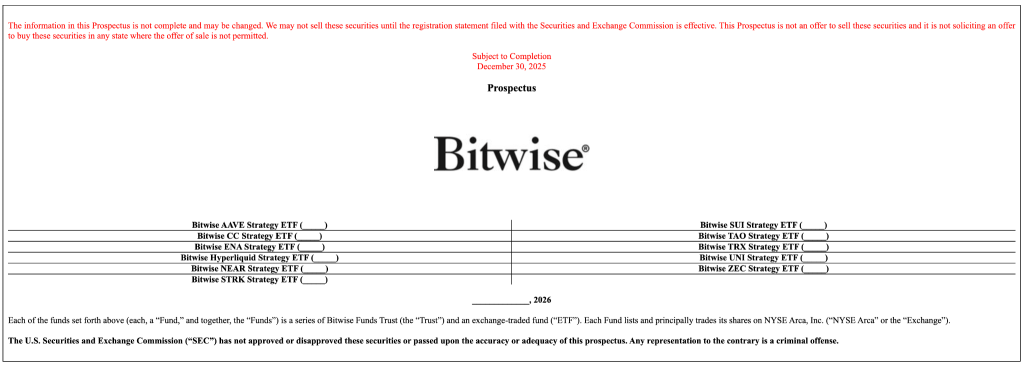
Bitwise Funds Trust filed registration statements with the SEC on December 30 for eleven strategy-based exchange-traded funds targeting major blockchain protocols, marking one of the largest single-day crypto ETF filings in industry history.
The funds, expected to become effective 75 days after filing, will trade on NYSE Arca and offer exposure to governance, utility, and native tokens through a hybrid investment structure combining direct holdings with European exchange-traded products.
The filing arrives as asset managers race to capture market share following the SEC’s October 2025 introduction of generic listing standards for crypto ETFs, which eliminated case-by-case approval requirements and accelerated product launches across the industry.
Bitwise Targets DeFi, Layer-2s, and Privacy Networks
The eleven funds span diverse blockchain sectors, with each targeting a specific protocol.
The Bitwise AAVE Strategy ETF focuses on decentralized lending, while the Bitwise UNI Strategy ETF tracks Uniswap’s decentralized exchange and Unichain Layer-2 network.
Infrastructure plays include the Bitwise NEAR Strategy ETF, which covers NEAR’s sharded architecture, and the Bitwise SUI Strategy ETF, which targets Mysten Labs’ Move-based blockchain.
Layer-2 scaling solutions feature prominently through the Bitwise STRK Strategy ETF for Starknet’s ZK-STARK technology.
Privacy-focused networks also appear via the Bitwise ZEC Strategy ETF, which tracks Zcash’s zk-SNARK implementation.
Specialized protocols round out the suite, including the Bitwise TAO Strategy ETF for Bittensor’s AI marketplace, the Bitwise ENA Strategy ETF for Ethena’s synthetic dollar protocol, and funds covering Canton Network, Hyperliquid, and TRON blockchain.
 Source: SEC Filing
Each fund employs identical investment mechanics, with up to 60% in direct token holdings and at least 40% allocated to European ETPs that track token performance through fully collateralized debt securities.
Funds maintain a minimum 80% exposure to designated tokens, related ETPs, and derivatives under normal conditions, with an optional 25% allocation to Cayman Islands subsidiaries for tax compliance and access to derivatives.
Institutional Access and Regulatory Complexity
Bitwise Investment Manager serves as adviser across all funds, with portfolio management shared by Jennifer Thornton, Daniela Padilla, and Gayatri Choudhury.
The Bank of New York Mellon handles administration and custody for traditional securities, while Coinbase Custody Trust Company and BitGo Europe GmbH secure digital assets.
The funds operate under a unitary fee structure, though specific percentages remain undisclosed in the filing.
Despite the professional infrastructure, these products still carry significant risks.
Regulatory uncertainty persists over whether tokens qualify as securities or commodities, with the potential for fund dissolution if classifications shift.
European ETP exposure introduces issuer default risk and valuation challenges due to time-zone differences between the U.S. and European markets.
Notably, the funds intend to qualify as Regulated Investment Companies, avoiding federal taxation at the fund level if income is distributed to shareholders.
Creation and redemption occur primarily through cash rather than in-kind transactions, potentially resulting in higher capital gains distributions than in traditional ETF structures.
Shares trade throughout the day at market prices that may deviate from net asset value.
Wave of Altcoin Products Reshapes ETF Landscape
The filing extends Bitwise’s aggressive ETF expansion following recent launches, including the Bitwise Dogecoin ETF, which has accumulated significant assets despite its non-1940 Act classification and reduced investor protections.
These waves of filling came as Bitwise previously predicted that more than 100 crypto ETFs could launch by 2026 as generic listing standards eliminate approval bottlenecks.
The firm has also filed for products tracking NEAR and Chainlink, with the latter appearing on the DTCC registry, signaling a potential near-term launch.
Market structure shifts continue to accelerate institutional crypto access. Solana, XRP, and Dogecoin ETFs launched throughout 2025, with the Bitwise Solana Staking ETF gathering over $660 million in three weeks without experiencing outflows.
Bank of America recently authorized advisers to recommend Bitcoin ETFs to clients, potentially channeling portions of the bank’s $3.5 trillion in managed assets toward digital assets as regulatory clarity improves under new SEC leadership.
Bitwise Maintains Bullish Outlook Despite Market Volatility
Bitwise Chief Investment Officer Matt Hougan maintains that Bitcoin will reach new all-time highs in 2026, breaking the traditional four-year cycle pattern through sustained institutional capital inflows.
The firm argues that Bitcoin’s declining volatility, now lower than Nvidia shares in 2025, reflects a maturing investor base as traditional financial institutions, including Morgan Stanley, Wells Fargo, and Merrill Lynch, prepare allocations.
Hougan also recently said he expects a decade of steady gains from here with reduced volatility rather than explosive rallies, driven by structural market changes and regulatory clarity rather than retail speculation.


You May Also Like

WTI Forecast: Vulnerable near $90.50 after Iran ceasefire news

Graham calls out opponents for refusing to fire workers behind racist content




