Bitcoin started 2026 stuck near $88,000, extending weeks of sideways trading. While price action looks stagnant, on-chain data suggests the market may be quietlyBitcoin started 2026 stuck near $88,000, extending weeks of sideways trading. While price action looks stagnant, on-chain data suggests the market may be quietly

Will Bitcoin Price Reclaim $100,000 in January? 3 Charts Hold the Answer

2026/01/02 07:30
2 min read

Bitcoin started 2026 stuck near $88,000, extending weeks of sideways trading. While price action looks stagnant, on-chain data suggests the market may be quietly shifting beneath the surface.

Three indicators from CryptoQuant point to easing sell pressure, even as macro uncertainty continues to cap upside momentum.

Long-Term Holders Show Signs of Accumulation

Bitcoin’s price has struggled to reclaim key resistance after a sharp pullback in late 2025. The lack of follow-through buying has kept sentiment fragile, with traders waiting for confirmation that the correction has run its course.

The first signal comes from long-term holder (LTH) supply data. After months of negative readings, the 30-day net change in LTH supply has turned positive by roughly 10,700 BTC.
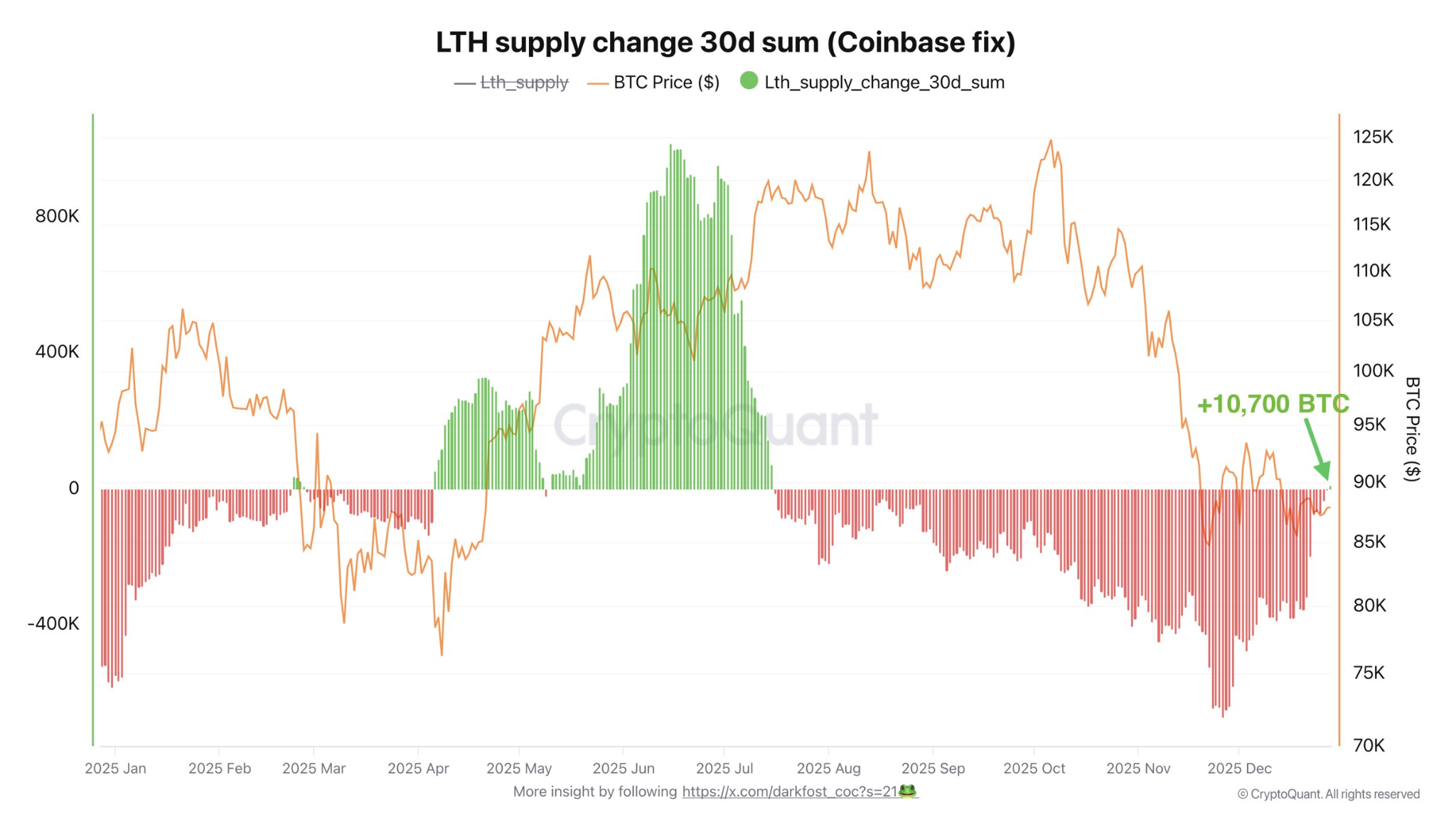
Bitcoin Long-Term Holder’s Supply. Source: X/Darkfost

This shift suggests that long-term investors are no longer distributing coins at scale. 

Instead, supply is gradually moving back into stronger hands, a pattern often seen during consolidation phases rather than market tops.

LTH SOPR Signals Balance, not Capitulation

A second chart tracks the long-term holder spent output profit ratio (SOPR). This metric shows whether long-term holders are selling at a profit or a loss.

Currently, LTH SOPR is hovering around the neutral 1.0 level. That indicates long-term holders are not capitulating or rushing to exit at losses. 

Historically, this behavior aligns with markets finding equilibrium after a correction, rather than entering a deeper breakdown.

Exchange outflows reduce immediate sell pressure

The third indicator looks at Bitcoin exchange netflows. Recent data shows continued net outflows, with more BTC leaving exchanges than entering them.

This trend reduces immediate sell-side supply on spot markets. 

However, the lack of a price rebound suggests demand remains cautious, likely constrained by tighter liquidity and delayed expectations for US rate cuts.
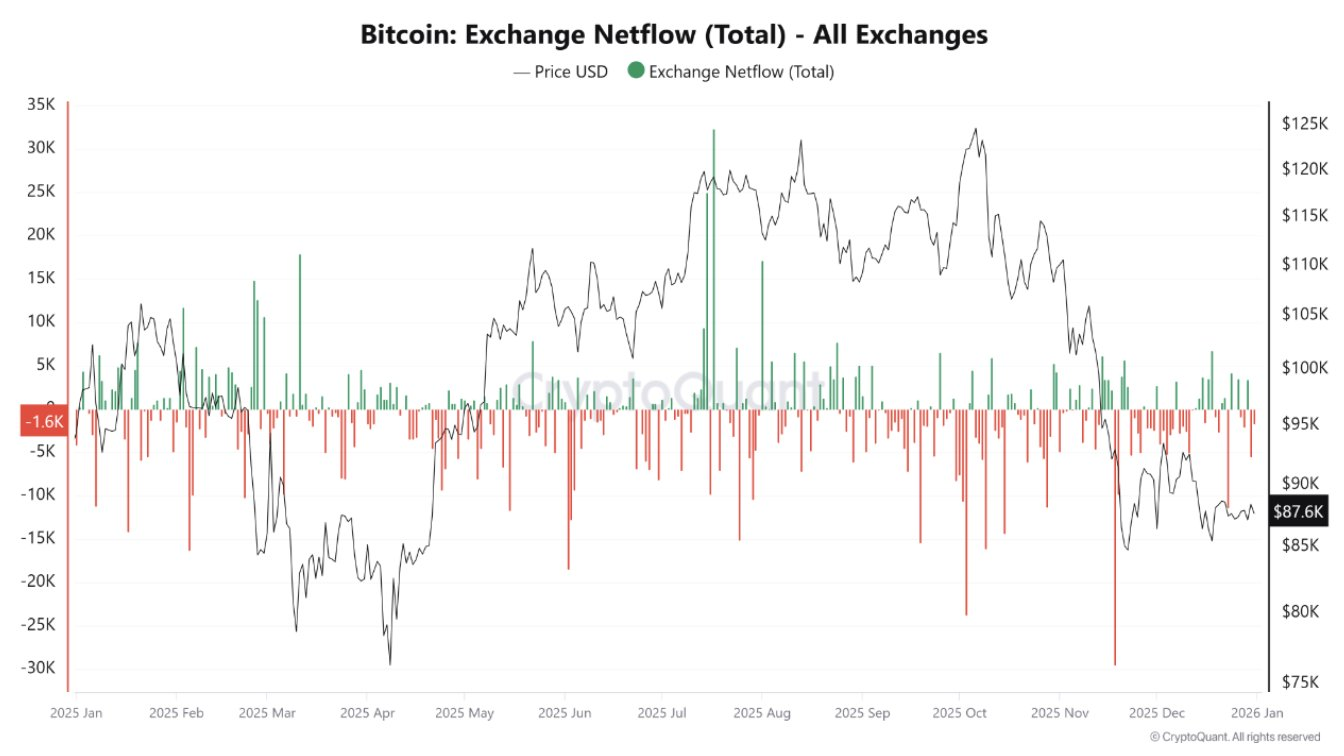
Bitcoin Exchange Netflow. Source: X/CryptoQuant

Will Bitcoin Price Recover in January?

Taken together, the charts paint a mixed but improving picture. Supply-side pressure appears to be easing, and long-term holders remain confident. 

Still, price remains range-bound due to weak demand and macro headwinds. A rapid move to $100,000 in January would likely require a fresh catalyst. 

Without it, Bitcoin may continue consolidating, building a base that could support a stronger recovery later in 2026 rather than an immediate breakout.


Market Opportunity
NEAR Logo
NEAR Price(NEAR)
$1.0116
$1.0116$1.0116
+2.05%
USD
NEAR (NEAR) Live Price Chart
Disclaimer: The articles reposted on this site are sourced from public platforms and are provided for informational purposes only. They do not necessarily reflect the views of MEXC. All rights remain with the original authors. If you believe any content infringes on third-party rights, please contact [email protected] for removal. MEXC makes no guarantees regarding the accuracy, completeness, or timeliness of the content and is not responsible for any actions taken based on the information provided. The content does not constitute financial, legal, or other professional advice, nor should it be considered a recommendation or endorsement by MEXC.

You May Also Like

A whale that made a 141% profit on PUMP three days ago bought 321 million TRUMPs today, with a floating profit of $223,000.

A whale that made a 141% profit on PUMP three days ago bought 321 million TRUMPs today, with a floating profit of $223,000.

PANews reported on September 18th that according to Lookonchain monitoring, whale H56YMH sold 317 million PUMPs (worth approximately $2.53 million) at an average price of $0.008 three days ago, realizing a net profit of $1.48 million (a 141% return). Subsequently, eight hours ago, it purchased 321 million TRUMPs at an average price of $0.007835, resulting in unrealized profits of $223,000.
Share
PANews2025/09/18 10:36
Tokenized Assets Shift From Wrappers to Building Blocks in DeFi

Tokenized Assets Shift From Wrappers to Building Blocks in DeFi

The post Tokenized Assets Shift From Wrappers to Building Blocks in DeFi appeared on BitcoinEthereumNews.com. RWAs are rapidly moving on-chain, unlocking new opportunities for investors and DeFi protocols, according to a new report from Dune and RWAxyz. Tokenized real-world assets (RWAs) are moving beyond digital versions of traditional securities to become key building blocks of decentralized finance (DeFi), according to the 2025 RWA Report from Dune and RWAxyz. The report notes that Treasuries, bonds, credit, and equities are now being used in DeFi as collateral, trading instruments, and yield products. This marks tokenization’s “real breakthrough” – composability, or the ability to combine and reuse assets across different protocols. Projects are already showing how this works in practice. Asset manager Maple Finance’s syrupUSDC, for example, has grown to $2.5 billion, with more than 30% placed in DeFi apps like Spark ($570 million). Centrifuge’s new deJAAA token, a wrapper for Janus Henderson’s AAA CLO fund, is already trading on Aerodrome, Coinbase and other exchanges, with Stellar planned next. Meanwhile, Aave’s Horizon RWA Market now lets institutional users post tokenized Treasuries and CLOs as collateral. This trend underscores a bigger shift: RWAs are no longer just copies of traditional assets; instead, they are becoming core parts of on-chain finance, powering lending, liquidity, and yield, and helping to close the gap between traditional finance (TradFi) and DeFi. “RWAs have crossed the chasm from experimentation to execution,” Sid Powell, CEO of Maple Finance, says in the report. “Our growth to $3.5B AUM reflects a broader shift: traditional financial services are adopting crypto assets while institutions seek exposure to on-chain markets.” Investor demand for higher returns and more diversified options is mainly driving this growth. Tokenized Treasuries proved there is strong demand, with $7.3 billion issued by September 2025 – up 85% year-to-date. The growth was led by BlackRock, WisdomTree, Ondo, and Centrifuge’s JTRSY (Janus Henderson Anemoy Treasury Fund). Spark’s $1…
Share
BitcoinEthereumNews2025/09/18 06:10
Trader Leaves Crypto Permanently After Losing $10,000 to LIBRA

Trader Leaves Crypto Permanently After Losing $10,000 to LIBRA

One year has passed since Argentine President Javier Milei backed a project that drove hundreds of thousands of people worldwide to invest in Libra, a meme coin
Share
Coinstats2026/02/20 06:56