Starknet, an Ethereum layer-2 system that is based on zero-knowledge rollups, experienced another mainnet outage on Monday that halted network operations for overStarknet, an Ethereum layer-2 system that is based on zero-knowledge rollups, experienced another mainnet outage on Monday that halted network operations for over

Starknet Mainnet Halted Again: Fresh Outage Freezes Ethereum L2 for Over 2 Hours

2026/01/06 01:34
3 min read
For feedback or concerns regarding this content, please contact us at [email protected]

Starknet, an Ethereum layer-2 system that is based on zero-knowledge rollups, experienced another mainnet outage on Monday that halted network operations for over two hours and once again questioned the stability of Starknet as an operational system as it enters 2026.

Starknet developers reported the outage on X as a post, saying engineers were investigating the issue.

No immediate explanation was given for the cause of the outage. At the time of the initial update, block production had stalled for just over two hours, leaving users unable to submit or finalize transactions.

Despite Strong Metrics, Starknet Halt Stops All On-Chain Activity

On-chain data from Starknet’s block explorer showed the network had processed more than 264 million transactions since launch and supported over 56,000 active accounts, with average transaction fees sitting below one cent.
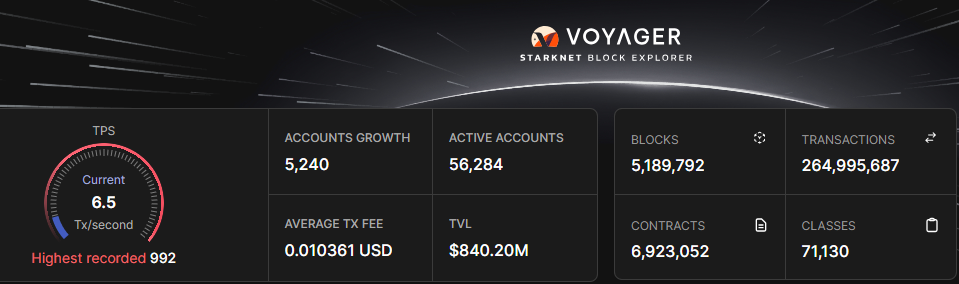
Source: Voyager Online

Total value locked stood at roughly $840 million. Despite these metrics, the halt effectively paused all activity across decentralized applications, wallets, and smart contracts during the downtime.

The explorer later indicated that block production had resumed, with new blocks appearing minutes after the incident was acknowledged publicly.

Source: Voyager Online

Starknet is designed to batch transactions off-chain and submit cryptographic proofs to Ethereum, allowing it to scale decentralized finance, gaming, and other smart contract use cases while relying on Ethereum for settlement and security.

The network has also positioned itself as a bridge for Bitcoin-related decentralized finance, promoting what it calls a BTCFi expansion within the Ethereum ecosystem.

The latest outage interrupted these ambitions, at least temporarily, as developers and users waited for normal operations to resume.

The disruption follows a difficult year for the network. In September 2025, Starknet experienced a far more severe incident after deploying a major upgrade known as Grinta, version 0.14.0.

That update, intended to advance decentralization by introducing multiple sequencers, triggered an extended halt in block production that lasted approximately nine hours.

During that episode, the network required two chain reorganizations, rolling back around an hour of activity and forcing users to resubmit transactions.

Starknet Outage Adds to Growing Pattern of Network Interruptions

A post-mortem published after the September outage traced the failure to a combination of factors.

Different sequencers were operating with inconsistent views of Ethereum due to issues with RPC providers, which disrupted block proposals.

A separate software bug in the component responsible for updating Starknet’s state compounded the problem when handling reverted transactions, ultimately leading the team to manually halt the chain to preserve correctness.

In April 2024, Starknet suffered a four-hour outage after a rounding error triggered block reorganizations, filling transaction capacity before developers cleared the backlog and restored normal network operations.

While the latest halt appears shorter and less severe than the September incident, it adds to a pattern of interruptions during Starknet’s transition toward a more decentralized architecture.

Such halts typically result in delayed or failed transactions, temporary inaccessibility of funds and services, and downtime for applications built on the network.

In previous incidents, some centralized exchanges temporarily suspended STRK deposits and withdrawals as a precaution, although trading often continued internally.

Market reaction to the latest outage was muted. STRK was trading around $0.089, up about 1.3% over the past 24 hours, with daily trading volume rising more than 38% to roughly $63.7 million.

Source: Coingecko

The token remains sharply below its early-2024 peak above $4, reflecting broader market conditions and lingering concerns around supply and network reliability rather than a single event.


Disclaimer: The articles reposted on this site are sourced from public platforms and are provided for informational purposes only. They do not necessarily reflect the views of MEXC. All rights remain with the original authors. If you believe any content infringes on third-party rights, please contact [email protected] for removal. MEXC makes no guarantees regarding the accuracy, completeness, or timeliness of the content and is not responsible for any actions taken based on the information provided. The content does not constitute financial, legal, or other professional advice, nor should it be considered a recommendation or endorsement by MEXC.

You May Also Like

Shocking OpenVPP Partnership Claim Draws Urgent Scrutiny

Shocking OpenVPP Partnership Claim Draws Urgent Scrutiny

The post Shocking OpenVPP Partnership Claim Draws Urgent Scrutiny appeared on BitcoinEthereumNews.com. The cryptocurrency world is buzzing with a recent controversy surrounding a bold OpenVPP partnership claim. This week, OpenVPP (OVPP) announced what it presented as a significant collaboration with the U.S. government in the innovative field of energy tokenization. However, this claim quickly drew the sharp eye of on-chain analyst ZachXBT, who highlighted a swift and official rebuttal that has sent ripples through the digital asset community. What Sparked the OpenVPP Partnership Claim Controversy? The core of the issue revolves around OpenVPP’s assertion of a U.S. government partnership. This kind of collaboration would typically be a monumental endorsement for any private cryptocurrency project, especially given the current regulatory climate. Such a partnership could signify a new era of mainstream adoption and legitimacy for energy tokenization initiatives. OpenVPP initially claimed cooperation with the U.S. government. This alleged partnership was said to be in the domain of energy tokenization. The announcement generated considerable interest and discussion online. ZachXBT, known for his diligent on-chain investigations, was quick to flag the development. He brought attention to the fact that U.S. Securities and Exchange Commission (SEC) Commissioner Hester Peirce had directly addressed the OpenVPP partnership claim. Her response, delivered within hours, was unequivocal and starkly contradicted OpenVPP’s narrative. How Did Regulatory Authorities Respond to the OpenVPP Partnership Claim? Commissioner Hester Peirce’s statement was a crucial turning point in this unfolding story. She clearly stated that the SEC, as an agency, does not engage in partnerships with private cryptocurrency projects. This response effectively dismantled the credibility of OpenVPP’s initial announcement regarding their supposed government collaboration. Peirce’s swift clarification underscores a fundamental principle of regulatory bodies: maintaining impartiality and avoiding endorsements of private entities. Her statement serves as a vital reminder to the crypto community about the official stance of government agencies concerning private ventures. Moreover, ZachXBT’s analysis…
Share
BitcoinEthereumNews2025/09/18 02:13
CME Group to Launch Solana and XRP Futures Options

CME Group to Launch Solana and XRP Futures Options

The post CME Group to Launch Solana and XRP Futures Options appeared on BitcoinEthereumNews.com. An announcement was made by CME Group, the largest derivatives exchanger worldwide, revealed that it would introduce options for Solana and XRP futures. It is the latest addition to CME crypto derivatives as institutions and retail investors increase their demand for Solana and XRP. CME Expands Crypto Offerings With Solana and XRP Options Launch According to a press release, the launch is scheduled for October 13, 2025, pending regulatory approval. The new products will allow traders to access options on Solana, Micro Solana, XRP, and Micro XRP futures. Expiries will be offered on business days on a monthly, and quarterly basis to provide more flexibility to market players. CME Group said the contracts are designed to meet demand from institutions, hedge funds, and active retail traders. According to Giovanni Vicioso, the launch reflects high liquidity in Solana and XRP futures. Vicioso is the Global Head of Cryptocurrency Products for the CME Group. He noted that the new contracts will provide additional tools for risk management and exposure strategies. Recently, CME XRP futures registered record open interest amid ETF approval optimism, reinforcing confidence in contract demand. Cumberland, one of the leading liquidity providers, welcomed the development and said it highlights the shift beyond Bitcoin and Ethereum. FalconX, another trading firm, added that rising digital asset treasuries are increasing the need for hedging tools on alternative tokens like Solana and XRP. High Record Trading Volumes Demand Solana and XRP Futures Solana futures and XRP continue to gain popularity since their launch earlier this year. According to CME official records, many have bought and sold more than 540,000 Solana futures contracts since March. A value that amounts to over $22 billion dollars. Solana contracts hit a record 9,000 contracts in August, worth $437 million. Open interest also set a record at 12,500 contracts.…
Share
BitcoinEthereumNews2025/09/18 01:39
Stablecoin market hits $312B as banks, card networks embrace onchain dollars

Stablecoin market hits $312B as banks, card networks embrace onchain dollars

Finance Share Share this article
Copy linkX (Twitter)LinkedInFacebookEmail
Stablecoin market hits $312B as banks, card
Share
Coindesk2026/03/10 22:48