Community polls suggest AI is fragmenting into specialized and hybrid models, but prediction markets still back a few dominant generalist platforms to lead the Community polls suggest AI is fragmenting into specialized and hybrid models, but prediction markets still back a few dominant generalist platforms to lead the

Is Generalist AI Really Dying or Just Learning to Share the Stage?

Happy New Year, Hackers!

Welcome to the first 3 Tech Polls newsletter of the year. Each week, we curate community-led conversations about technology and other related verticals, featuring results from our latest Poll of the Week and two related polls from around the web.

This week, we’re looking at the current AI landscape, and more specifically, whether 2025 marked a real turning point away from generalist AI toward something more fragmented, specialized, or hybrid as we settle into the new year.

\

This Week’s HackerNoon Poll Results

Was 2025 the “Death of the Generalist AI”?

The "Death of Generalist AI" refers to the end of the one-size-fits-all era. In its place, Small Language Models (SLMs) and Domain-Specific AI have emerged as the industry's workhorses. These models are trained on curated, high-fidelity data for specific sectors like law, healthcare, and finance, allowing them to outperform general models in accuracy and reliability within those niches. By running locally on hardware or on-premise servers, they prioritize privacy (data remains on-device), speed (zero cloud latency), and cost-efficiency.

If you were expecting a clear verdict, this poll didn’t deliver one. Instead, it revealed just how divided the conversation still is.

  • 31% — No. Generalist models like ChatGPT and Gemini still dominate. This was the most selected response, though not by a wide margin. For many readers, generalist models remain the default interface for AI. They’re still the tools people use most often, even as new alternatives emerge.

    \

  • 27% — Yes. Highly specialized models now dominate. Nearly as many respondents see the opposite trend. From domain-specific tools in healthcare, law, and finance to smaller models optimized for speed or privacy, this group believes specialization is now where real value lives.

    \

  • 29% — Not really. Generalist and specialized models now exist as a hybrid. A sizable portion of the audience rejects the idea of a clean break altogether. Instead, they see an ecosystem where generalist models act as a foundation, with specialized systems layered on top.

\

:::tip It’s not too late to join the conversation. Weigh in on the poll results here.

:::

\

What the Prediction Markets Have to Say

Kalshi

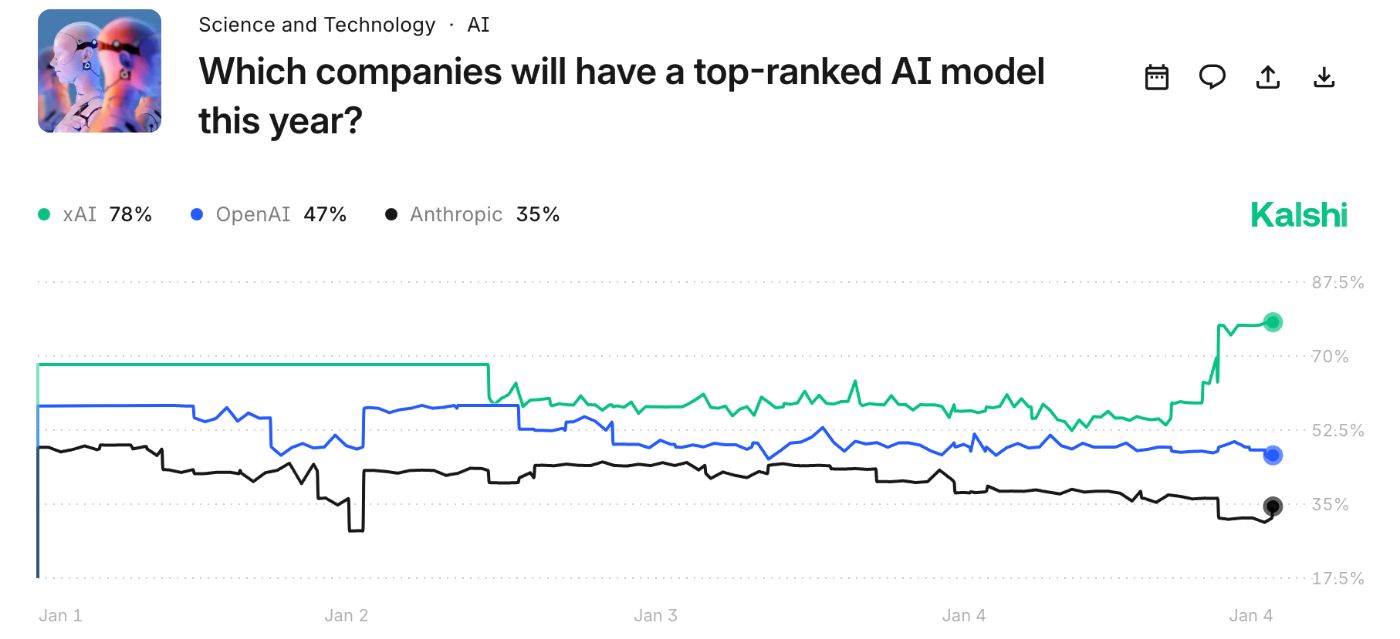
Which companies will have a top-ranked AI model this year?

While the HackerNoon poll focused on the types of AI, Kalshi traders are betting on who will come out on top overall.

\ Kalshi poll: which companies will have a top-ranked AI model this year?
\

  • xAI — 78%
  • OpenAI — 47%
  • Anthropic — 35%

The confidence here is clustered around a small group of major players. Even as the industry talks more about specialization, markets still expect leadership to come from companies building large, broadly capable systems.

\

Polymarket

Which company will have the best AI model end of January?

Polymarket takes this a step further, with results that are far less ambiguous.

  • Google — 92%
  • xAI — 6.4%
  • OpenAI — 1.4%
  • Everyone else — under 1% each

When real money is on the line, traders overwhelmingly favor a single incumbent. Whatever changes are happening under the hood, market confidence still points toward large, general-purpose AI backed by massive infrastructure.


Put together, the three tech polls paint a clear picture:

  • The community is split on whether generalist AI is fading, evolving, or simply being rebranded.
  • Prediction markets remain focused on a handful of dominant companies.
  • Despite growing interest in specialized models, confidence still concentrates around generalist platforms at scale.

The “death of generalist AI” may be overstated. What we’re seeing instead is a reshaping of the ecosystem, where specialization grows in importance, but generalist models continue to anchor the space as we move into 2026.


That’s all for this week.

Once again, Happy New Year Hackers!

\

Market Opportunity
null Logo
null Price(null)
--
----
USD
null (null) Live Price Chart
Disclaimer: The articles reposted on this site are sourced from public platforms and are provided for informational purposes only. They do not necessarily reflect the views of MEXC. All rights remain with the original authors. If you believe any content infringes on third-party rights, please contact [email protected] for removal. MEXC makes no guarantees regarding the accuracy, completeness, or timeliness of the content and is not responsible for any actions taken based on the information provided. The content does not constitute financial, legal, or other professional advice, nor should it be considered a recommendation or endorsement by MEXC.

You May Also Like

Trust Wallet issues security alert: It will never ask users for their mnemonic phrase or private key.

Trust Wallet issues security alert: It will never ask users for their mnemonic phrase or private key.

PANews reported on January 17 that Trust Wallet issued a security warning on its X platform, stating that it will never ask users for their mnemonic phrases or
Share
PANews2026/01/17 21:10
Crypto Market Cap Edges Up 2% as Bitcoin Approaches $118K After Fed Rate Trim

Crypto Market Cap Edges Up 2% as Bitcoin Approaches $118K After Fed Rate Trim

The global crypto market cap rose 2% to $4.2 trillion on Thursday, lifted by Bitcoin’s steady climb toward $118,000 after the Fed delivered its first interest rate cut of the year. Gains were measured, however, as investors weighed the central bank’s cautious tone on future policy moves. Bitcoin last traded 1% higher at $117,426. Ether rose 2.8% to $4,609. XRP also gained, rising 2.9% to $3.10. Fed Chair Jerome Powell described Wednesday’s quarter-point reduction as a risk-management step, stressing that policymakers were in no hurry to speed up the easing cycle. His comments dampened expectations of more aggressive cuts, limiting enthusiasm across risk assets. Traders Anticipated Fed Rate Trim, Leaving Little Room for Surprise Rally The Federal Open Market Committee voted 11-to-1 to lower the benchmark lending rate to a range of 4.00% to 4.25%. The sole dissent came from newly appointed governor Stephen Miran, who pushed for a half-point cut. Traders were largely prepared for the move. Futures markets tracked by the CME FedWatch tool had assigned a 96% probability to a 25 basis point cut, making the decision widely anticipated. That advance positioning meant much of the potential boost was already priced in, creating what analysts described as a “buy the rumour, sell the news” environment. Fed Rate Decision Creates Conditions for Crypto, But Traders Still Hold Back Andrew Forson, president of DeFi Technologies, said lower borrowing costs would eventually steer more money toward digital assets. “A lower cost of capital indicates more capital flows into the digital assets space because the risk hurdle rate for money is lower,” he noted. He added that staking products and blockchain projects could become attractive alternatives to traditional bonds, offering both yield and appreciation. Despite the cut, crypto markets remained calm. Open interest in Bitcoin futures held steady and no major liquidation cascades followed the Fed’s decision. Analysts pointed to Powell’s language and upcoming economic data as the key factors for traders before building larger positions. Powell’s Caution Tempers Immediate Impact of Fed Rate Move on Crypto Markets History also suggests crypto rallies after rate cuts often take time. When the Fed eased in Dec. 2024, Bitcoin briefly surged 5% cent before consolidating, with sustained gains arriving only weeks later. This time, market watchers are bracing for a similar pattern. Powell’s insistence on caution, combined with uncertainty around inflation and growth, has kept short-term volatility muted even as sentiment for risk assets improves. BitMine’s Tom Lee this week predicted that Bitcoin and Ether could deliver “monster gains” in the next three months if the Fed continues on an easing path. His view echoes broader expectations that liquidity-sensitive assets will outperform once the cycle gathers pace. For now, the crypto sector has digested the Fed’s move with restraint. Traders remain focused on signals from the central bank’s October meeting to determine whether Wednesday’s step marks the beginning of a broader policy shift or just a one-off adjustment
Share
CryptoNews2025/09/18 13:14
Trust Wallet Alerts Users After Security Incident

Trust Wallet Alerts Users After Security Incident

The post Trust Wallet Alerts Users After Security Incident appeared on BitcoinEthereumNews.com. Key Points: Trust Wallet issues alert after $7 million theft from
Share
BitcoinEthereumNews2026/01/17 21:43