Should Nigerians expect improved network and internet performance in 2026?
The Nigerian telecoms industry, being a major driver of the digital economy and business operations, witnessed a mixed 2025 characterised by infrastructure upgrades, increased network penetration and a series of disruptions. With this, over 177 million Nigerian telecom subscribers will be hoping to have an improved 2026 in terms of comfort and consumer experience.
Individuals, businesses and the national economy thrive when both network and internet experience are reliable. Digital payment, voice calls, SMS, data usage, streaming of music and videos, and enjoying quiet time by surfing through the internet; all depend on a service that provides the necessary utility for the cost incurred.
Following the 50% telecoms tariff hike, Nigerians clamoured for a system where there would be no data depletion, and a situation where the service justified the increase in voice and data prices. For Mobile Network Operators (MNOs) and Internet Service Providers (ISPs), sustainable investment in infrastructure and provision of affordable services for subscribers becomes a non-debatable mantra.
While 2025 posed a series of challenges to the Nigerian telecoms industry, Nigerians will be hoping that 2026 holds the future where they can enjoy uninterrupted network and internet services regardless of the location or service provider.
The question is: Is 2026 the year?
A sketch of 2025
The industry ended 2025 on a positive note with broadband penetration (50.58%) crossing the halfway mark for the first time. However, the figure is short of the National Broadband Plan (NBP 2020-2025) 70% target by December 2025 due to slow fibre deployment, vandalism, and unreliable power.
4G network holds the highest market share at nearly 60%, strongly displacing 2G, which stood at 38.29% as of December 2025. While the 5G network is growing (3.60%), yet crawling, the increase in 4G adoption signals a surge in mobile phone penetration and internet usage among Nigerians.
 A smiling elderly Nigerian woman using her phone…
A June 2026 report by The African Exponent revealed that internet penetration in Nigeria reached 85%, attributed to its high population and large number of smartphone users. At the end of 2025, it was projected that an estimated 140 million Nigerians would have smartphones.
Between December 2024 and December 2025, median mobile download speeds on 4G increased by 25%, rising from 16 Mbps to 20 Mbps. Also, the average 4G download speed increased by 18% from 28 Mbps to 33 Mbps according to the Nigerian Communications Commission (NCC). 4G is the dominant technology in use by Nigerians for broadband internet access, accounting for 52% of mobile connections nationwide.
However, the reason for the surge and adoption is not far-fetched. Latest industry data revealed that Nigerian internet subscribers have now reached 144.7 million. Although the industry witnessed a slip during the year, as subscribers dropped to 138.7 million in July.
On the negative side, there were a series of outages marred by fibre cuts, power outages, and vandalism practices.
For instance, NCC revealed that the industry suffered 19,384 fibre cuts between January and August 2025. During the same period, it recorded 3,241 cases of equipment theft and over 19,000 cases of denials of access to telecom sites, which resulted in prolonged shutdown.
To make matters worse, MTN Nigeria disclosed that it experienced 760 fibre cuts nationwide in July 2025. At the end of June 2025, MTN had suffered 4,700 cuts, bringing the total to about 13,700 incidents in 18 months.
 Fibre cut repairs: Image Copyright: James Arthur Photography
Latest data from the NCC uptime portal also revealed that the industry saw 118 cases of network outages in December 2025. The breakdown shows that MTN Nigeria suffered the highest (64), followed by T2Mobile, formerly 9mobile (18), and Spectranet (15) cases. Others are Layer3 (8), Airtel Nigeria (6), FibreOne (3), Tizeti (3), and Globacom (1).
The data showed that causes of these outages ranged from power outages in tower sites to fibre cuts, bush burning, vandalism, equipment failure and others.
Frequent challenges with fibre cuts, right-of-way grant and vandalism of telecoms infrastructures have caused repeatable financial loss to mobile network operators and disruption in internet connectivity nationwide. By extension, these vices are negatively impacting core services, such as banking, healthcare, education, and security.
Despite issues with reliable internet connections, Nigerians used 1.236 million terabytes of data in November 2025, the highest peak yet.
What changed in 2025
Several efforts were made by the NCC, telecom operators and stakeholders to improve internet and network experience for Nigerians.
A leading initiative is the Project Bridge (90,000km fibre deployment) of the Minister of Communications, Innovation and Digital Economy, Dr Bosun Tijani. The initiative seeks to digitally connect Nigerians and boost broadband penetration.
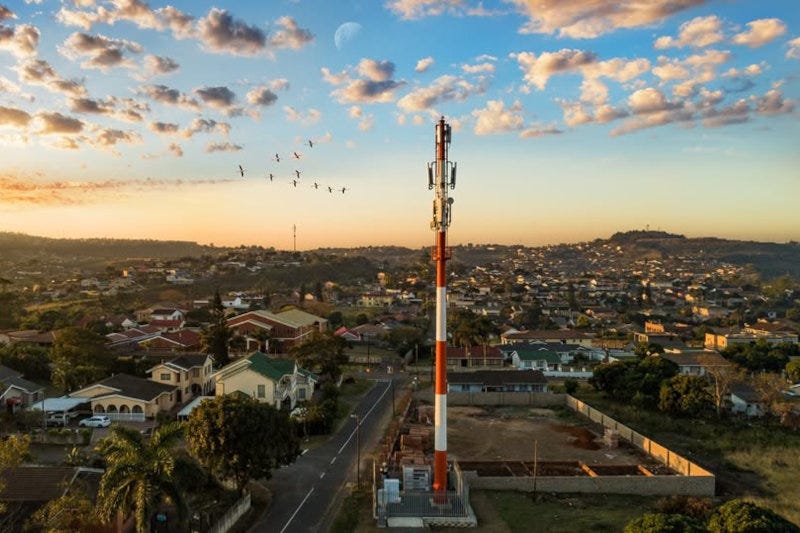
The NCC EVC/CEO, Dr Aminu Maida, in his New Year’s address, revealed that Nigerian telecom operators rolled out 2,800 towers in 2025. The move is part of its continued push to strengthen network coverage and internet penetration nationwide.
The industry also witnessed continued investment in fibre optics, data centres (MTN’s Dabengwa Data Centre in Lagos), and infrastructure to further boost the sector’s future growth potential. In late 2025, the Federal Executive Council (FEC) approved the nationwide deployment of 4,000 new telecom towers, which are aimed at closing the digital divide and supporting economic growth through improved connectivity.
On another positive note, Nigeria is reportedly in talks with Google for a new subsea cable infrastructure. This is an initiative that seeks to increase existing subsea cable links with Europe.
Read More: Nigeria, Google in talks for new subsea cable to strengthen digital backbone.
Nigerian telecoms: What 2026 holds
NCC has continued to reiterate its commitment to deepening the quality of service and strengthening the network experience for Nigerians in 2026. It’s part of the commission’s move to maintain transparency and improvement in the Nigerian telecoms industry.
Dr Aminu Maida noted in the new year’s address that the commission will prioritise Quality of Service (QoS) monitoring, see through an improved voice quality and more consistent data performance in everyday use.
 NCC EVC/CEO, Dr Aminu Maida
In short, the NCC is promising Nigerians a 2026 filled with stronger networks, clearer communications, better customer care and stricter compliance.
The commission’s boss also pledged to deepen collaboration with the Office of the National Security Adviser (ONSA) and the Nigerian Security and Civil Defence Corps (NSCDC) for the protection of telecoms infrastructure nationwide.
From another point of assurance, industry experts, during Technext’s X space, assured a better 2026.
Abioye Tomiwa, Regional Manager at ZTE, said that ISPs and the MNOs are in the process of upgrading infrastructures and changing core devices. However, he pointed out that it takes time because they are done in phases, which need to be planned.
“It is presently ongoing, to the best of my knowledge, it is presently ongoing in most of the ISPs around and most of the MNOs. It is done in phases, and I’m very sure that before the end of the year, Nigerians will be talking about better quality in some locations. I’m just saying, from what I’m seeing, things are getting better already,” he said.

For the Nigerian telecoms sector, the ability to further curtail disruptions to telecom towers and increase investments in infrastructure will shape Nigerian subscribers’ experience going forward.
But for now, they can only hope for a better 2026.
The post Should Nigerians expect improved network and internet performance in 2026? first appeared on Technext.


You May Also Like

Next Crypto to Explode: Altcoin Season Jumps as Pepeto Targets 100x

Solana Price Prediction as Exchange Supply Surges