Colombia Orders Crypto Exchanges to Report User Data in Tax Crackdown — Here’s What’s at Stake
Colombia has taken a decisive step toward tightening oversight of its fast-growing crypto market, ordering exchanges and service providers to collect and report detailed user data as part of a broader tax enforcement push.
The move places Bitcoin, stablecoins, and other digital assets firmly within the country’s national tax framework and shows a shift from partial disclosure to full transactional transparency.
Colombia Sets 2027 Deadline for First Nationwide Crypto Reports
Under Resolution 000240, issued by the Directorate of National Tax and Customs (DIAN) in late December 2025, Colombia has formally adopted the OECD’s Cryptoasset Reporting Framework.
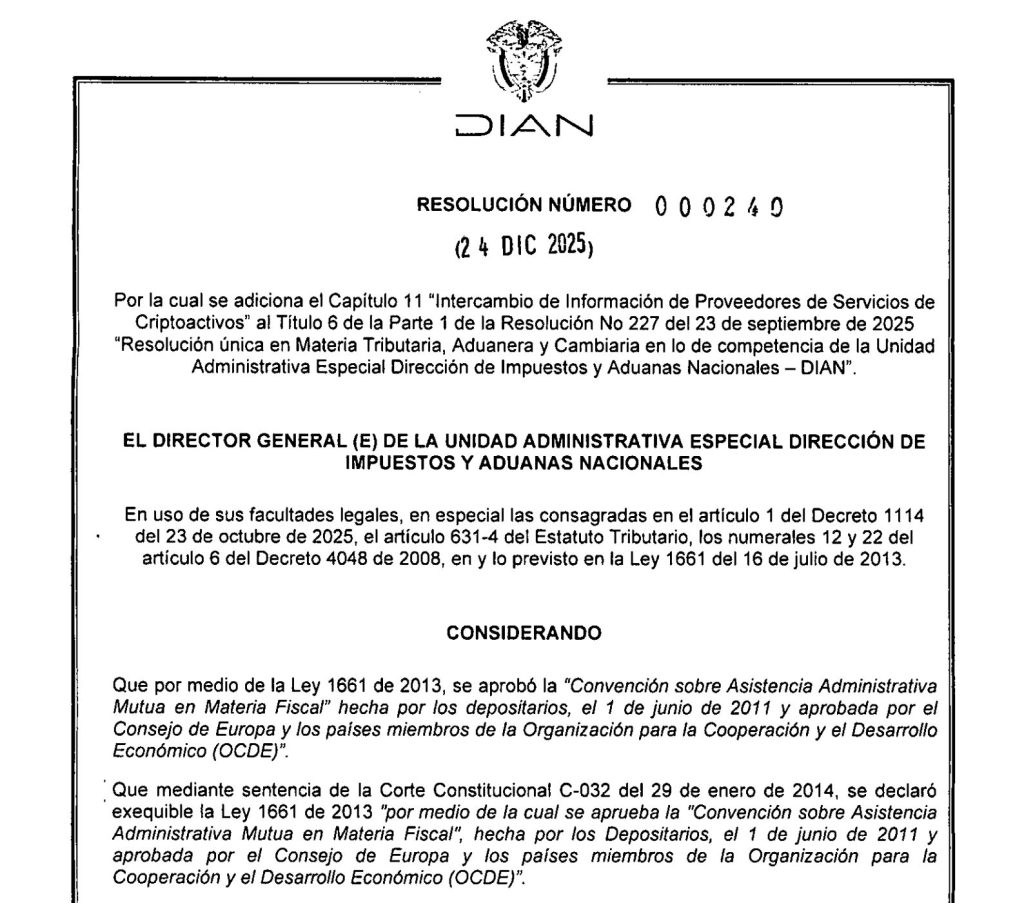 Source: DIAN
The rules require crypto exchanges, intermediaries, and other service providers operating in or serving Colombian residents to carry out enhanced due diligence and automatically share user and transaction data with tax authorities, including for international information exchanges.
Local outlet CriptoNoticias first reported the details of the resolution, saying the regulation applies from the 2026 tax year, with the first large-scale reporting deadline set for May 2027.
Answering that, each platform will be expected to provide detailed reports on all crypto activity performed in 2026.
This involves information on account ownership, transaction volumes, transactions on tokens moved, and the market value of each operation involving bitcoin, ether, and popular stablecoins, like the USDT and USDC.
Even though in 2025 the resolution was already in effect as of December 24, the first complete observation period will be in 2026.
From DIAN’s perspective, every transaction executed by Colombian users during the year will be logged by service providers and prepared for electronic submission.
Authorities have made clear that crypto activity will no longer be treated as opaque or informal within the tax system.
The scope of the reporting obligation is broad, as it covers both domestic and foreign platforms serving Colombian residents, regardless of whether they hold a specific crypto license.
Rising Crypto Adoption Meets Tougher Tax Rules in Colombia
Colombia does not yet have a comprehensive licensing regime for crypto exchanges, and digital assets are still classified as intangible assets rather than legal tender.
However, exchanges operating in the country are already expected to comply with general tax, anti-money laundering, and know-your-customer rules.
One provision likely to draw particular attention from retail users is the monitoring of large payments and transfers. Transactions exceeding $50,000 will trigger automatic alerts to DIAN.
Even below that threshold, platforms must report users’ tax residence information and net balances, excluding commissions, through standardized XML files processed electronically by the tax authority.
Penalties for non-compliance are significant, with companies that fail to report, or submit incomplete or incorrect data, facing fines of up to 1% of the value of the unreported transactions.
Legal experts have warned that the reporting calendar leaves little room for error, effectively making transparency a mandatory cost of doing business in Colombia’s crypto market.
For users, the immediate impact is a loss of practical anonymity.
While individuals were already required to declare crypto holdings as part of their income or wealth tax filings, enforcement previously relied largely on self-reporting.
DIAN will now be able to cross-check exchange data against individual tax declarations, increasing scrutiny of the origin of funds and capital gains.
The crackdown comes as crypto adoption in Colombia reaches new highs. Chainalysis data in October shows that the country recorded $44.2 billion in crypto transaction volume between July 2024 and June 2025, ranking fifth in Latin America.
 Source: Chainalysis
This makes it the region’s second-fastest-growing market by value received. As of late 2025, Colombia is estimated to have about 10.72 million crypto users, representing nearly 19% of the population.


You May Also Like

Top Crypto Presales as T. Rowe Price Files ETF, Pepeto Targets 100x

Shiba Inu Price Prediction Faces Limits as Pepeto Races Toward 100x Potential