White Whale posts a decisive breakout, signaling strong bullish momentum entering 2026. Overbought indicators suggest short-term consolidation may occur before White Whale posts a decisive breakout, signaling strong bullish momentum entering 2026. Overbought indicators suggest short-term consolidation may occur before

White Whale (WHALE) Price Prediction 2026–2030: Can WHALE Hit $0.4200 Soon?

2026/01/12 01:43
6 min read
For feedback or concerns regarding this content, please contact us at [email protected]
  • White Whale posts a decisive breakout, signaling strong bullish momentum entering 2026.
  • Overbought indicators suggest short-term consolidation may occur before the next major expansion.
  • Long-term projections remain bullish, with $0.4200 emerging as a realistic target if support holds.

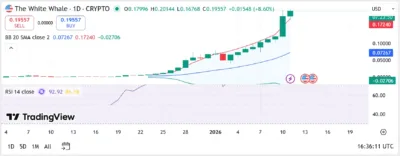
White Whale (WHALE) has entered 2026 with a powerful bullish breakout, surging above key resistance levels and drawing renewed attention from traders. Currently trading near $0.1955, WHALE has recorded a strong daily gain, reflecting aggressive buying pressure and expanding volatility. The breakout has pushed price well above the upper Bollinger Band, while momentum indicators confirm that bulls are firmly in control. Although short-term technical conditions appear stretched, the broader structure suggests that WHALE may be positioning for further upside if critical support zones remain intact.


The rally has reinvigorated interest in speculative altcoins, placing WHALE among the more technically compelling assets at the start of 2026. However, the sustainability of this momentum will depend on how price behaves during expected consolidation phases following such a rapid advance.


Also Read: Polygon Ecosystem Token (MATIC) Price Prediction 2026–2030: Can MATIC Hit $0.3000 Soon?


Market Sentiment and Momentum

Market sentiment surrounding WHALE has turned decisively bullish as buyers continue to dominate daily price action. The size and strength of the breakout candle suggest genuine accumulation rather than a temporary speculative spike. Rising volatility supports the view that WHALE is transitioning from accumulation into a momentum-driven expansion phase.


Despite the optimism, rapid rallies often invite short-term profit-taking. Traders are closely monitoring whether WHALE can maintain higher lows during any pullbacks, which would confirm strength and increase the probability of sustained upside continuation.


Current Market Overview

As of the latest data, WHALE is trading around $0.1955, registering a strong daily advance. Price has decisively moved above the 20-day Simple Moving Average, confirming a clear shift in short-term trend direction from neutral to bullish.


The breakout has also pushed WHALE above the upper Bollinger Band, highlighting strong upside momentum. While this confirms buyer dominance, sustained trading above the upper band typically leads to consolidation. A period of sideways movement above the breakout zone would help reinforce the bullish structure and support a continued advance.


Technical Analysis

From a technical perspective, WHALE remains firmly bullish, though signs of short-term exhaustion are beginning to appear. Price is advancing significantly faster than its underlying moving averages, reflecting a momentum-driven environment. The market’s response during any cooling-off period will be critical in determining whether WHALE can sustain its upward trajectory.


Bollinger Bands

The Bollinger Bands on the daily chart show a sharp expansion, underscoring a volatility-driven breakout. Price is trading well above the upper band, while the 20-day SMA remains far below current levels, illustrating the speed of the recent surge.


This setup confirms strong bullish conviction but also suggests that price is overstretched in the short term. A consolidation near the former resistance zone around $0.1720 to $0.1750 would represent a healthy technical development and help establish a stronger base for further upside.


RSI Behavior

The Relative Strength Index has surged to extreme levels, with readings near 93 placing WHALE deep into overbought territory. This reflects intense buying pressure and strong bullish sentiment, but it also increases the likelihood of a short-term pause or consolidation.


In strong trending markets, RSI can remain elevated for extended periods. A controlled pullback that keeps RSI above the 65–70 range would signal sustained bullish momentum, while a sharper decline below 60 would suggest weakening demand and increase downside risk.


Support and Resistance Levels

Immediate support for WHALE lies in the $0.1720 to $0.1750 region, which aligns with the prior resistance and recent breakout zone. Holding above this level would preserve the bullish market structure. Additional support exists near $0.1500, a psychological level that could attract buyers during deeper pullbacks.


On the upside, immediate resistance is found near the $0.2000 psychological level. A sustained move above this zone could open the door to higher targets at $0.2300 and $0.2800, with $0.4200 emerging as a key medium-term objective if momentum continues to build.

whales

Source: Tradingview

WHALE Price Predictions (2026–2030)

Year Minimum Price Average Price Maximum Price
2026 $0.1500 $0.2100 $0.2800
2027 $0.1900 $0.2600 $0.3400
2028 $0.2300 $0.3200 $0.4200
2029 $0.3000 $0.4000 $0.5200
2030 $0.3800 $0.5200 $0.6800

2026

In 2026, WHALE is expected to experience heightened volatility as traders react to its breakout structure. If price maintains support above the $0.1720 zone, the token could stabilize at higher valuation levels compared to late 2025. Consolidation phases followed by momentum-driven expansions could gradually push WHALE toward the $0.25 to $0.28 range.


2027

By 2027, improving liquidity and broader market participation could support a more structured uptrend. If overall crypto sentiment remains favorable, WHALE may benefit from stronger holder confidence, allowing price to trend toward the $0.34 region with reduced downside volatility.


2028

In 2028, WHALE could benefit from recurring speculative cycles within the altcoin market. Wider trading ranges are likely, but the broader trend may remain bullish. Under favorable conditions, WHALE could reach the $0.4200 level, marking a major milestone in its long-term growth trajectory.


2029

As WHALE matures in 2029, it could establish stronger price stability above $0.30, with pullbacks increasingly viewed as accumulation opportunities. Sustained trading interest and liquidity growth could support advances toward the $0.50 region during bullish market phases.


2030

By 2030, WHALE’s long-term outlook will depend largely on continued crypto adoption and market cycles. With favorable conditions, the token could enter a new growth phase and potentially trade above $0.60, supported by strong participation and deeper liquidity.


Conclusion

White Whale enters 2026 in a strong technical position following a decisive breakout above key resistance levels. While overbought conditions suggest the possibility of short-term consolidation, the broader trend remains bullish as long as WHALE holds above its breakout support zone.


If the token can continue building on its current momentum and successfully navigate consolidation phases, a move toward $0.4200 could become achievable within the next few years.


FAQs

1. What is the current market sentiment for WHALE in 2026?
Market sentiment is strongly bullish, supported by a clear breakout and aggressive buying pressure.


2. Is WHALE currently overbought?
Yes, RSI readings near 93 indicate that WHALE is in overbought territory, which is common during strong breakout phases.


3. Can WHALE hit $0.4200 soon?
If WHALE maintains support above $0.1720 and momentum continues, $0.4200 becomes a realistic target by 2028.


4. What are the key levels to watch?
Key support lies at $0.1720 and $0.1500, while resistance is located near $0.2000 and $0.2800.


5. What is the long-term outlook for WHALE?
With favorable market conditions, WHALE could continue appreciating through 2030, potentially trading well above $0.50.


Also Read: Pi Network Price Prediction 2026–2030: Can PI Hit $0.30 Soon?


The post White Whale (WHALE) Price Prediction 2026–2030: Can WHALE Hit $0.4200 Soon? appeared first on 36Crypto.


Market Opportunity
Whiterock Logo
Whiterock Price(WHITE)
$0.00008011
$0.00008011$0.00008011
-0.21%
USD
Whiterock (WHITE) Live Price Chart
Disclaimer: The articles reposted on this site are sourced from public platforms and are provided for informational purposes only. They do not necessarily reflect the views of MEXC. All rights remain with the original authors. If you believe any content infringes on third-party rights, please contact [email protected] for removal. MEXC makes no guarantees regarding the accuracy, completeness, or timeliness of the content and is not responsible for any actions taken based on the information provided. The content does not constitute financial, legal, or other professional advice, nor should it be considered a recommendation or endorsement by MEXC.

You May Also Like

Tether Backs Ark Labs’ $5.2 Million Bet on Bitcoin’s Stablecoin Revival

Tether Backs Ark Labs’ $5.2 Million Bet on Bitcoin’s Stablecoin Revival

The post Tether Backs Ark Labs’ $5.2 Million Bet on Bitcoin’s Stablecoin Revival appeared on BitcoinEthereumNews.com. In brief Ark Labs secured backing from Tether
Share
BitcoinEthereumNews2026/03/12 21:44
MySQL Single Leader Replication with Node.js and Docker

MySQL Single Leader Replication with Node.js and Docker

Modern applications demand high availability and the ability to scale reads without compromising performance. One of the most common strategies to achieve this is Replication. In this setup, we configured a single database to act as the leader (master) and handle all write operations, while three replicas handle read operations. In this article, we’ll walk through how to set up MySQL single-leader replication on your local machine using Docker. Once the replication is working, we’ll connect it to a Node.js application using Sequelize ORM, so that reads are routed to the replica and writes go to the master. By the end, you’ll have a working environment where you can see replication in real time Prerequisites knowledge of database replication Background knowledge of docker and docker compose Background knowledge of Nodejs and how to run a NodeJS server An Overview of what we are building Setup Setup our database servers on docker compose in the root of our project directory, create a file named docker-compose.yml with the following content to setup our mysql primary and replica databases. \ \ name: "learn-replica" volumes: mysqlMasterDatabase: mysqlSlaveDatabase: mysqlSlaveDatabaseII: mysqlSlaveDatabaseIII: networks: mysql-replication-network: services: mysql-master: image: mysql:latest container_name: mysql-master command: --server-id=1 --log-bin=ON environment: MYSQL_ROOT_PASSWORD: master MYSQL_DATABASE: replicaDb ports: - "3306:3306" volumes: - mysqlMasterDatabase:/var/lib/mysql networks: - mysql-replication-network mysql-slave: image: mysql:latest container_name: mysql-slave command: --server-id=2 --log-bin=ON environment: MYSQL_ROOT_PASSWORD: slave MYSQL_DATABASE: replicaDb MYSQL_ROOT_HOST: "%" ports: - "3307:3306" volumes: - mysqlSlaveDatabase:/var/lib/mysql depends_on: - mysql-master networks: - mysql-replication-network mysql-slaveII: image: mysql:latest container_name: mysql-slaveII command: --server-id=2 --log-bin=ON environment: MYSQL_ROOT_PASSWORD: slave MYSQL_DATABASE: replicaDb MYSQL_ROOT_HOST: "%" ports: - "3308:3306" volumes: - mysqlSlaveDatabaseII:/var/lib/mysql depends_on: - mysql-master networks: - mysql-replication-network mysql-slaveIII: image: mysql:latest container_name: mysql-slaveIII command: --server-id=3 --log-bin=ON environment: MYSQL_ROOT_PASSWORD: slave MYSQL_DATABASE: replicaDb MYSQL_ROOT_HOST: "%" ports: - "3309:3306" volumes: - mysqlSlaveDatabaseIII:/var/lib/mysql depends_on: - mysql-master networks: - mysql-replication-network In this setup, I’m creating a master database container called mysql-master and 3 replica containers called mysql-slave, mysql-slaveII and mysql-slaveIII. I won’t go too deep into the docker-compose.yml file since it’s just a basic setup, but I do want to walk you through the command line instructions used in all four services because that’s where things get interesting.
command: --server-id=1 --log-bin=ON The --server-id option gives each MySQL server in your replication setup its own name tag. Each one has to be unique and without it, replication won’t work at all. Another cool option not included here is binlog_format=ROW. This tells MySQL how to keep track of changes before passing them along to the replicas. By default, MySQL already uses row-based replication, but you can explicitly set it to ROW to be sure or switch it to STATEMENT if you’d rather log the actual SQL statements instead of row-by-row changes. \ Run our containers on docker Now, in the terminal, we can run the following command to spin up our database containers: docker-compose up -d \ Setting Up Our Master (Primary) Server To configure our master server, we would have to first access the running instance on docker using the following command docker exec -it mysql-master bash This command opens an interactive Bash shell inside the running Docker container named mysql-master, allowing us to run commands directly inside that container. \ Now that we’re inside the container, we can access the MySQL server and start running commands. type: mysql -uroot -p This will log you into MySQL as the root user. You’ll be prompted to enter the password you set in your docker-compose.yml file. \ Next, we need to create a special user that our replicas will use to connect to the master server and pull data. Inside the MySQL prompt, run the following commands: \ CREATE USER 'repl_user'@'%' IDENTIFIED BY 'replication_pass'; GRANT REPLICATION SLAVE ON . TO 'repl_user'@'%'; FLUSH PRIVILEGES; Here’s what’s happening: CREATE USER makes a new MySQL user called repl_user with the password replication_pass. GRANT REPLICATION SLAVE gives this user permission to act as a replication client. FLUSH PRIVILEGES tells MySQL to reload the user permissions so they take effect immediately. \ Time to Configure the Replica (Secondary) Servers a. First, let’s access the replica containers the same way we did with the master. Run this command in your terminal for each of the replica containers: \ docker exec -it <replica_container_name> bash mysql -uroot -p <replica_container_name> should be replace with the name of the replica container you are trying to setup b. Now it’s time to tell our replica where to get its data from. While inside the replica’s MySQL shell, run the following command to configure replication using the master’s details: CHANGE REPLICATION SOURCE TO SOURCE_HOST='mysql-master', SOURCE_USER='repl_user', SOURCE_PASSWORD='replication_pass', GET_SOURCE_PUBLIC_KEY=1; With the replication settings in place, let’s fire up the replica and get it syncing with the master. Still inside the MySQL shell on the replica, run: START REPLICA; This starts the replication process. To make sure everything is working, check the replica’s status with:
SHOW REPLICA STATUS\G; Look for Replica_IO_Running and Replica_SQL_Running — if both say Yes, congratulations! 🎉 Your replica is now successfully connected to the master and replicating data in real time.
Testing Our Replication Setup from the Node.js App Now that our replication is successfully set up, we can configure our Node.js server to observe the real-time effect of data being replicated from the master server to the replica server whenever we write to it. We start by installing the following dependencies:
npm i express mysql2 sequelize \ Now create a folder called src in the root directory and add the following files inside that folder connection.js, index.js and model.js. Our current directory should look like this We can now set up our connections to our master and replica server in the connection.js file as shown below
const Sequelize = require("sequelize"); const sequelize = new Sequelize({ dialect: "mysql", replication: { write: { host: "127.0.0.1", username: "root", password: "master", database: "replicaDb", }, read: [ { host: "127.0.0.1", username: "root", password: "slave", database: "replicaDb", port: 3307 }, { host: "127.0.0.1", username: "root", password: "slave", database: "replicaDb", port: 3308 }, { host: "127.0.0.1", username: "root", password: "slave", database: "replicaDb", port: 3309 }, ], }, }); async function connectdb() { try { await sequelize.authenticate(); } catch (error) { console.error("❌ unable to connect to the follower database", error); } } connectdb(); module.exports = { sequelize, }; \ We can now create a User table in the model.js file
const {DataTypes} = require("sequelize"); const { sequelize } = require("./connection"); const User = sequelize.define("User", { name: { type: DataTypes.STRING, allowNull: false, }, email: { type: DataTypes.STRING, unique: true, allowNull: false, }, }); module.exports = User \ and finally in our index.js file we can start our server and listen for connections on port 3000. from the code sample below, all inserts or updates will be routed by sequelize to the master server. while all read queries will be routed to the read replicas.
const express = require("express"); const { sequelize } = require("./connection"); const User = require("./model"); const app = express(); app.use(express.json()); async function main() { await sequelize.sync({ alter: true }); app.get("/", (req, res) => { res.status(200).json({ message: "first step to setting server up", }); }); app.post("/user", async (req, res) => { const { email, name } = req.body; let newUser = await User.build({ name, email, }); // This INSERT will go to the write (master) connection newUser = newUser.save({ returning: false }); res.status(201).json({ message: "User successfully created", }); }); app.get("/user", async (req, res) => { // This SELECT query will go to one of the read replicas const users = await User.findAll(); res.status(200).json(users); }); app.listen(3000, () => { console.log("server has connected"); }); } main(); When you make a POST request to the /users endpoint, take a moment to check both the master and replica servers to observe how data is replicated in real time. Right now, we are relying on Sequelize to automatically route requests, which works for development but isn’t robust enough for a production environment. In particular, if the master node goes down, Sequelize cannot automatically redirect requests to a newly elected leader. In the next part of this series, we’ll explore strategies to handle these challenges
Share
Hackernoon2025/09/18 14:44
Nvidia shares fall 3%

Nvidia shares fall 3%

The post Nvidia shares fall 3% appeared on BitcoinEthereumNews.com. Home » AI » Nvidia shares fall 3% Chipmaker extends decline as investors continue to take profits from recent highs. Photo: Budrul Chukrut/SOPA Images/LightRocket via Getty Images Key Takeaways Nvidia’s stock decreased by 3% today. The decline extends Nvidia’s recent losing streak. Nvidia shares fell 3% today, extending the chipmaker’s recent decline. The stock dropped further during trading as the artificial intelligence chip leader continued its pullback from recent highs. Disclaimer Source: https://cryptobriefing.com/nvidia-shares-fall-2-8/
Share
BitcoinEthereumNews2025/09/18 03:13





