US President Donald Trump Pledges to Make Tech Giants Cover Power Costs Amid Rising Electricity Bills In a bold move, former US President Donald Trump has announcedUS President Donald Trump Pledges to Make Tech Giants Cover Power Costs Amid Rising Electricity Bills In a bold move, former US President Donald Trump has announced

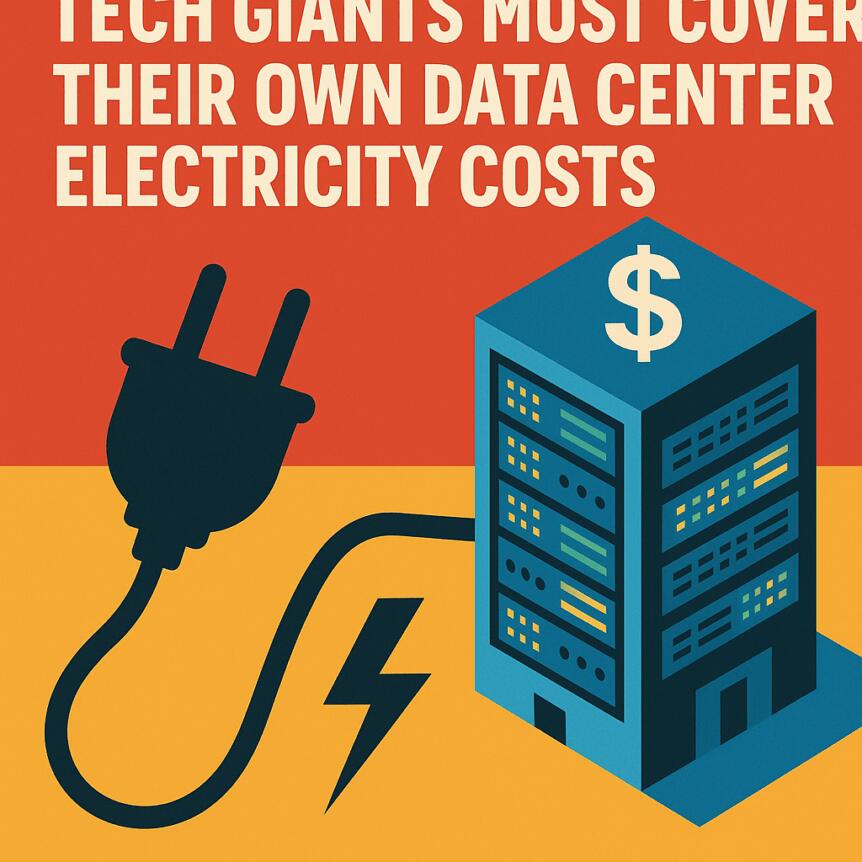
Tech Giants Must Cover Their Own Data Center Electricity Costs
For feedback or concerns regarding this content, please contact us at [email protected]
Tech Giants Must Cover Their Own Data Center Electricity Costs

US President Donald Trump Pledges to Make Tech Giants Cover Power Costs Amid Rising Electricity Bills

In a bold move, former US President Donald Trump has announced plans to hold major technology companies accountable for their significant energy consumption, promising that they will bear the financial burden for their data center operations. The initiative aims to prevent American consumers from facing higher electricity bills due to the surging energy demands of the tech sector.

Trump emphasized that the rising household electricity costs—up approximately 40% over the past five years—are a concern rooted in policy decisions he attributes to Democratic leadership. Speaking on his social media platform Truth Social, he stated, “I never want Americans to pay higher electricity bills because of data centers.” He highlighted collaborations with companies like Microsoft, suggesting that these firms would implement changes starting this week to ensure their operations do not unfairly impact consumers.

The Growing Power Demand of Data Centers

The surge in data center infrastructure is significantly impacting US electricity demand. According to Visual Capitalist, data centers accounted for 5.2% of the nation’s total power consumption in 2025, representing 224 terawatt-hours (TWh), a 21% increase from the previous year. Projections from McKinsey & Company indicate that by 2030, power used by these facilities could approach 600 TWh, or 11.7% of US electricity consumption.

Cooling systems contribute roughly 30–40% of a data center’s energy use, while servers and IT equipment account for 40–60%. The International Energy Agency reports that electricity demand from AI-focused data centers is growing approximately 30% annually, outpacing traditional server workloads, which grow at about 9% per year.

Bitcoin Mining and Its Power Consumption

Bitcoin mining remains a highly energy-intensive activity, relying on expansive data centers to perform complex calculations. However, recent analyses challenge the narrative that it exacerbates consumer electricity bills. ESG expert Daniel Batten compared the increase in US utility costs from 2021 to 2024 with the regions hosting concentrated Bitcoin mining operations, notably Texas. His findings suggest a correlation but not causation, arguing that Bitcoin mining does not significantly impact household energy costs.

Batten cites environmental benefits linked to Bitcoin mining, including facilitating greater integration of renewable energy on grids, funding advancements in green technology, and reducing methane emissions. These claims underscore a nuanced perspective on the environmental footprint of cryptocurrency mining, which remains a hotly debated topic in the industry.

While critics argue against the environmental sustainability of mining operations, proponents highlight their potential to support renewable energy initiatives and reduce harmful emissions, positioning Bitcoin as a contributor to a greener energy future.

This article was originally published as Tech Giants Must Cover Their Own Data Center Electricity Costs on Crypto Breaking News – your trusted source for crypto news, Bitcoin news, and blockchain updates.


Market Opportunity
Talus Logo
Talus Price(US)
$0.00273
$0.00273$0.00273
-2.84%
USD
Talus (US) Live Price Chart
Disclaimer: The articles reposted on this site are sourced from public platforms and are provided for informational purposes only. They do not necessarily reflect the views of MEXC. All rights remain with the original authors. If you believe any content infringes on third-party rights, please contact [email protected] for removal. MEXC makes no guarantees regarding the accuracy, completeness, or timeliness of the content and is not responsible for any actions taken based on the information provided. The content does not constitute financial, legal, or other professional advice, nor should it be considered a recommendation or endorsement by MEXC.

You May Also Like

Is Hyperliquid the new frontier for innovation?

Is Hyperliquid the new frontier for innovation?

The post Is Hyperliquid the new frontier for innovation? appeared on BitcoinEthereumNews.com. This is a segment from the 0xResearch newsletter. To read full editions, subscribe. One of the key things I like to track in crypto is a subjective criterion I call “where are new interesting developments and proposals taking place.” There are plenty of dashboards and analytics sites for this, the most popular being the Electric Capital site. The issue is that it still shows Polkadot as having a lot of developers. (At Blockworks we solved the noise problem with active users; maybe we can try the same for active developers.) Because of this noise, I prefer to track two simple observations: What is the velocity of new products launching, and how much mindshare are these products capturing? Are many people getting nerdsniped into discussing the novelties and intricacies of the chain? A related point is the caliber of people being attracted to new ecosystems. For example, over the past few years, Solana (and Ethereum) attracted the majority of talent. Talent generally goes where: It can solve interesting problems or create interesting projects. It can make a lot of money. In a podcast I did with Icebergy about a year ago, we discussed how crypto still wasn’t attracting talent at the levels AI was, despite offering faster exits and more money. AI was (and probably still is) more interesting to most talent and seen as more prestigious. After FTX, crypto lost a lot of credibility and has only recently started recovering as larger institutional players re-entered. Apart from FTX, crypto has also been criticized for being full of low-effort forks and limited utility products. This dynamic isn’t unique to crypto though. Many AI companies are also just building wrappers around GPT, which is as uninteresting as some projects in crypto. Anyway, to the point: Historically, Solana has captured the majority of…
Share
BitcoinEthereumNews2025/09/18 08:13
Why More Startups Are Automating Their HR Processes in 2025

Why More Startups Are Automating Their HR Processes in 2025

  Startups in 2025 are moving faster than ever. With lean teams, remote workforces, and aggressive growth goals, manual HR management no longer fits the modern
Share
Techbullion2026/03/08 15:29
Shiba Inu Records -131 Billion in 24 Hours: Negative Netflow Signals Growing Demand

Shiba Inu Records -131 Billion in 24 Hours: Negative Netflow Signals Growing Demand

The post Shiba Inu Records -131 Billion in 24 Hours: Negative Netflow Signals Growing Demand appeared on BitcoinEthereumNews.com. SHIB exchange flow is hinting
Share
BitcoinEthereumNews2026/03/08 15:30