Happiness is usually treated as a vague, ethereal concept that "just happens" If life is a system, then Happiness is the output. To fix it, I realized I needed Happiness is usually treated as a vague, ethereal concept that "just happens" If life is a system, then Happiness is the output. To fix it, I realized I needed

Happiness = Variables - Frictions: The Source Code

\

The Engineer’s Dilemma

Engineers, architects, and developers share a common flaw: we hate ambiguity. We build systems based on logic, predictable inputs, and measurable outputs. Yet, the most important metric of our existence—Happiness—is usually treated as a vague, ethereal concept that "just happens."

I don't like things that "just happen." I like things I can track, optimize, and debug.

If life is a system, then Happiness is the output. If the output is inconsistent, the code is buggy. To fix it, I realized I needed to stop treating happiness like magic and start treating it like math.

I developed a simple mental model called the Happiness Formula, and then I wrote a script to run it.

The Algorithm: H = ΣV - ΣF

The core philosophy is binary. There are things that charge your battery, and things that drain it.

  • H (Happiness): The net score of your current existence.
  • V (Variables): The drivers. These are consistent sources of joy (Family, coding, painting, coffee).
  • F (Frictions): The bugs. These are consistent sources of pain or resistance (Debt, anxiety, a bad commute, toxic relationships).

The formula is simple:

\ $$H = (V1 + V2 + V3…) - (F1 + F2 + F3…)$$

You rate every item on a scale of 0 to 100 based on intensity.

If you have a Variable like "Deep Work" that gives you immense satisfaction, it might be a 90. If you have a Friction like "Chronic Back Pain," that might be a -80.

Visualizing the Logic

The goal isn't just to "be happy." The goal is to maximize H.

\
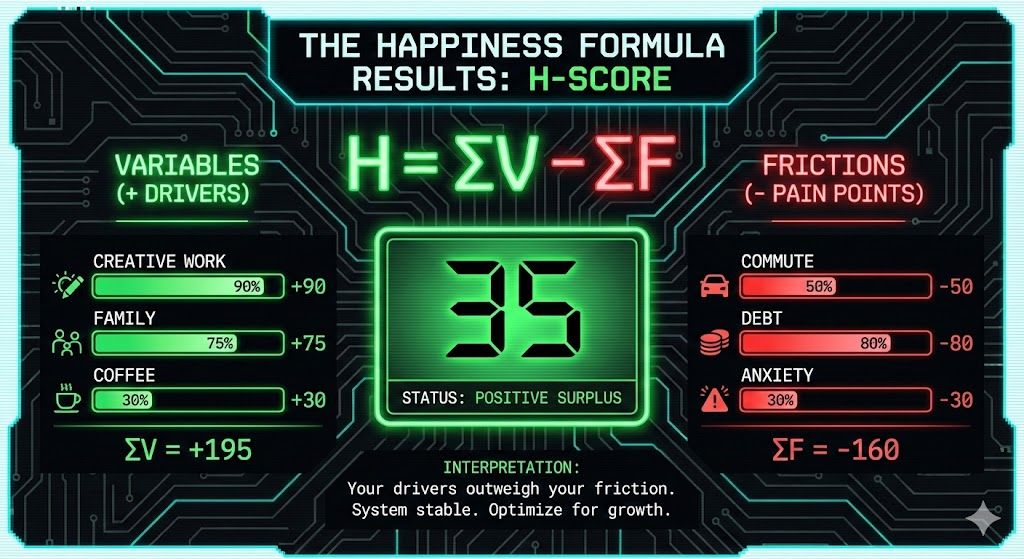
\ When you visualize it this way, "getting happier" stops being an abstract wish and becomes an engineering ticket. You either need to push a feature update (add a new Variable) or patch a bug (remove a Friction).

The Build: A JavaScript H-Calculator

I didn't just want a theory; I wanted a tool. I whipped up a high-contrast, dark-mode calculator that allows me to input these values dynamically.

You can host this on GitHub Pages for free. The logic is lightweight. Here is the core function that drives the score:

function calculateHappiness() { // 1. Sum up the Variables (The Good) let vSum = 0; document.querySelectorAll('.v-score').forEach(input => { let val = parseFloat(input.value); if (!isNaN(val)) vSum += val; }); // 2. Sum up the Frictions (The Bad) let fSum = 0; document.querySelectorAll('.f-score').forEach(input => { let val = parseFloat(input.value); if (!isNaN(val)) fSum += val; }); // 3. The Formula let h = vSum - fSum; // 4. Render the Reality Check const resultArea = document.getElementById('result-area'); if (h > 0) { // Green: System is stable resultArea.style.borderColor = '#00ff00'; msg = "POSITIVE H. Your drivers outweigh your friction."; } else { // Red: System critical resultArea.style.borderColor = '#ff0000'; msg = "NEGATIVE H. Focus on minimizing your top frictions."; } }

Interpreting Your Data (My Score: 35)

I ran my own life through the calculator. I listed my drivers (creative work, family) and subtracted my frictions.

My H-Score came out to 35.

This is a positive integer, which means my system is stable. However, it’s not 100. This tells me that while my variables are strong, my frictions are likely creating too much drag.

If your score is Negative: You are in technical debt. No amount of "positive thinking" (adding small Variables) will fix a massive Friction score. You need to refactor. If your job causes you 90 points of friction, and your weekend hobby only brings 20 points of joy, the math will never work in your favor. You have to remove the friction.

If your score is Positive: You have a surplus. You can now afford to take risks, invest in new skills, or optimize your Variables to push that number higher.

Conclusion

We spend all day optimizing code, refactoring architectures, and cleaning up databases. Why do we accept spaghetti code in our personal lives?

Fork the repo. Run the numbers. Debug your life.

[https://github.com/damianwgriggs/The-Happiness-Formula]()

\ My Favorite Part: The Art

I made the header image today whilst thinking about this article and my formula. I wanted to have the canvas be yellow to represent happiness. The other colors, black, blue, (and some others I am unsure about) were selected to form a piece that conveys the messiness of happiness. Sometimes there are black spots, sometimes we are blue, but what matters most is that we are yellow (not cowardly lol) more than the splotches that can appear in our life. Below is the original image without the crop:

\ \ I would also encourage you to upload to socials and share your results. You can tag me @damianwgriggs!


Market Opportunity
Cyberlife Logo
Cyberlife Price(LIFE)
$0.0309
$0.0309$0.0309
+0.32%
USD
Cyberlife (LIFE) Live Price Chart
Disclaimer: The articles reposted on this site are sourced from public platforms and are provided for informational purposes only. They do not necessarily reflect the views of MEXC. All rights remain with the original authors. If you believe any content infringes on third-party rights, please contact [email protected] for removal. MEXC makes no guarantees regarding the accuracy, completeness, or timeliness of the content and is not responsible for any actions taken based on the information provided. The content does not constitute financial, legal, or other professional advice, nor should it be considered a recommendation or endorsement by MEXC.

You May Also Like

The Channel Factories We’ve Been Waiting For

The Channel Factories We’ve Been Waiting For

The post The Channel Factories We’ve Been Waiting For appeared on BitcoinEthereumNews.com. Visions of future technology are often prescient about the broad strokes while flubbing the details. The tablets in “2001: A Space Odyssey” do indeed look like iPads, but you never see the astronauts paying for subscriptions or wasting hours on Candy Crush.  Channel factories are one vision that arose early in the history of the Lightning Network to address some challenges that Lightning has faced from the beginning. Despite having grown to become Bitcoin’s most successful layer-2 scaling solution, with instant and low-fee payments, Lightning’s scale is limited by its reliance on payment channels. Although Lightning shifts most transactions off-chain, each payment channel still requires an on-chain transaction to open and (usually) another to close. As adoption grows, pressure on the blockchain grows with it. The need for a more scalable approach to managing channels is clear. Channel factories were supposed to meet this need, but where are they? In 2025, subnetworks are emerging that revive the impetus of channel factories with some new details that vastly increase their potential. They are natively interoperable with Lightning and achieve greater scale by allowing a group of participants to open a shared multisig UTXO and create multiple bilateral channels, which reduces the number of on-chain transactions and improves capital efficiency. Achieving greater scale by reducing complexity, Ark and Spark perform the same function as traditional channel factories with new designs and additional capabilities based on shared UTXOs.  Channel Factories 101 Channel factories have been around since the inception of Lightning. A factory is a multiparty contract where multiple users (not just two, as in a Dryja-Poon channel) cooperatively lock funds in a single multisig UTXO. They can open, close and update channels off-chain without updating the blockchain for each operation. Only when participants leave or the factory dissolves is an on-chain transaction…
Share
BitcoinEthereumNews2025/09/18 00:09
Trading time: Tonight, the US GDP and the upcoming non-farm data will become the market focus. Institutions are bullish on BTC to $120,000 in the second quarter.

Trading time: Tonight, the US GDP and the upcoming non-farm data will become the market focus. Institutions are bullish on BTC to $120,000 in the second quarter.

Daily market key data review and trend analysis, produced by PANews.
Share
PANews2025/04/30 13:50
CEO Sandeep Nailwal Shared Highlights About RWA on Polygon

CEO Sandeep Nailwal Shared Highlights About RWA on Polygon

The post CEO Sandeep Nailwal Shared Highlights About RWA on Polygon appeared on BitcoinEthereumNews.com. Polygon CEO Sandeep Nailwal highlighted Polygon’s lead in global bonds, Spiko US T-Bill, and Spiko Euro T-Bill. Polygon published an X post to share that its roadmap to GigaGas was still scaling. Sentiments around POL price were last seen to be bearish. Polygon CEO Sandeep Nailwal shared key pointers from the Dune and RWA.xyz report. These pertain to highlights about RWA on Polygon. Simultaneously, Polygon underlined its roadmap towards GigaGas. Sentiments around POL price were last seen fumbling under bearish emotions. Polygon CEO Sandeep Nailwal on Polygon RWA CEO Sandeep Nailwal highlighted three key points from the Dune and RWA.xyz report. The Chief Executive of Polygon maintained that Polygon PoS was hosting RWA TVL worth $1.13 billion across 269 assets plus 2,900 holders. Nailwal confirmed from the report that RWA was happening on Polygon. The Dune and https://t.co/W6WSFlHoQF report on RWA is out and it shows that RWA is happening on Polygon. Here are a few highlights: – Leading in Global Bonds: Polygon holds 62% share of tokenized global bonds (driven by Spiko’s euro MMF and Cashlink euro issues) – Spiko U.S.… — Sandeep | CEO, Polygon Foundation (※,※) (@sandeepnailwal) September 17, 2025 The X post published by Polygon CEO Sandeep Nailwal underlined that the ecosystem was leading in global bonds by holding a 62% share of tokenized global bonds. He further highlighted that Polygon was leading with Spiko US T-Bill at approximately 29% share of TVL along with Ethereum, adding that the ecosystem had more than 50% share in the number of holders. Finally, Sandeep highlighted from the report that there was a strong adoption for Spiko Euro T-Bill with 38% share of TVL. He added that 68% of returns were on Polygon across all the chains. Polygon Roadmap to GigaGas In a different update from Polygon, the community…
Share
BitcoinEthereumNews2025/09/18 01:10