

Solana Policy Institute Demands SEC Exemption for DeFi Developers — Here’s Why
The Solana Policy Institute has asked the US Securities and Exchange Commission to provide an explicit exemption for developers of decentralized finance.
His argument was that the release of open-source and non-custodial software should not require engineers to assume the same regulatory risks as centralized crypto exchanges or other market intermediaries.
The appeal comes as regulatory pressure, enforcement actions, and legal uncertainty continue to weigh on DeFi development in the United States, even as policymakers show a shift away from aggressive enforcement toward clearer rules.
SEC Framework Built for Centralized Markets Falls Short for DeFi
In a letter submitted Friday through the SEC’s website, the nonprofit responded to a December 17, 2025, request for public input from Commissioner Hester Peirce on how crypto assets are traded on national securities exchanges and alternative trading systems.
The Institute focused on how the SEC can protect the ability of individuals to write and deploy software and transact directly through autonomous systems without creating unnecessary regulatory barriers.
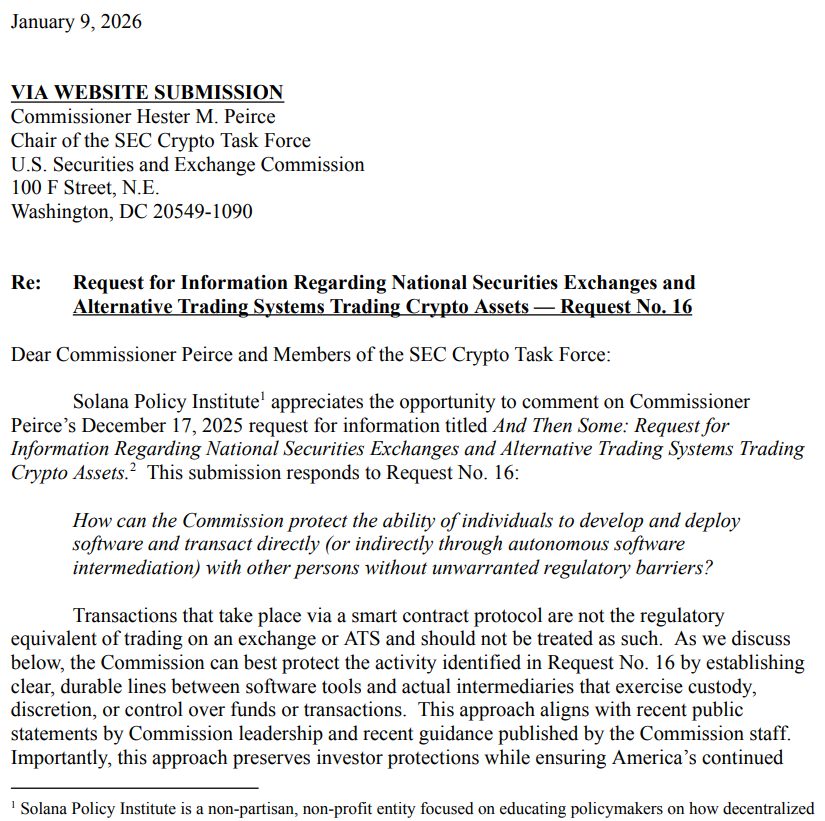
It argued that the agency’s existing framework, built around centralized intermediaries, does not fit how smart-contract-based systems actually work.
In DeFi systems, users retain custody of their assets, approve their own transactions, and interact directly with public blockchains. The software does not hold funds, exercise discretion, or act on behalf of users.
Because those trust-based risks are absent, the Institute said, applying broker, dealer, exchange, or clearing agency rules to non-custodial software would be misplaced and counterproductive.
Requiring such software to register as an ATS would be impractical and, in many cases, impossible. In practice, the Institute said, it would force decentralized protocols either to shut down or to reintroduce centralized control, undermining the very investor protections regulators seek to preserve.
Crypto Developers Call for Protection as Enforcement Pressure Grows
This push for clarity comes against a backdrop of mounting legal risks for developers. In recent years, several high-profile cases have targeted individuals who wrote or maintained open-source software, including prosecutions tied to crypto mixer projects.
Developers have also faced enforcement actions from the SEC and the Commodity Futures Trading Commission over registration and compliance failures, even when protocols were designed to operate autonomously.
Industry participants say the lack of clear exemptions leaves developers choosing between innovation and personal legal exposure.
The Institute’s position aligns with recent public remarks from SEC leadership.
Chairman Paul Atkins has repeatedly criticized the agency’s past reliance on regulation by enforcement and has argued that engineers should not be subject to securities laws simply for publishing code.
Commissioner Peirce has similarly stated that regulators should not impose obligations on developers who do not custody assets or override user decisions.
As a practical path forward, the Solana Policy Institute recommended a technology-neutral approach based on custody and control.
Under this framework, true intermediaries would be regulated because they hold customer funds or control execution, while developers of non-custodial, non-discretionary software would remain outside registration requirements.
The Institute called on the SEC to issue interpretive guidance confirming that publishing and maintaining such software does not amount to operating an exchange or effecting transactions for others, and to narrow Exchange Act Rule 3b-16 so it clearly excludes passive tools and interfaces.
The letter lands as Congress and regulators debate broader reforms.
Senators Cynthia Lummis and Ron Wyden recently introduced legislation aimed at shielding blockchain developers who do not handle user funds from money-transmitter rules.
Meanwhile, the long-running crypto market structure bill, often referred to as the CLARITY Act, includes similar protections.
Atkins has also said a formal “innovation exemption” could be finalized soon, offering temporary regulatory relief for qualifying projects.


You May Also Like

Up To $10,000 Per Person Heading to Victims of Massive Cybersecurity Attack on Tech Firm

Aave CEO Reveals Upcoming Protocol Upgrades Set for Q4 2025 Launch




