Roman Storm, co-founder of the sanctioned Tornado Cash cryptocurrency mixer, has accused federal prosecutors of fundamentally mishandling key evidence ahead of his July 14 criminal trial in Manhattan. The dispute centers on a Telegram message reading “Heya, anyone around to chat about axie? Would like to ask a few general questions about how one goes about cashing out 600 mil,” which referenced the $600 million Axie Infinity exploit. According to court filings dated July 12, 2025 , prosecutors initially claimed the message was authored by Storm’s co-developer Alexey Pertsev. Source: Court Listener Defense attorneys revealed the message was actually written by Andrew Thurman, a former CoinDesk senior tech reporter, then forwarded to a Tornado Cash chat by Pertsev. The revelation emerged just days before Storm’s trial on charges of conspiracy to commit money laundering and sanctions violations related to Tornado Cash, which allegedly facilitated over $1 billion in illicit transactions. Government’s Evidence Chain Under Tight Scrutiny The controversy stems from Dutch authorities’ extraction of what prosecutors claim is Pertsev’s phone following his arrest in the Netherlands, where he was sentenced to 64 months in prison for money laundering through Tornado Cash. ⚖️ DOJ pursues federal charges against Roman Storm, cofounder of Tornado Cash, after dropping unlicensed money transmission charge. #TornadoCash #RomanStorm https://t.co/ZGXe7IGREZ — Cryptonews.com (@cryptonews) May 16, 2025 Storm’s defense argues that the government’s extraction contains multiple fatal flaws, including missing author information for forwarded Telegram messages and incomplete file retrieval by FBI Agent Dickerman from Dutch authorities. The defense contends that prosecutors cannot authenticate the extraction’s completeness because they were limited in what files they could obtain from Dutch law enforcement. This authentication challenge becomes more significant given that the government admitted in court filings that its original September 2023 production of extracted text messages to the defense did not include “forwarded” tags on forwarded messages. Prosecutors provided a corrected version in December 2024, which they plan to use at trial, but defense attorneys argue this timeline raises serious questions about the government’s handling of evidence. The misattribution carried real consequences in court proceedings when Assistant U.S. Attorney Ben Arad referenced the message during a July 8 pretrial hearing, telling the judge it demonstrated the co-founders’ awareness of wrongdoing. According to the hearing transcript, Arad told the court: “For example, when the Ronin hack happened, one of the co-conspirators asked, sum and substance, I’d like to ask you some questions about how you go about laundering $600 million worth of stolen crypto.” The defense characterized this as providing “false information” to both the court and potentially the grand jury that issued the indictment. Defense attorneys wrote in their filing: “Given that the government mistakenly attributed the reporter’s Telegram message to Pertsev at the Pretrial Conference, it appears that the government itself was unaware of this issue until the defense raised it.” Enforcement Challenges Echo Across Crypto Cases The evidence dispute highlights a pattern of prosecutorial challenges emerging across high-profile cryptocurrency cases, particularly when international evidence gathering intersects with complex digital communications. Just last month, the DOJ faced similar authentication issues in the case of Russian crypto CEO Iurii Gugnin, who was charged with orchestrating a $530 million fraud scheme through his Miami-based platform Evita. 🇷🇺 A Russian crypto firm CEO used his crypto company, Evita, to funnel $530 million of overseas payments via US banks and crypto platforms. #Evita #CryptoFraud #IuriiGugnin https://t.co/hk5kgucF95 — Cryptonews.com (@cryptonews) June 10, 2025 That case also involved cross-border evidence collection and questions about the authenticity of digital communications used to establish criminal intent. Storm’s defense has consistently argued that the case threatens to criminalize open-source software development, with the Ethereum Foundation pledging $500,000 toward his legal defense and matching up to $750,000 in community contributions. As part of the DOJ’s crypto fraud crackdown, the recently seized $225 million in USDT was linked to a global “pig butchering” scam that defrauded over 400 victims through a network of international exchanges and wallets.Roman Storm, co-founder of the sanctioned Tornado Cash cryptocurrency mixer, has accused federal prosecutors of fundamentally mishandling key evidence ahead of his July 14 criminal trial in Manhattan. The dispute centers on a Telegram message reading “Heya, anyone around to chat about axie? Would like to ask a few general questions about how one goes about cashing out 600 mil,” which referenced the $600 million Axie Infinity exploit. According to court filings dated July 12, 2025 , prosecutors initially claimed the message was authored by Storm’s co-developer Alexey Pertsev. Source: Court Listener Defense attorneys revealed the message was actually written by Andrew Thurman, a former CoinDesk senior tech reporter, then forwarded to a Tornado Cash chat by Pertsev. The revelation emerged just days before Storm’s trial on charges of conspiracy to commit money laundering and sanctions violations related to Tornado Cash, which allegedly facilitated over $1 billion in illicit transactions. Government’s Evidence Chain Under Tight Scrutiny The controversy stems from Dutch authorities’ extraction of what prosecutors claim is Pertsev’s phone following his arrest in the Netherlands, where he was sentenced to 64 months in prison for money laundering through Tornado Cash. ⚖️ DOJ pursues federal charges against Roman Storm, cofounder of Tornado Cash, after dropping unlicensed money transmission charge. #TornadoCash #RomanStorm https://t.co/ZGXe7IGREZ — Cryptonews.com (@cryptonews) May 16, 2025 Storm’s defense argues that the government’s extraction contains multiple fatal flaws, including missing author information for forwarded Telegram messages and incomplete file retrieval by FBI Agent Dickerman from Dutch authorities. The defense contends that prosecutors cannot authenticate the extraction’s completeness because they were limited in what files they could obtain from Dutch law enforcement. This authentication challenge becomes more significant given that the government admitted in court filings that its original September 2023 production of extracted text messages to the defense did not include “forwarded” tags on forwarded messages. Prosecutors provided a corrected version in December 2024, which they plan to use at trial, but defense attorneys argue this timeline raises serious questions about the government’s handling of evidence. The misattribution carried real consequences in court proceedings when Assistant U.S. Attorney Ben Arad referenced the message during a July 8 pretrial hearing, telling the judge it demonstrated the co-founders’ awareness of wrongdoing. According to the hearing transcript, Arad told the court: “For example, when the Ronin hack happened, one of the co-conspirators asked, sum and substance, I’d like to ask you some questions about how you go about laundering $600 million worth of stolen crypto.” The defense characterized this as providing “false information” to both the court and potentially the grand jury that issued the indictment. Defense attorneys wrote in their filing: “Given that the government mistakenly attributed the reporter’s Telegram message to Pertsev at the Pretrial Conference, it appears that the government itself was unaware of this issue until the defense raised it.” Enforcement Challenges Echo Across Crypto Cases The evidence dispute highlights a pattern of prosecutorial challenges emerging across high-profile cryptocurrency cases, particularly when international evidence gathering intersects with complex digital communications. Just last month, the DOJ faced similar authentication issues in the case of Russian crypto CEO Iurii Gugnin, who was charged with orchestrating a $530 million fraud scheme through his Miami-based platform Evita. 🇷🇺 A Russian crypto firm CEO used his crypto company, Evita, to funnel $530 million of overseas payments via US banks and crypto platforms. #Evita #CryptoFraud #IuriiGugnin https://t.co/hk5kgucF95 — Cryptonews.com (@cryptonews) June 10, 2025 That case also involved cross-border evidence collection and questions about the authenticity of digital communications used to establish criminal intent. Storm’s defense has consistently argued that the case threatens to criminalize open-source software development, with the Ethereum Foundation pledging $500,000 toward his legal defense and matching up to $750,000 in community contributions. As part of the DOJ’s crypto fraud crackdown, the recently seized $225 million in USDT was linked to a global “pig butchering” scam that defrauded over 400 victims through a network of international exchanges and wallets.

Tornado Cash Developer Storm Claims DOJ Bungled Critical Telegram Evidence

2025/07/14 16:58
3 min read
For feedback or concerns regarding this content, please contact us at [email protected]

Roman Storm, co-founder of the sanctioned Tornado Cash cryptocurrency mixer, has accused federal prosecutors of fundamentally mishandling key evidence ahead of his July 14 criminal trial in Manhattan.

The dispute centers on a Telegram message reading “Heya, anyone around to chat about axie? Would like to ask a few general questions about how one goes about cashing out 600 mil,” which referenced the $600 million Axie Infinity exploit.

According to court filings dated July 12, 2025, prosecutors initially claimed the message was authored by Storm’s co-developer Alexey Pertsev.
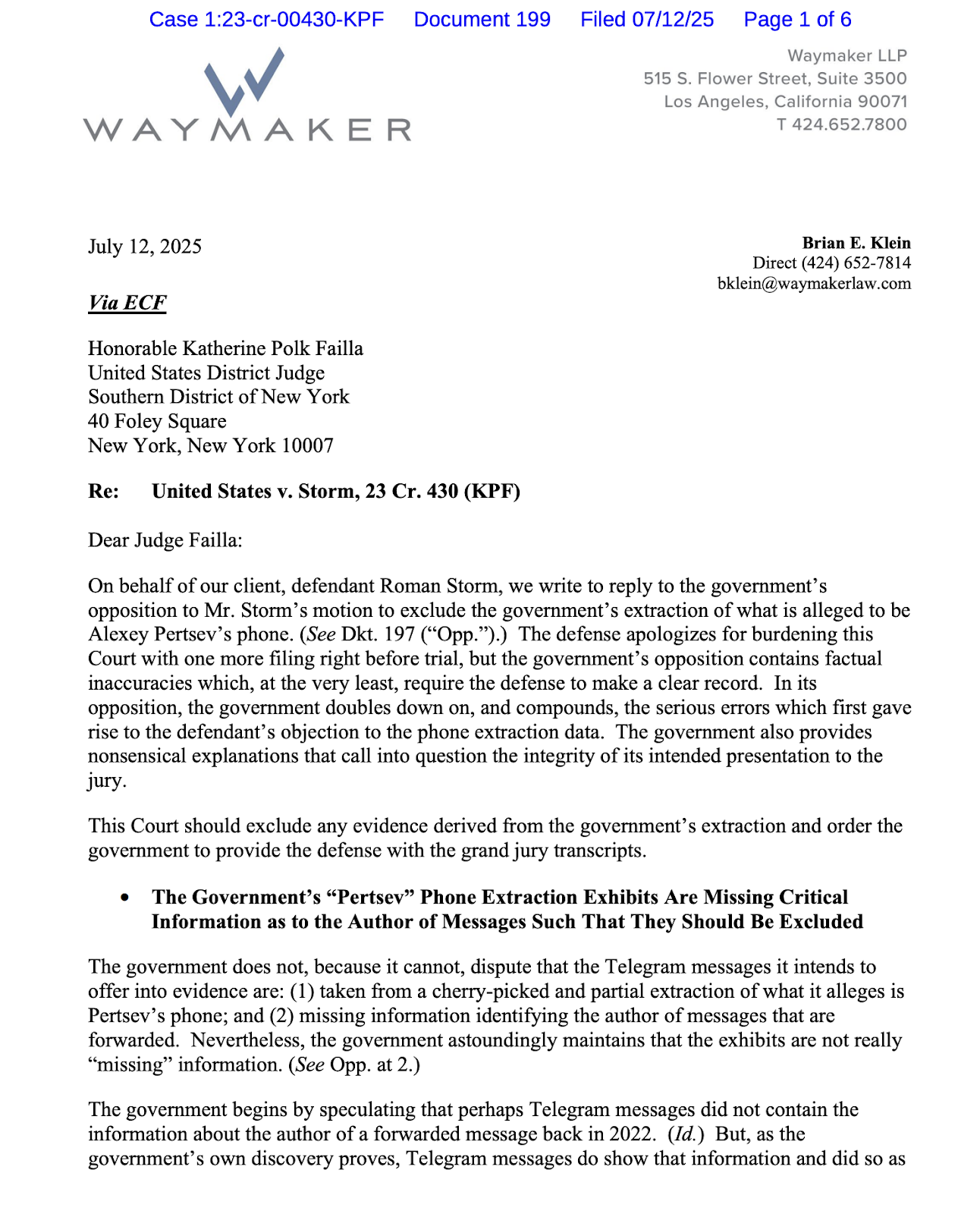
Tornado Cash Developer Storm Claims DOJ Bungled Critical Telegram EvidenceSource: Court Listener

Defense attorneys revealed the message was actually written by Andrew Thurman, a former CoinDesk senior tech reporter, then forwarded to a Tornado Cash chat by Pertsev.

The revelation emerged just days before Storm’s trial on charges of conspiracy to commit money laundering and sanctions violations related to Tornado Cash, which allegedly facilitated over $1 billion in illicit transactions.

Government’s Evidence Chain Under Tight Scrutiny

The controversy stems from Dutch authorities’ extraction of what prosecutors claim is Pertsev’s phone following his arrest in the Netherlands, where he was sentenced to 64 months in prison for money laundering through Tornado Cash.

Storm’s defense argues that the government’s extraction contains multiple fatal flaws, including missing author information for forwarded Telegram messages and incomplete file retrieval by FBI Agent Dickerman from Dutch authorities.

The defense contends that prosecutors cannot authenticate the extraction’s completeness because they were limited in what files they could obtain from Dutch law enforcement.

This authentication challenge becomes more significant given that the government admitted in court filings that its original September 2023 production of extracted text messages to the defense did not include “forwarded” tags on forwarded messages.

Prosecutors provided a corrected version in December 2024, which they plan to use at trial, but defense attorneys argue this timeline raises serious questions about the government’s handling of evidence.

The misattribution carried real consequences in court proceedings when Assistant U.S. Attorney Ben Arad referenced the message during a July 8 pretrial hearing, telling the judge it demonstrated the co-founders’ awareness of wrongdoing.

According to the hearing transcript, Arad told the court: “For example, when the Ronin hack happened, one of the co-conspirators asked, sum and substance, I’d like to ask you some questions about how you go about laundering $600 million worth of stolen crypto.”

The defense characterized this as providing “false information” to both the court and potentially the grand jury that issued the indictment.

Defense attorneys wrote in their filing: “Given that the government mistakenly attributed the reporter’s Telegram message to Pertsev at the Pretrial Conference, it appears that the government itself was unaware of this issue until the defense raised it.”

Enforcement Challenges Echo Across Crypto Cases

The evidence dispute highlights a pattern of prosecutorial challenges emerging across high-profile cryptocurrency cases, particularly when international evidence gathering intersects with complex digital communications.

Just last month, the DOJ faced similar authentication issues in the case of Russian crypto CEO Iurii Gugnin, who was charged with orchestrating a $530 million fraud scheme through his Miami-based platform Evita.

That case also involved cross-border evidence collection and questions about the authenticity of digital communications used to establish criminal intent.

Storm’s defense has consistently argued that the case threatens to criminalize open-source software development, with the Ethereum Foundation pledging $500,000 toward his legal defense and matching up to $750,000 in community contributions.

As part of the DOJ’s crypto fraud crackdown, the recently seized $225 million in USDT was linked to a global “pig butchering” scam that defrauded over 400 victims through a network of international exchanges and wallets.


Disclaimer: The articles reposted on this site are sourced from public platforms and are provided for informational purposes only. They do not necessarily reflect the views of MEXC. All rights remain with the original authors. If you believe any content infringes on third-party rights, please contact [email protected] for removal. MEXC makes no guarantees regarding the accuracy, completeness, or timeliness of the content and is not responsible for any actions taken based on the information provided. The content does not constitute financial, legal, or other professional advice, nor should it be considered a recommendation or endorsement by MEXC.
Tags:

You May Also Like

Stephen Gregory named binance us ceo as exchange targets expansion in US crypto market

Stephen Gregory named binance us ceo as exchange targets expansion in US crypto market

Binance.US names Stephen Gregory as binance us ceo, signaling expansion in the US crypto market with a renewed focus on compliance.
Share
The Cryptonomist2026/03/12 20:09
The Growing World of Medical Aesthetics: Enhancing Beauty Through Science and Innovation

The Growing World of Medical Aesthetics: Enhancing Beauty Through Science and Innovation

In recent years, the field of medical aesthetics has grown rapidly as more individuals seek safe and effective ways to enhance their appearance and improve their
Share
Techbullion2026/03/12 23:21
Why The Green Bay Packers Must Take The Cleveland Browns Seriously — As Hard As That Might Be

Why The Green Bay Packers Must Take The Cleveland Browns Seriously — As Hard As That Might Be

The post Why The Green Bay Packers Must Take The Cleveland Browns Seriously — As Hard As That Might Be appeared on BitcoinEthereumNews.com. Jordan Love and the Green Bay Packers are off to a 2-0 start. Getty Images The Green Bay Packers are, once again, one of the NFL’s better teams. The Cleveland Browns are, once again, one of the league’s doormats. It’s why unbeaten Green Bay (2-0) is a 8-point favorite at winless Cleveland (0-2) Sunday according to betmgm.com. The money line is also Green Bay -500. Most expect this to be a Packers’ rout, and it very well could be. But Green Bay knows taking anyone in this league for granted can prove costly. “I think if you look at their roster, the paper, who they have on that team, what they can do, they got a lot of talent and things can turn around quickly for them,” Packers safety Xavier McKinney said. “We just got to kind of keep that in mind and know we not just walking into something and they just going to lay down. That’s not what they going to do.” The Browns certainly haven’t laid down on defense. Far from. Cleveland is allowing an NFL-best 191.5 yards per game. The Browns gave up 141 yards to Cincinnati in Week 1, including just seven in the second half, but still lost, 17-16. Cleveland has given up an NFL-best 45.5 rushing yards per game and just 2.1 rushing yards per attempt. “The biggest thing is our defensive line is much, much improved over last year and I think we’ve got back to our personality,” defensive coordinator Jim Schwartz said recently. “When we play our best, our D-line leads us there as our engine.” The Browns rank third in the league in passing defense, allowing just 146.0 yards per game. Cleveland has also gone 30 straight games without allowing a 300-yard passer, the longest active streak in the NFL.…
Share
BitcoinEthereumNews2025/09/18 00:41