

Trump team’s “official” DEX CoW Protocol: a large-scale exclusive aggregator, with revenue of $6 million last year but still losing money
Author: Frank, PANews
Recently, the Trump family's crypto project World Liberty has increased its holdings of Ethereum and other assets. In the process of increasing holdings, almost all operations were completed through the CoW Protocol. It seems that the Trump family has a special love for this aggregator. In addition, Ethereum founder Vitalik and the Ethereum Foundation also frequently use CoW Protocol when transferring and trading assets. However, for ordinary users, the CoW Protocol is obviously not as well-known as DEX products such as Uniswap and 1inch. Until recently, due to the use of the Trump family, the attention to CoW Protocol has been raised to a higher level, and its token COW has also risen after Trump was elected. From November 6 to December 25, it rose by as much as 392%.
The "OTC market" in DEX is favored by big investors
CoW Protocol was created in 2020 and incubated by the Ethereum infrastructure builder Gnosis team. Its founder Anna George is also the business director of Gnosis. From 2016 to 2017, Anna George served as a monitoring and evaluation expert for the United Nations.
As of January 23, data showed that the number of daily active users of CoW Protocol has only reached more than 1,000 even after a significant increase. The number of daily users before was only a few hundred people per day. But in terms of cumulative trading volume, the cumulative trading volume of the project has reached 77 billion US dollars, which ranks seventh in the Ethereum ecosystem. In December 2024, CoW set a trading volume of 7.8 billion US dollars. Based on the daily active user volume of about 1,600 in December, the average monthly transaction amount completed by each user on CoW reached 4.87 million US dollars. From this point of view, CoW deserves its reputation as an exclusive trading pool for large households.

CoW Protocol has many technical features. In terms of effect, it mainly eliminates MEV and low transaction friction. The most characteristic core technical principle used is the "demand matching" mechanism. Regarding "demand matching", I will not give too much technical explanation here. In layman's terms, this mechanism is more like a kind of on-chain OTC market, which crosses the demand of AMM liquidity pool and directly matches two large users with the same demand for pricing transactions. In this way, the MEV and transaction wear on the chain are almost zero.
For users who trade millions or even tens of millions of dollars each time, this mechanism directly hits the pain point and can also minimize the impact on market prices. This also explains why the Trump family project World Liberty chose to use the CoW Protocol for asset allocation. At the same time, the Ethereum Foundation and Vitalik are also keen to use this project. The Ethereum Foundation has sold coins many times through CoW.
On the other hand, for ordinary users, the most important considerations may be transaction speed, the number of transaction categories, and flexible transaction pools. In contrast, the matching mechanism of CoW Protocol does not lead in these aspects. But it does not matter. For CoW Protocol, it seems to be designed for large users from the beginning.
The data has indeed improved, and we want to increase our income level
Recently, CoW Protocol has benefited from the World Liberty project. The price of its governance token COW has soared since November 6, from a low of $0.25 to a high of $1.23, with the largest increase reaching 392%.
The COW token was launched as early as 2022, with the earliest opening price of about $0.8. In the following year, the price fell all the way, falling to a low of $0.062. It did not start to rise until 2023, but it hovered below $0.4 most of the time. It was not until September 2024 that Coinbase announced that it would introduce the CoW Protocol into the coin listing route. On November 6, Binance, Bybit and other exchanges launched COW. Interestingly, this day is also the day when Trump won the 2024 US election. It can be seen that various exchanges have added COW to the Trump series of related assets, and as soon as the victory results came out, it immediately triggered market pursuit.
However, since Christmas, the price of COW tokens has been falling. As of January 23, its price has fallen to around $0.63, and the overall correction is close to 50% from the high point.
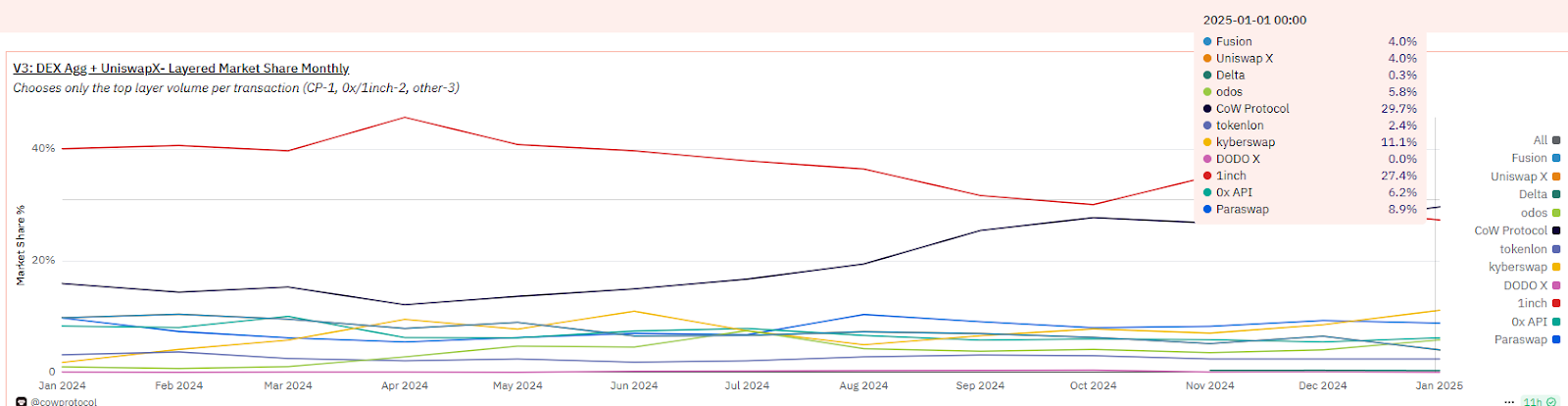
Apart from the traffic effect brought by the hot spots, the data performance of CoW Protocol itself has seen tremendous growth in recent months. The most obvious is the transaction volume. Since 2024, the monthly transaction volume of CoW Protocol has basically fluctuated between 2 billion and 3 billion US dollars. Starting in November, this figure began to surge to 6.2 billion US dollars, and in December it reached an all-time high of 7.8 billion US dollars. Throughout 2024, CoW Protocol's market share in Ethereum ecosystem aggregators has always been lower than 1inch, ranking second. On January 23, 2025, the data performance of that month has exceeded 1inch for the first time, ranking first. However, the final ranking of the two for that month may not be known until the beginning of next month.
On January 22, Cow DAO released the CIP-61 proposal on Snapshot, attempting to achieve a better level of income by further standardizing the charging model and ratio of CoW Protocol. According to the proposal, CoW Protocol achieved a total revenue of approximately $6 million in 2024, but still failed to break even, with development costs ($4.4 million), grants ($700,000) and solver rewards ($5.2 million) for the year. Therefore, Cow DAO hopes that through this proposal, it will be able to optimize the transaction execution price of users, create more additional value to reach break-even as soon as possible, and get rid of the need for external funds.
According to the official dashboard of CoW, the cumulative income of CoW DAO is 3,648 Ethereum, which is about 12 million USD at the price of 3,300 USD. In the Ethereum ecosystem, the income level of CoW Protocol ranks around 50th. As an aggregator that has been operating for 4 years and ranks among the top in terms of transaction volume, this income level is indeed low.
Coupled with the overall improvement in recent data, the CoW team obviously hopes to seize the current market opportunities and achieve new milestones. At present, the proposal has been successfully passed, but the discussion on social media is not very hot. The token market has not seen significant price fluctuations as a result. Perhaps, for the CoW team, capturing large users only requires targeted products and designs, but capturing the general public seems to be much more difficult. For ordinary users and token investors, complex proposal expressions seem far less affordable than a simple airdrop.


You May Also Like

Safe Unveils Safenet Beta: Transforming SAFE Token Into Security Staking Infrastructure

ARK Invest Doubles Down on Coinbase (COIN), Circle, and Robinhood (HOOD) During Market Pullback

Pi Network Faces Centralization Debate as Community Questions Pi2Day Direction



