SOL Price Enters A Key Demand Zone—Can Solana Rebound On Strong On-Chain Fundamentals?
The post SOL Price Enters A Key Demand Zone—Can Solana Rebound On Strong On-Chain Fundamentals? appeared first on Coinpedia Fintech News
The tariff-war chatter is back on the table, and it’s shaking both Wall Street and crypto in tandem. Solana hasn’t been spared. After pushing toward the $150 region, Solana (SOL) price faced a sharp rejection at a key resistance zone and then printed a weak weekend close below $140—an early sign that momentum has tilted bearish to start the week.
Still, the downside picture isn’t clean-cut. While price action hints at a developing bearish curve, Solana’s on-chain and ecosystem signals remain constructive, suggesting the current move could be more of a shakeout than a sustained breakdown—especially if buyers defend the next support band and reclaim the rejected level quickly.
Mixed Fundamentals: Short-Term ETF Outflows, Long-Term Ecosystem Growth
On one side, Solana ETFs reportedly saw their first net outflows since launch, with withdrawals of roughly $2.2 million. That matters because ETF flows can influence short-term sentiment—especially in a tape that’s already risk-off. Even modest outflows can get amplified by traders as “institutions are backing off,” regardless of whether the flow is meaningful in the bigger picture.
On the other side, Solana’s broader ecosystem narrative remains strong. The network continues to attract capital into on-chain use cases, with Solana’s RWA ecosystem reportedly reaching ~$1.12B in TVL, reflecting growing institutional participation and expanding liquidity. If that trend holds, it supports the idea that Solana’s demand is being driven by more than just memecoin cycles.
At the same time, expectations for TVL expansion into 2026—some forecasts even pointing as high as $30B—underline the market’s longer-term belief that Solana’s application layer will keep widening across multiple sectors.
Can SOL Reclaim Resistance And Flip The Trend?
With Solana price compressing under resistance, the next move is likely to be decisive. The technical picture suggests SOL is still capped beneath the upper boundary of its structure, but the fundamentals argue the accumulation phase may not last long if buyers step in with conviction.
That sets up the key question for traders: Will SOL reclaim the rejected resistance zone and invalidate the bearish weekly open—or will rallies continue to get sold until the market finds a deeper base?
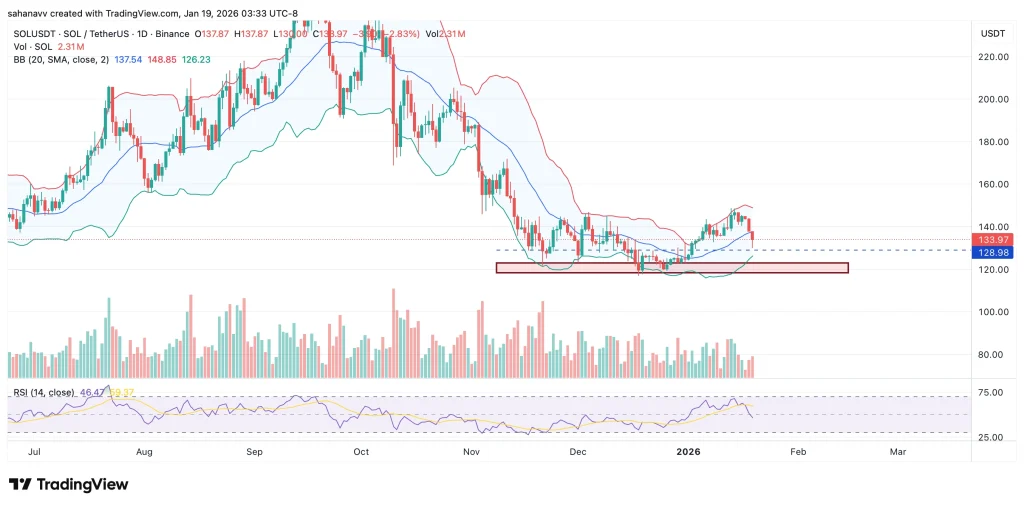
The SOL price dropped below the average bands of Bollinger and appears to be heading towards the lower bands. However, the price range of around $128 is acting as a strong base, which has triggered a strong rebound on various occasions. On the other hand, the RSI is bearish, with the levels seeming to be poised to reach the lower threshold. In such a case, even if the price breaks below $128, the lower support of the Bollinger hold the rally. However, the range between $118.32 and $122.94 may act as the last point of defence.
The Bottom Line
Solana’s rejection at a key resistance has tilted the near-term bias bearish, and the chart now suggests buyers are losing control of momentum after a strong run-up. Still, the broader setup doesn’t look broken. Ecosystem fundamentals remain supportive, with expanding RWA activity, steady application-driven adoption, and liquidity staying active across DeFi. If market-wide risk sentiment stabilizes, SOL could resume its recovery from this consolidation phase. For now, bulls need a clean reclaim of resistance to negate the bearish weekend signal.


You May Also Like

Beyond Cleaning: What Else You Must Check Before Moving Out

Justice Department has 'gone off the rails' for Trump's 'pretzel logic': analysis