

Kazakhstan Bans Cryptocurrency Trading for Central Bank-approved assets
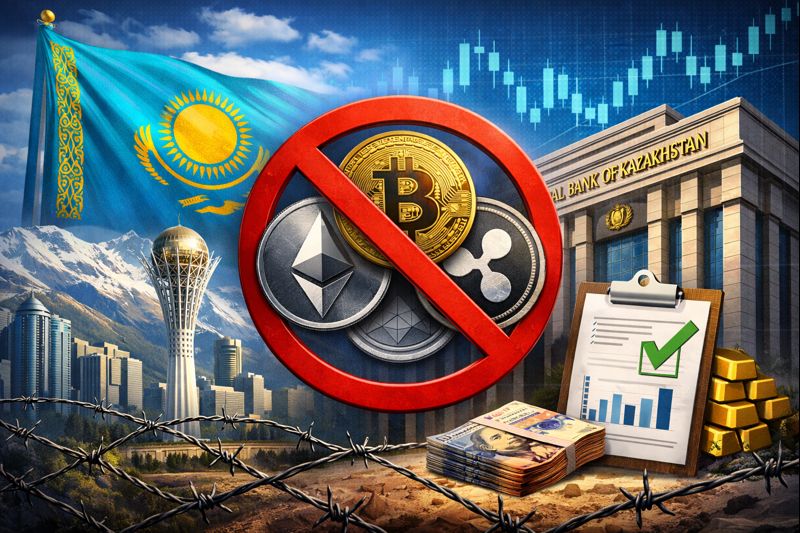
The Republic of Kazakhstan has made major changes to its cryptocurrency legislative regime, limiting trading operations to digital assets, which have been expressly authorized by the National Bank of Kazakhstan. The action, which is part of an overall revision of banking and digital finance legislation, is a significant move to centralize the regulation of the hitherto lax crypto market within the country.
New Legal Framework and Chairman of the Central Bank
The newly adopted Law on Banks and Banking Activities, signed by President Kassym-Jomart Tokayev and to come into effect upon its publication, incorporates the digital financial assets into the official banking regulatory perimeter of Kazakhstan. The National Bank, through the law, has been mandated to decide the type of cryptocurrencies that can be made available to investors and traded on licensed platforms. This is effective in limiting the free trading of unregistered digital tokens outside the central bank-approved list.
Besides the definition of digital financial assets in the legislation of the Republic of Kazakhstan, the authorities are developing a licensing framework for crypto exchanges and digital asset service providers. Those platforms that intend to conduct business in the country need to obtain authorizations, as well as meet a similar monitoring requirement as those imposed on traditional financial institutions.
Kazakhstan’s Justification of the Restrictions
Kazakh officials have presented several reasons behind the new rules, such as investor protection, blocking of illicit finance, and following the global standards of regulatory expectations. Authorities have stressed that restricting domestic trading of assets approved by the central bank would help reduce the risk of volatility, fraud, and money laundering, which have haunted the crypto industry of the country over the past few years.
This transition is after a continued crackdown on unlicensed operators. Over the past few years, the Financial Monitoring Agency of Kazakhstan has eliminated dozens of illegal crypto exchanges as part of an attempt to suppress the illegal trade and make it much harder to violate anti-money-laundering regulations.
Implications for the market and Industry reaction
The market players are adapting to the new world. Regulated exchanges in the Astana International Financial Centre (AIFC) and other licensed outlets should become more dominant, since the informal or offshore trading will be a legal issue in the new regime. According to experts, the process of approval by the central bank, especially the criteria and schedules of adding assets to the market, will be the major determinant of market activity in the months to come.
Concurrently, certain stakeholders in the industry have raised concerns that too restrictive asset lists may actually kill innovation or make trading move to other jurisdictions. The transparency has been joyfully embraced by others, who propose that a clear regulatory framework will bring institutions in and help Kazakhstan achieve its vision of being a regional leader in digital finance.
Wider Framework in the Kazakh Financial Digitalization
The requirement of the approved-asset is based on the overall plan of modernizing the financial services in Kazakhstan. The new banking law, in addition to crypto trading regulations, gives legal status to stablecoins, tokenized assets, and other blockchain-based instruments. Stablecoins pegged to the domestic currency and tokenization of physical assets are endorsed pilot projects, which highlight the importance of the regulator in the combination of innovativeness with control.
The execution of the new mandate by the central bank and an appropriate trade-off between the agency, and the economic potential of the digital assets will be monitored by the market watchers as the implementation process progresses.
This article was originally published as Kazakhstan Bans Cryptocurrency Trading for Central Bank-approved assets on Crypto Breaking News – your trusted source for crypto news, Bitcoin news, and blockchain updates.


You May Also Like

The changing face of elder care in Malaysia — Sayed Mohammad Reza Yamani Sayed Umar

Not a loophole: Singapore AI export controls let China tap US AI legally

Exclusive interview with Smokey The Bera, co-founder of Berachain: How the innovative PoL public chain solves the liquidity problem and may be launched in a few months



