

Bitcoin Price Prediction: is BTC About to Plummet Below $90K This Week?
Bitcoin is undergoing a decisive pullback after the strong recovery that followed the early-January reset. The price has been rejected from a major confluence area around $98,000, where higher-timeframe resistance and a key moving average cluster are.
It is now rotating lower while still holding above the most important higher-low zones established during December.
The current phase, therefore, appears as a test of support strength within a maturing corrective structure rather than a confirmed trend reversal.
Bitcoin Price Prediction: The Daily Chart
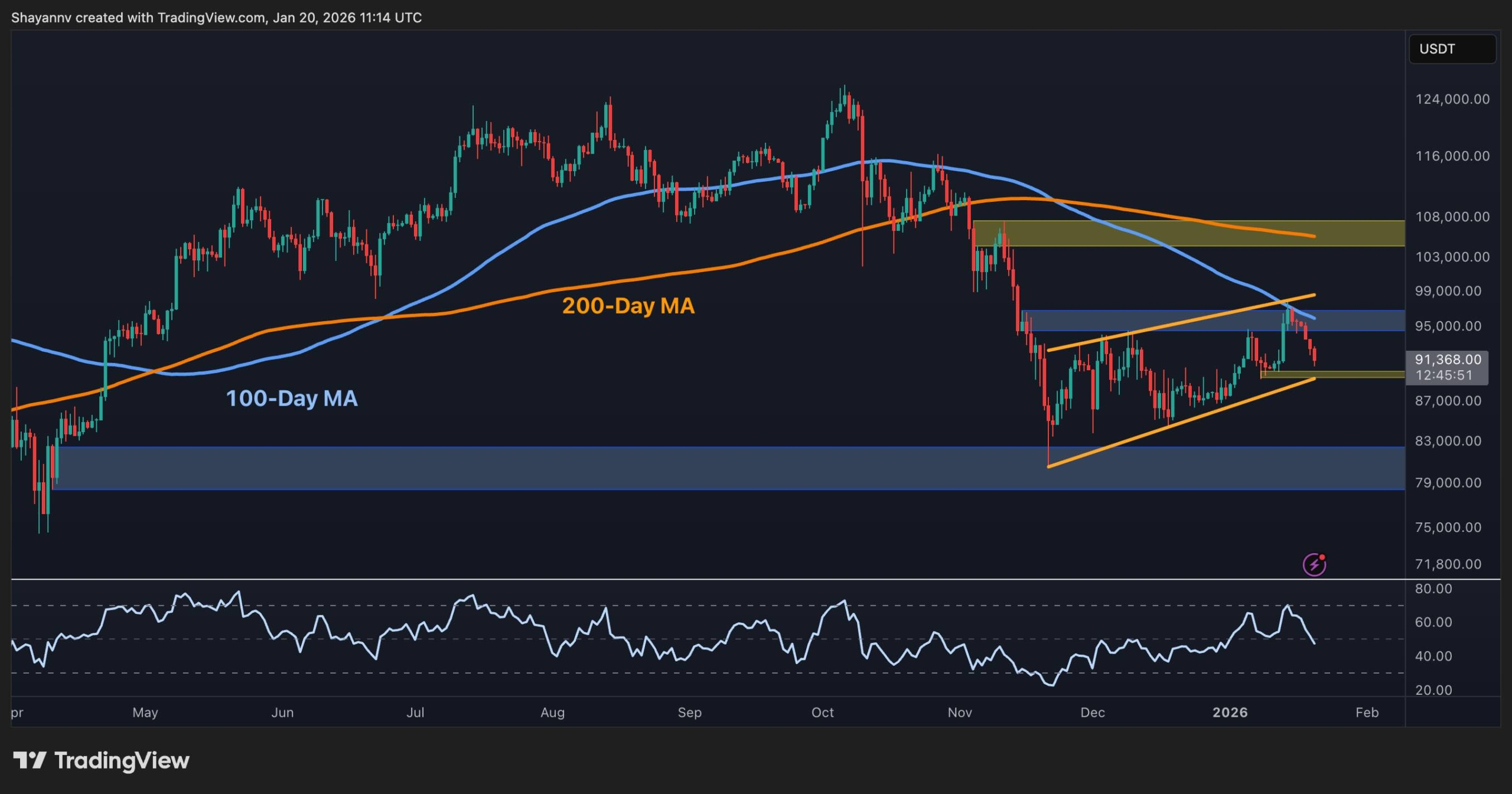
On the daily chart, Bitcoin has rolled over from the $98,000 resistance band, which coincides with the upper boundary of a rising channel structure and the vicinity of the 100-day moving average.
The 200-day moving average remains overhead and downward-sloping around $105,000, confirming that the broader medium-term trend is not yet fully realigned to the upside. The Daily RSI has also retreated from overbought territory and is dropping below the 50% threshold.
The first important support now sits in the $90,000 region, where the lower channel boundary and the recent bounce’s base overlap. Loss of this area on a closing basis would open the way toward the deeper demand block around $80,000, which marks the origin of the latest leg higher and the prior major accumulation zone. As long as price holds above $88,000 and reclaims the mid-$90,000s with conviction, the daily structure can still evolve into a constructive higher-low configuration, but sustained trade below $88,000 would significantly weaken that constructive bias.
 Source: TradingView
BTC/USDT 4-Hour Chart
The 4-hour chart shows the price is poised to test the lower boundary of the ascending channel. It has declined from the recent local high near $96,000 back into the $90,000–$91,000 area, where short-term support formed during the earlier consolidation.
The 4-hour RSI has also moved into oversold territory, signalling stretched downside momentum after several consecutive red candles.
If the lower boundary around $89,000–$90,000 holds, a technical rebound toward $93,000–$95,000 would be consistent with a standard retest of the broken intraday range and could help determine whether sellers retain control.
On the other hand, a clean break below $89,000 with would confirm a loss of the short-term up-channel and probably invite a deeper test of the high-timeframe demand zone around $80,000. At the moment, the intraday structure reflects corrective pressure within a broader consolidation band rather than a fully developed bearish trend.
 Source: TradingView
On-Chain Analysis
Short-term holder behaviour over recent months has been characterised by persistent loss realisation. The 30-day EMA of the short-term holder SOPR has spent an extended period below its neutral threshold around 1, indicating that coins held for a relatively short duration have been spent on average at a loss. This pattern suggests that late entrants and weaker hands have been continuously exiting during the consolidation phase, absorbing downside and sideways volatility instead of aggressively defending higher prices.
Historically, prolonged periods in which short-term holders realise losses while price holds above key higher-timeframe support are often associated with a “reset” of market positioning: speculative excess is reduced, ownership shifts toward stronger hands, and sensitivity to marginal new demand increases.
This dynamic does not guarantee immediate continuation, and if macro demand were to weaken further, the overhang of realised losses could still weigh on price. However, the combination of structural support holding on the chart and evidence of capitulation among shorter-term participants is consistent with a late-stage corrective environment that can, once selling pressure is exhausted, provide the foundation for a subsequent impulsive advance.
 Source: CryptoQuant
The post Bitcoin Price Prediction: is BTC About to Plummet Below $90K This Week? appeared first on CryptoPotato.


You May Also Like

Today’s Biggest Crypto Movers: Dogecoin Leads the Pack

RWA Boom Accelerates As Tokenized Assets Hit New Highs In Early 2026



