

XRP price rally fails at volume node as bearish trend continues
XRP price rejected from a major volume resistance near the point of control, confirming another lower high and keeping downside risk active toward the $0.58 range low.
- XRP failed at POC volume resistance, signaling supply overhead
- Rejection confirmed a lower high, keeping the bearish trend active
- Next downside objective remains the $0.58 range low
XRP (XRP) price is showing continued weakness after the latest rally failed at a key volume-based resistance level, reinforcing the broader bearish market structure. The rejection occurred near the Point of Control (POC), a major high-volume node where heavy trading activity has previously concentrated.
When price fails to reclaim and hold above the POC, it often signals that supply remains dominant and that buyers lack conviction at higher levels.
XRP price key technical points
- XRP rejected from volume resistance at the Point of Control (POC)
- The rejection formed another lower high, maintaining bearish structure
- Downside rotation remains active toward the $0.58 range low
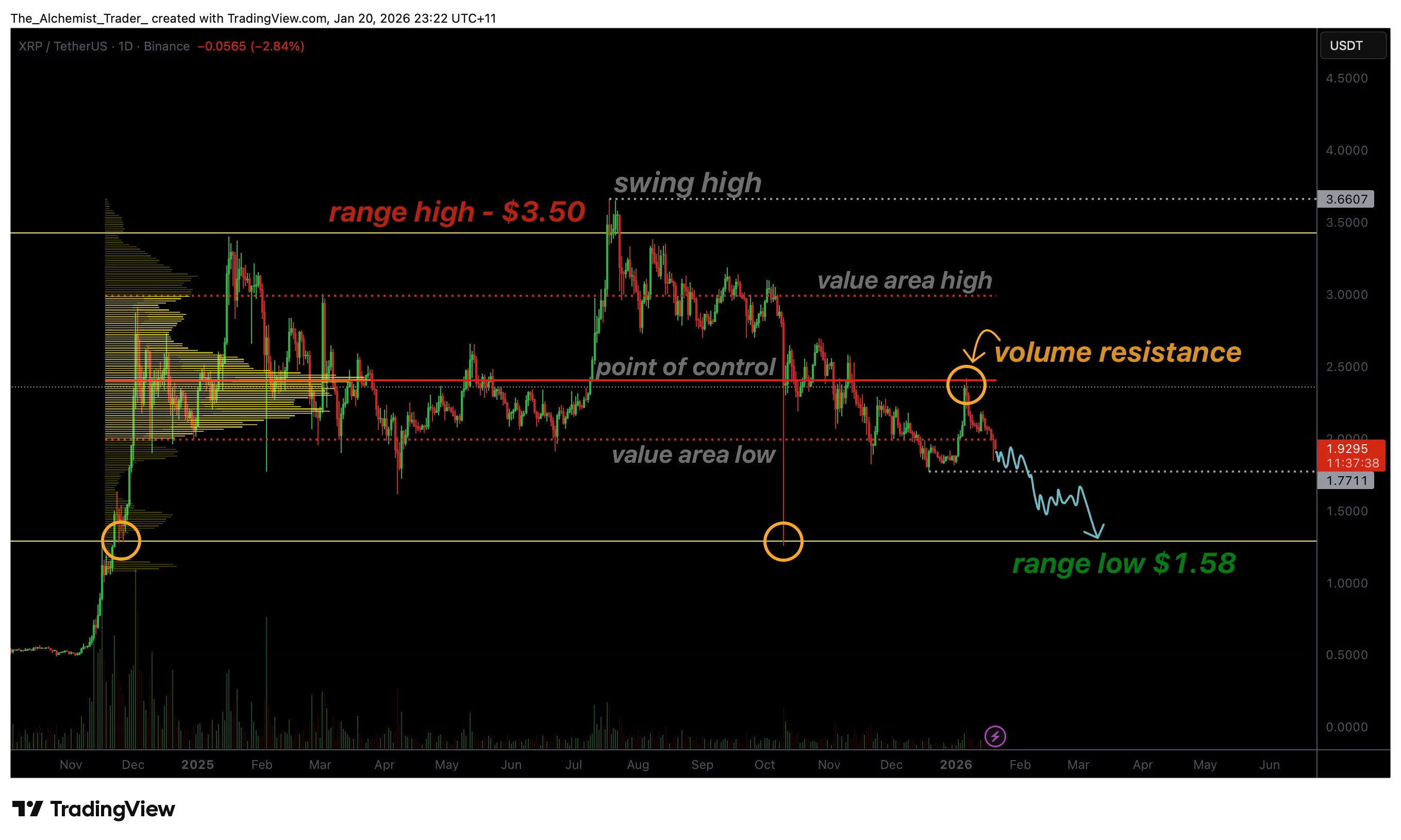
The Point of Control is one of the most important volume profile levels in range structures. It represents the price level where the highest volume has traded and often acts as a pivot between bullish and bearish market phases. When XRP trades below this level, the market tends to remain weak and range-bound, with resistance overhead continuously pressuring upside attempts.
XRP’s recent rejection at this volume node signals that sellers are still active at that price zone. Rather than breaking through and sustaining higher value, price stalled and reversed, showing that demand was not strong enough to absorb supply at resistance.
This is a key detail because rallies that fail at high-volume resistance often lead to deeper rotations lower. The market effectively “rejects” the attempt to move into higher-value territory, and the price returns to test lower-liquidity zones where buyers may step in again.
Lower high confirms bearish market structure
From a market structure perspective, XRP is still trading in a bearish framework characterized by lower highs and lower lows. The most recent rejection from the POC has confirmed another lower high, indicating the bearish trend remains intact and the market has not yet entered a bullish reversal phase.
Lower highs are significant because they show that sellers remain in control of the trend. Even when XRP rallies, it continues to fail at resistance and cannot reclaim key levels on a closing basis. This behavior keeps downward momentum active and increases the likelihood that the market will revisit prior support levels.
Until XRP can reclaim the POC and hold above it, the structure remains bearish. Any rally into resistance is likely to be treated as a corrective move rather than a confirmed trend reversal.
$0.58 range low becomes the next objective
The next major downside target is the $0.58 range low, which represents a critical support level in XRP’s macro trading environment. This zone has been tested multiple times, and each test previously triggered a bullish reaction and short-term bounce.
Because of this repeated behavior, $0.58 remains a key liquidity and demand area where buyers may attempt another defense. However, it is important to recognize that even if XRP bounces from $0.58 again, that bounce may still be part of a broader sideways range rather than the start of a true trend reversal.
In range markets, price often rotates between resistance and support repeatedly before a decisive breakout occurs. A bounce from the range low can continue the sideways structure, while a breakdown below it can trigger accelerated downside continuation.
Bearish candle follow-through strengthens rejection
The rejection has not been minor. XRP has printed multiple bearish follow-through candles after failing at the POC, confirming that downside momentum is active. Follow-through candles are important because they validate that sellers are not only defending resistance, but also pressing price lower with strength.
This matters because weak rejections often lead to sideways consolidation. Strong rejections with follow-through typically lead to continuation moves, where the market rotates lower toward the next liquidity zone.
In XRP’s case, bearish follow-through suggests the market is likely to continue moving lower unless buyers step in aggressively to reclaim structure. The longer XRP remains capped below the volume resistance zone, the more likely it is that price continues rotating toward the range low.
What to expect in the coming price action
XRP remains weak after rejecting from the high-volume Point of Control, confirming another lower high and maintaining bearish market structure. As long as price stays capped below volume resistance, the probability favors continued downside rotation toward the $0.58 range low.
If XRP reaches $0.58, a bounce is possible given historical reactions, but it would likely continue the broader sideways range unless a structural breakout occurs. A decisive breakdown below $0.58 would shift momentum further bearish and open the door for deeper downside targets.


You May Also Like

Covéa Chooses Shift Technology as Strategic Partner for Fraud and Risk Management

Moody’s Bitcoin Haircut: Forced-Selling Trigger

Liventus Acquires Tamarack to Become the Most Comprehensive Technology Partner for Equipment Finance Organizations



