

How Bessent Played Japan: A Hedge Fund Veteran’s Guide to Deflecting Blame
Treasury Secretary Scott Bessent, a hedge fund veteran who spent decades trading currencies and bonds, has emerged as the Trump administration’s chief crisis manager in global markets—accurately diagnosing Japan’s historic bond selloff while strategically framing the narrative to shield the White House from blame over its aggressive Greenland campaign.
The playbook reveals how the former hedge fund manager is turning Asia’s two largest US allies into very different chess pieces—one to absorb blame, the other to deliver investment.
Hedge Fund Veteran Spots Japan’s “Six-Standard-Deviation Move”
In an interview on January 20, Bessent pointed to extraordinary volatility in Japan’s bond market as the primary driver of global market turmoil.
The assessment was grounded in reality. Japan’s 40-year government bond yield had surged above 4% for the first time since its introduction in 2007, while 10-year yields hit levels not seen since 1999. The selloff intensified after Prime Minister Sanae Takaichi announced a snap election for February 8 and confirmed plans to suspend Japan’s 8% sales tax on food for two years—fueling investor concerns about Japan’s high 200% debt-to-GDP ratio and rising yields.
Bessent made clear he expected Japanese authorities to act. “I’ve been in touch with my economic counterparts in Japan and I am sure that they will begin saying the things that will calm the market down,” he said.
Tokyo Delivers, Markets Stabilize
Japanese Finance Minister Satsuki Katayama appeared to answer Bessent’s call at the World Economic Forum in Davos on Tuesday.
Katayama pledged that Japan’s debt-to-GDP ratio could be reduced through “wise spending” and “strategic fiscal measures” to boost potential growth. “This will bring about the sustainability of public finances and ensure trust from the markets,” she said.
The market response was immediate. JGB yields retreated across all maturities on January 21, with the 20-year bond seeing the sharpest decline at 12.1 basis points. The 40-year yield eased to 4.15% from its peak above 4.2%.
The sequence validated Bessent’s approach: identify the pressure point, demand verbal intervention, and let Japanese officials do the heavy lifting.
Convenient Timing: Deflecting From Greenland Fallout
Yet Bessent’s framing served a dual purpose. By attributing market volatility to Japan’s bond rout, he effectively deflected attention from the Trump administration’s escalating confrontation with European allies over Greenland.
That same week, President Trump had threatened 10% tariffs on eight European countries—Denmark, Norway, Sweden, France, Germany, the United Kingdom, the Netherlands, and Finland—over their opposition to the US acquisition of Greenland. European leaders issued a joint statement condemning the threats, while Danish officials boycotted Davos entirely.
By centering Japan as the source of market stress, Bessent constructed a narrative that insulated Trump’s aggressive diplomacy from immediate market accountability.
Korea: A Study in Contrast
Bessent’s approach to South Korea has been notably different, despite both countries having major investment commitments to the US. Japan agreed to a $550 billion investment deal, larger than Korea’s $350 billion package. Yet Tokyo faces relentless pressure while Seoul receives verbal support.
On January 15, Bessent offered rare backing for the Korean won, which had fallen to near 17-year lows against the dollar. The Treasury Department said Bessent “emphasized that excess volatility in the foreign exchange market is undesirable” and noted the won’s decline “was not in line with Korea’s strong economic fundamentals.”
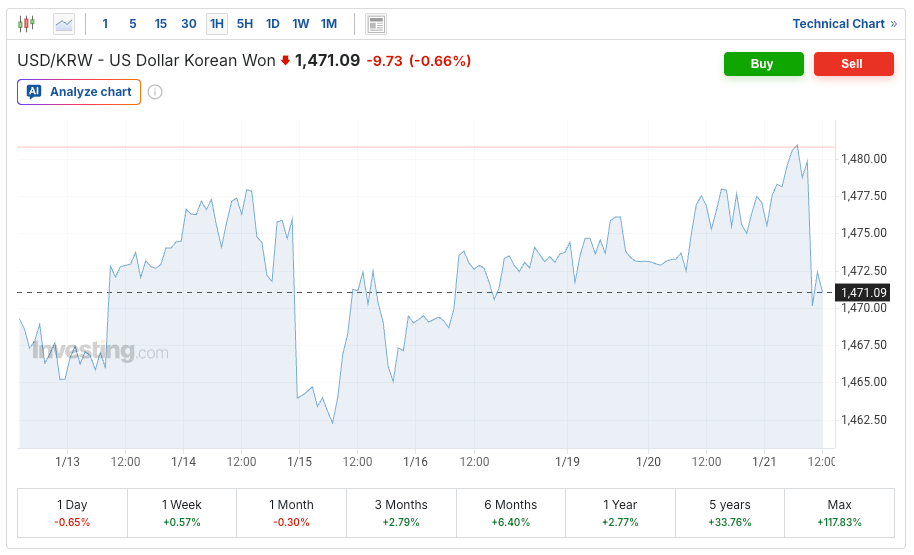 USD/KRW. Source: Investing.com
The won initially responded, strengthening from around 1,477 to 1,462 per dollar in the days following Bessent’s remarks. But the rally proved short-lived—by January 21, the currency had weakened back to 1,478, erasing most of its gains.
The contrast suggests Bessent’s calculus isn’t simply about investment dollars. Japan’s bond market turmoil offered a convenient scapegoat for global volatility, allowing him to deflect from the Greenland controversy. Korea presented no such opportunity—and no such utility.
The Hedge Fund Playbook
Bessent knows Japan. In 2013, while serving as chief investment officer at Soros Fund Management, he made $1.2 billion in three months betting against the Japanese yen. A decade later, he’s deploying that same expertise—not to profit from Tokyo’s pain, but to use it as political cover.
With Japan, he identified a genuine market dislocation and leveraged it as both a policy tool and a political shield. With Korea, he’s providing verbal support to protect a major investment commitment, while with Europe, the administration has chosen direct confrontation.
The approach marks a departure from the traditional Treasury doctrine of avoiding comment on specific exchange rates. Instead, Bessent is running a country-by-country playbook, calibrating pressure and support based on US strategic interests.
Whether this strategy proves sustainable depends on factors beyond Bessent’s control—including whether Japan’s fiscal trajectory actually improves, or whether markets eventually connect Trump’s trade threats to broader financial instability.
For now, the former macro trader has bought the administration time, using Tokyo’s bond crisis as cover while keeping Seoul on side. It’s classic hedge fund risk management: isolate the variables you can control, and find someone else to blame for the rest.


You May Also Like

XRP Confirms Monthly Trend Shift vs. Bitcoin: Why 41% Drop Is Now Base Case

US stocks slide as Trump calls for war escalation



