

Bitcoin price flashes weakens as $80K becomes the next liquidity magnet
Bitcoin price is weakening after losing key range support, with momentum fading and downside liquidity building. A breakdown below mid-range support could pull BTC toward $80,000.
- BTC lost key range structure and is showing bearish expansion
- Mid-range support is critical as price shows no strong bounce
- Breakdown with volume increases rotation risk toward $80,000 liquidity magnet
Bitcoin (BTC) price is showing renewed weakness after losing a key structural support zone, with price now trading back inside the broader range and struggling to generate any meaningful bounce. The recent bearish expansion suggests sellers remain in control, and the lack of follow-through on the upside indicates demand is not yet strong enough to reverse the short-term trend.
Bitcoin price key technical points
- Bitcoin has lost key range structure, with bearish expansion reclaiming control
- Price is hovering near mid-range support with little bounce, signaling weakness
- Untapped downside liquidity increases rotation risk toward $80,000
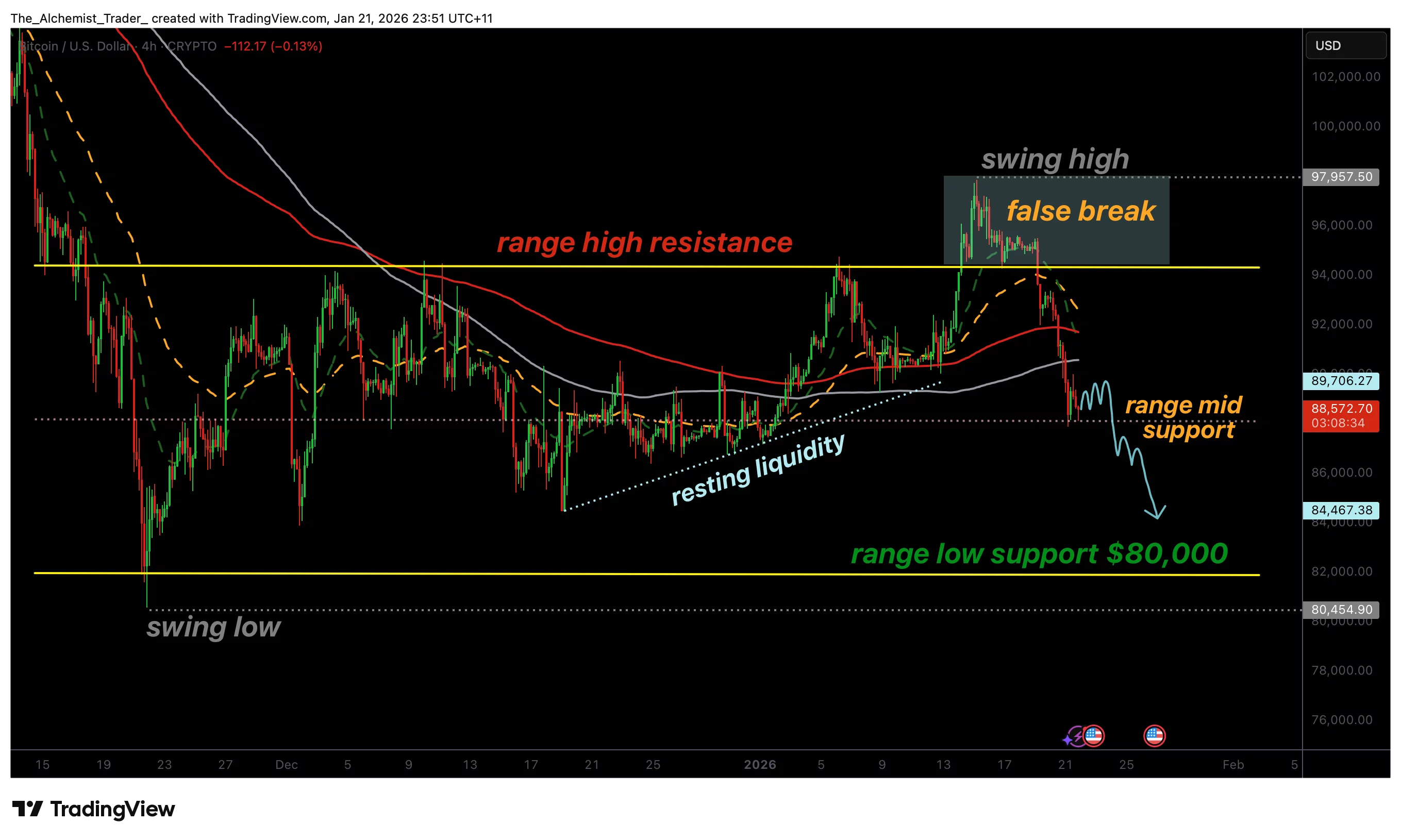
Bitcoin’s current weakness stems from the loss of a key support level that previously served as a major structural boundary within the trading range. When a market fails to hold above a range level and begins trading lower without strong demand stepping in, it often signals that value is shifting downward.
In this case, BTC has not only broken down but also failed to immediately recover, which is a warning sign. Markets that are ready to reverse typically show strong reaction candles, aggressive dip buying, and rapid reclaiming of lost support. Instead, Bitcoin is trading heavily and remains vulnerable to continuation.
This type of price action often aligns with bearish phases inside a larger range, where price rotates lower to rebalance and tap liquidity before a new expansion leg develops.
Why liquidity matters: the market seeks untapped stops
One of the most important concepts in technical price behavior is liquidity. Liquidity is often concentrated around key lows and highs because traders place stop losses near those areas. When these stop levels remain untapped, they become targets for price movement, especially during periods of volatility.
Resting liquidity is essentially a pool of orders waiting to be triggered. When a market begins trending lower or loses support, it becomes easier for price to travel toward these liquidity zones because there is less structural support in between.
This is why the downside becomes increasingly attractive during weak conditions: once support breaks, the market often accelerates toward lower liquidity to fill orders, rebalance price, and create the conditions needed for the next sustained move.
With Bitcoin showing weakness and limited bullish volume, downside liquidity remains the primary magnet.
Capitulation risk increases if volume expands on the breakdown
Capitulation is typically defined by a sharp move lower fueled by increased selling pressure and stop-loss triggers. While Bitcoin is not yet in full capitulation, the conditions for it begin to form when:
- support levels break cleanly,
- price fails to bounce,
- bearish volume increases,
- and liquidity remains untouched below.
If Bitcoin breaks mid-range support with rising volume, it would confirm that sellers are pressing the price lower aggressively. That move would likely trigger a deeper rotation into range-low support and accelerate price movement as the market seeks lower liquidity zones.
This is where the $80,000 area becomes a key downside focus. It represents the range low region and the next major zone where liquidity rests and where buyers may attempt to defend the price more aggressively.
$80,000 becomes the primary downside magnet
If weakness persists and the mid-range fails, Bitcoin is more likely to rotate toward the range low near $80,000. This area represents a key structural demand zone and is likely where the market attempts a more meaningful reaction.
The path toward $80,000 is also supported by current market behavior: a bearish expansion with limited bounce suggests BTC is in a continuation phase rather than a consolidation. If price is unable to reclaim lost structure, the market naturally shifts toward deeper support and liquidity.
A move to $80,000 does not automatically mean Bitcoin is entering a longer-term bear market, but it does reinforce that the current range environment remains intact and that downside liquidity is still being pursued.
What to expect in the coming price action
Bitcoin remains weak after losing key range structure and failing to produce a strong recovery bounce. As long as price continues trading heavy around mid-range support and upside volume remains limited, downside liquidity remains the dominant magnet.
If BTC loses mid-range support with bearish follow-through and increasing volume, the probability of a sharper rotational move toward the $80,000 range-low support, where deeper liquidity is resting, increases. A strong defense at mid-range could stabilize the market, but failure to hold would raise capitulation risk.


You May Also Like

Surplus seen narrowing on external risks – UOB

Oil Surges Above $110 as War Fears Shake Markets



