

An ongoing journey towards modernized transport
Transportation may very well be the very engine that keeps any economy running. The sector, after all, is responsible for connecting producers to resources and consumers, creating jobs in the making of roads and in the driving of vehicles, boosting productivity by lowering costs, and fostering overall growth by moving goods, services, and people efficiently.
Dealing with the difficult task of making lives easier for millions of Filipino motorists and commuters, the Department of Transportation (DoTr) is the government entity in charge of promoting, developing, and regulating a dependable and coordinated network of transportation systems, as well as providing fast, safe, efficient, and reliable transportation services.
Established under the Malolos Constitution on Jan. 21, 1899, the agency, then called the Communicaciones y Obras Publicas, was given the role of accelerating the country’s economic development through the creation of effective and efficient transportation infrastructure systems.
After 80 years of regulating transportation activities in the country, the Ministry of Transportation and Communication (MoTC) was created pursuant to Executive Order No. 546 with the task of regulating a dependable and coordinated network of transportation and communication systems in the country. Eight years later, the MoTC converted to the Department of Transportation and Communications (DoTC) through Executive Order No. 125.
With the signing of Republic Act No. 10844 in 2016, the communications portfolio from the DoTC was removed following the creation of the Department of Information and Communications Technology (DICT). Hence, the department’s current name.
Expanded capacity
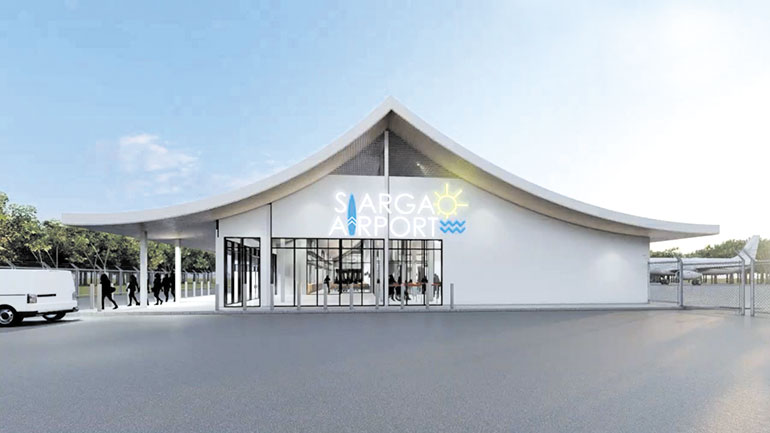 Artist’s render of Siargao Airport, one of the Philippine airports currently undergoing improvements — Photo from facebook.com/DOTrPH
This year, the agency is marking its 127th year in service of Filipinos, remaining committed to providing comfortable, accessible, safe, sustainable, and affordable transportation for Filipinos.
As the department reflects on more than a century of service and modernizing Philippine transport, it is equally important to highlight the agency’s recent achievements that show its lasting impact on the lives of Filipinos.
For rail transport, the DoTr has consistently maintained its standard in what may be the country’s busiest transport systems: the Metro Rail Transit Line 3 (MRT-3), the Light Rail Transit Line 1 (LRT-1), and Light Rail Transit Line 2 (LRT-2). Last year, both the MRT-3 and LRT-2 lines observed an increase in ridership, with the former recording a total of 141,626,536 passengers in 2025, higher than the 135,885,336 commuters served in 2024, and the latter tallying a total of 58,754,981 passengers served in last year compared to around 50.7 million total passengers the year before.
Over the past few years, the country’s rail system has seen improvements led by the DoTr. The most important of which is the completion of Phase 1 of the LRT-1 Cavite extension project, which opened up five new stations spanning from Pasay City to Sucat, Parañaque City. Additionally, the agency partnered up with the finance superapp GCash last year to enable commuters to pay for their fares in the MRT-3 railway line through cashless methods.
 The department has also carried out road decongestion works to remedy the capital region’s notorious traffic problem. One of the most visible successes in this area is the EDSA Busway, which has drastically reduced travel times along the capital’s busiest road by dedicating a lane exclusively for buses. This system has not only made commuting more predictable for thousands but has also served as a model for “people-centric” infrastructure that prioritizes high-capacity public transport over private vehicles.
Simultaneously, the Public Transport Modernization Program (PTMP) continues its phased implementation across the country. The project aims to replace aging, high-emission jeepneys and buses with safer, Euro-4-compliant modern public utility vehicles. In recent budget hearings, the increase in subsidy for cooperatives by the said program has been discussed to rise from P260,000 in 2025 to P400,000 in 2026.
In aviation, the agency has worked tirelessly to shed what is globally perceived as a legacy of congestion and inefficiency. The most significant move in this direction is the landmark privatization and rehabilitation of the Ninoy Aquino International Airport (NAIA) via a public-private partnership. Since the turnover to the San Miguel-led New NAIA Infra Corp. (NNIC), the gateway has seen improvement in terminal efficiency, upgraded baggage handling systems, and improved facilities, all aimed at restoring the airport’s reputation and elevating the passenger experience.
Similar to the rehabilitation efforts at NAIA, modernization efforts of the Tuguegarao, Bacon, Loakan, Daet, Cauayan, Vigan, and Candon airports are taking place, according to the DoTr. Catbalogan, Dumaguete, Kabankalan, Calbayog, Zamboanga, Mati, M’lang, Jolo, Siargao, and Tandag airports in Visayas and Mindanao will also undergo improvements.
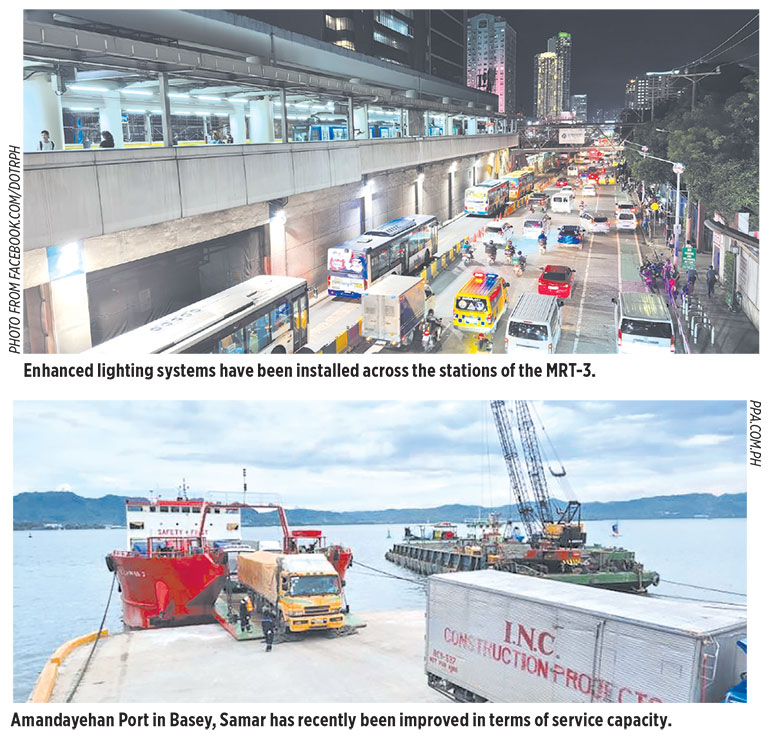
Maritime travel improvements have also been made in various ports in the country. An example of this is the Amandayehan Port in Basey, Samar. Improvements made on the port include increasing its service capacity, with six landing craft tank (LCT) vessels, as well as addressing the alleged “palakasan” (patronage) system and illegal collection of fees raised by port users.
Last year, the Philippine Ports Authority, under the DoTr, said that it allocated as much as P1.42 billion for the expansion and improvement of three ports in the country, including the third phase of the Malalag Port expansion project in Davao del Sur; Lipata Port improvement project in Surigao del Norte; and Buenavista Port expansion project in Guimaras.
Sustainable transport
 Aside from these achievements in different areas of transportation, the DoTr has also begun on projects that seek to make Philippine transport more convenient, inclusive, and sustainable.
Part of this is the transportation department’s recently launched Active Transport Project, aimed at promoting healthier and more sustainable modes of transport. Under the program, pedestrians and non-motorized vehicles are prioritized in the hierarchy of road users, with the DoTr mandated to focus on the development of active transport infrastructure. The project is pegged to establish 2,400 kilometers of protected and dedicated lanes for cyclists by 2028.
Topping off the agency’s lengthy list of accomplishments, the Transportation department, together with the DICT, launched the DICT Free WiFi for All program along EDSA Busway Stations, which will provide internet connection to over 183,000 passengers daily. Based on data from the department, the EDSA busway ridership jumped by 6% from 63.02 million in 2024 to 66.67 million last year.
Projects in the pipeline for the agency include the highly anticipated Metro Manila Subway Project (MMSP), often referred to as the “Project of the Century.” Complementing this is the North-South Commuter Railway (NSCR) system, a massive 147-kilometer rail network that will link Clark in Pampanga to Calamba in Laguna. The agency is also making significant strides in regional rail development through the PNR South Long Haul project, popularly known as the “Bicol Express.”
The department is also looking into the development of more Intermodal Terminal Exchanges (ITX) to provide commuters with seamless transfers between different modes of transport, similar to the operations of the Parañaque Integrated Terminal Exchange (PITX).
As the DoTr enters its 127th year, these ambitious projects signify its vision of a Philippines that is fully connected and economically vibrant. By blending the preservation of its historical mandate with the adoption of world-class technology and sustainable practices, the DoTr continues to drive the nation forward and ensure that the “engine” of the Philippine economy remains fueled for the generations of commuters yet to come. — Jomarc Angelo M. Corpuz
You May Also Like

Solana Hits $4B in Corporate Treasuries as Companies Boost Reserves

SHIB Price Prediction: Mixed Signals Point to $0.0000085 Target by February End
