

Polymarket Odds Surge to 77% for January US Government Shutdown
Introduction
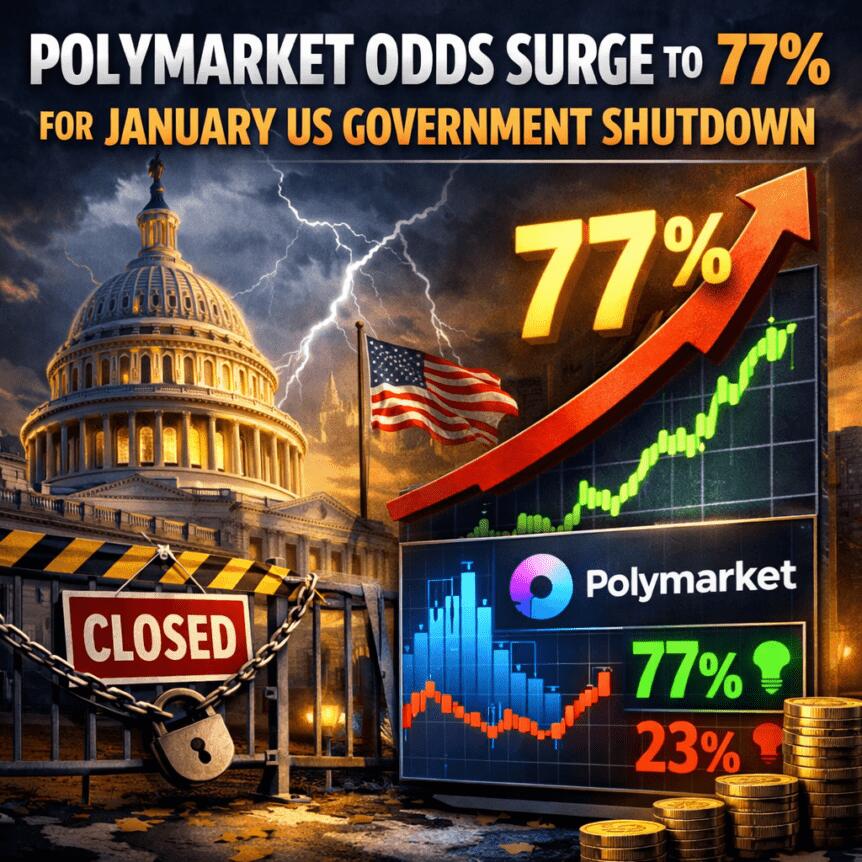
Polymarket bettors are pricing in a 77% probability of a new US federal government shutdown by January 31, a jump of about 67% in just 24 hours. The spike unfolds as lawmakers push the CLARITY Act, a core crypto-regulatory proposal that has stalled amid the fallout from the record-long shutdown that dominated Washington late last year. Senate Democrats led by Chuck Schumer signaled they might block progress on the broader appropriations bill if funding for the Department of Homeland Security is attached, injecting political risk into crypto policy discourse. The week’s headlines also featured a Minneapolis incident and renewed debate over regulation, with Coinbase (EXCHANGE: COIN) CEO Brian Armstrong warning that an inadequate bill could undermine competitiveness in the sector. President Donald Trump also floated the possibility of another shutdown, underscoring ongoing political volatility that could spill into digital-asset policy.
Key Takeaways
- Polymarket’s odds of a January 31 US government shutdown reached roughly 77%, rising 67% over the previous 24 hours.
- The CLARITY Act remains in flux in Congress, with delays tied to the last shutdown and uncertainty about a second markup window (4–6 weeks is cited by some observers).
- Senate Democrats stated they would not provide votes to proceed with the appropriations bill if DHS funding were included, complicating the regulatory path for crypto reform.
- Coinbase (EXCHANGE: COIN) CEO Brian Armstrong cautioned that the current draft of the CLARITY Act could be materially worse than the status quo, potentially eroding the industry’s competitive position.
- Former President Trump suggested another potential shutdown could occur, highlighting the persistent political volatility shaping regulatory expectations.
Tickers mentioned: $COIN
Sentiment: Neutral
Price impact: Neutral. The activity reflects political risk pricing into a crypto-regulatory framework rather than immediate asset moves.
Market context: The episodes illustrate how US budget dynamics and regulatory policy intersect with crypto markets, particularly around stablecoins and market structure debates that influence investor confidence and liquidity.
Why it matters
The ongoing dialogue over the CLARITY Act sits at the crosscurrents of policy clarity and crypto innovation. When lawmakers grapple with the text of crypto legislation, market participants monitor how changes could affect stablecoin yields, custody standards, and the broader framework governing digital assets. The price action in the Polymarket derivative reflects traders’ interpretation of who might win or lose in negotiations that could reshape market structure, funding, and enforcement expectations. A cleared timetable for a markup or the introduction of a revised bill could alter how firms plan product launches, risk controls, and lobbying strategies.
Industry players have voiced concerns about the bill’s current form. Armstrong’s warning that the version in circulation could be worse than the status quo underscores a broader industry demand for thoughtful, workable regulation rather than haste. The conversation is not purely aspirational; it carries real implications for competitiveness, innovation, and capital allocation within crypto markets. As lawmakers weigh compromises, operators and investors will continue to calibrate risk appetite in light of potential shifts in stablecoin policy, exchange rules, and the treatment of digital assets in light of traditional financial regulation.
Beyond policy specifics, the political environment—exemplified by remarks from Schumer and other leaders—affects how the market prices risk in the sector. The shutdown discourse is a reminder that legislative inertia can slow the deployment of frameworks that many in the crypto industry view as essential for legitimacy and mainstream adoption. In parallel, the regulatory dialogue remains interconnected with other market forces, including macro risk sentiment and the performance of crypto-related investment products, which have themselves faced their own cycles of inflows and outflows that reflect broader investor appetite for digital assets.
What to watch next
- Progress on the CLARITY Act: whether a second markup will occur within the proposed 4–6 week window and what revisions might be introduced.
- Senate negotiations on DHS funding: whether a path exists to attach or sever DHS funding from the broader appropriations bill.
- Industry responses: how major crypto firms and lobbyists adjust messaging and position as versions of the bill evolve.
- Polymarket odds updates: whether the market assigns greater or lesser probability to a shutdown as political signals shift.
- Public statements from Coinbase and other crypto executives: any new commentary on how policy design could affect market structure and competitiveness.
Sources & verification
- Polymarket event page: “Will there be another US government shutdown by January 31.”
- Senate Democratic Leader Chuck Schumer’s public stance on DHS funding and bill progression (X post).
- CBS News Minneapolis shooting coverage for contemporaneous context on the week’s headlines.
- Fox Business interview excerpts with former President Donald Trump discussing potential future shutdowns.
- Coinbase (EXCHANGE: COIN) CEO Brian Armstrong’s comments on CLARITY Act proposals (Cointelegraph).
- Public discussions around the 43-day US government shutdown and its influence on legislative timing and crypto policy.
Market reaction and regulatory drift: Polymarket odds surge as CLARITY Act stalls
Polymarket’s latest pricing reveals a market that is increasingly tethered to political outcomes rather than purely financial indicators. The platform’s odds for a January 31 government shutdown sit near 77%, a striking 67% advance over the prior day, illustrating how policy risk can translate into derivative markets that price in legislative uncertainty. The slam of headlines surrounding budget fights and crypto-regulatory debates has created a nucleus of speculative activity that reaches beyond traditional asset classes, reflecting traders’ expectations about which side of the aisle will shape crypto policy in the coming weeks.
Central to the debate is the CLARITY Act itself. The bill, designed to clarify the regulatory environment for digital assets, has faced persistent delays in Congress, with aides pointing to the fallout from the last shutdown as a complicating factor. Observers have framed the timeline for a markup as a litmus test for how seriously lawmakers intend to advance crypto reform this session. Galaxy Digital’s Alex Thorn highlighted industry concerns about stablecoin yields within this dynamic, noting that the banking lobby’s position on competition could influence the bill’s reception and ultimate form.
The political dynamics around DHS funding add another layer to policy considerations. Schumer’s assertion that senators will withhold votes to proceed with the appropriations package if DHS funding is included signals that partisan fault lines could stall or reshape the bill’s trajectory. In parallel, a broader political conversation—spurred by remarks from other leaders and a series of high-profile media appearances—continues to inject uncertainty into how and when crypto policy will crystallize. The impact on market participants is not limited to speculative bets; it touches on product development, investor confidence, and the long-run path to regulatory legitimacy for digital assets.
From a market structure perspective, industry voices have urged that any regulatory framework should preserve incentives for innovation while providing clear guardrails. Armstrong’s argument—that the current draft could undermine the competitive position of the sector—embodies a broader plea for balanced regulation that protects consumers without stifling growth. As lawmakers weigh compromises and revisions, the crypto industry will be watching closely to see whether a bipartisan path emerges or if political gridlock prolongs the status quo. The outcome will help define how digital assets and associated services are integrated into the traditional financial system in the years ahead.
This article was originally published as Polymarket Odds Surge to 77% for January US Government Shutdown on Crypto Breaking News – your trusted source for crypto news, Bitcoin news, and blockchain updates.


You May Also Like

Ripple CEO Tells Bloomberg: What Are Working Daily to Take Over SWIFT

Citigroup boosts Bitcoin exposure with $41.2M in Strategy shares




