The US dollar is weakening, yet Bitcoin continues to lag, and the reason is not bearish pressure but a lack of risk appetite. The post Dollar Is Weak, but Why IsThe US dollar is weakening, yet Bitcoin continues to lag, and the reason is not bearish pressure but a lack of risk appetite. The post Dollar Is Weak, but Why Is

Dollar Is Weak, but Why Is Bitcoin Lagging?

2026/01/26 20:35
3 min read

The US Dollar Index has fallen to around 97.17, with the latest 24‑hour change near minus 0.4%. In past cycles, this kind of move often helped Bitcoin, but this time, it has not. Bitcoin BTC $87 672 24h volatility: 1.1% Market cap: $1.75 T Vol. 24h: $53.19 B is trading near $87,000, down more than 6% in the last seven days.

According to CryptoQuant analysts, the reason is simple. The dollar drop comes from fear, not from growth or easy money. Data shows that as the dollar slipped, gold attracted flows while Bitcoin ETFs saw large outflows. Capital did not rotate into risk assets, but it moved into safety.

When the dollar weakens due to stress and policy rumors, such as talk of yen support actions, Bitcoin trades like stocks, not like gold.

Risk Mood Overrides the Dollar Signal

The Bitcoin Dollar Pulse chart shared by CryptoQuant analysts shows that during 2024 and early 2025, Bitcoin rose with a firm or stable dollar. The rally pushed BTC above $100,000 and later near $120,000 while DXY stayed near or above 100. The current phase is different because when DXY breaks down, Bitcoin also pulls back.
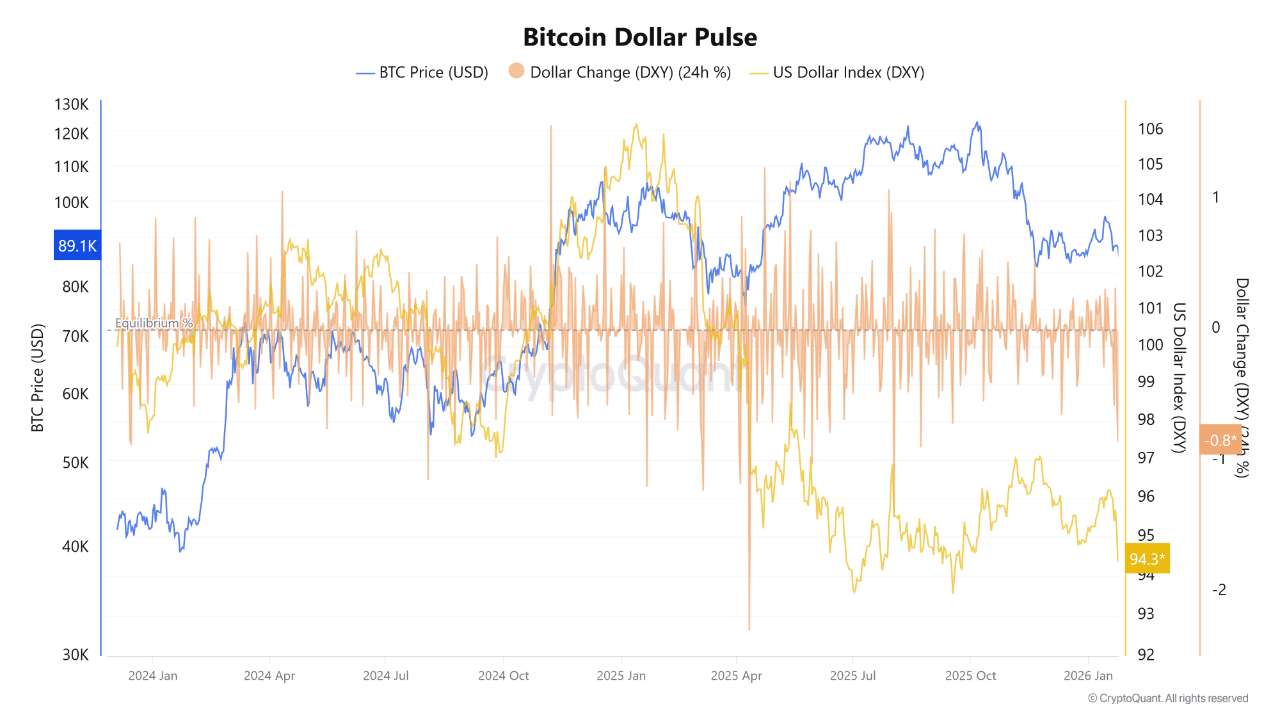
BTC dollar pulse chart | Source: CryptoQuant

BTC dollar pulse chart | Source: CryptoQuant

Analysts claim that the link is not direct and the driver is risk mood. A weak dollar only helps Bitcoin when inflation fear or easy liquidity pushes investors to take risk.

Right now, the move in FX markets is sending money to gold, not to crypto. A weak dollar is only the background and the market is missing risk appetite, added analysts.

Spot Demand in the US Is Still Missing

The Coinbase Premium Index stays deep below zero as Bitcoin continues to trade at a discount on Coinbase versus offshore exchanges. This points to steady sell pressure from US spot flows.

Even during short bounces, the discount holds which means institutions and long‑term US buyers are not active. In past cycles, a long negative premium indicated weak spot demand and capital moving away from US venues.
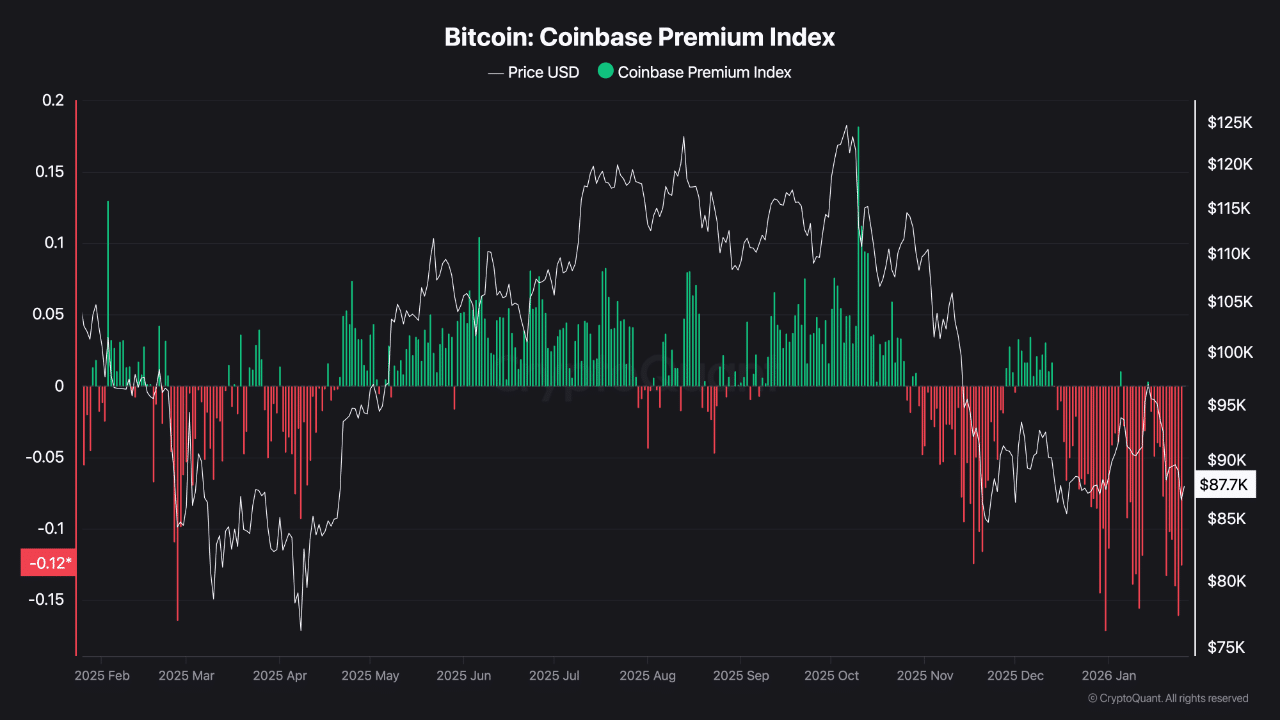
Bitcoin Coinbase premium index | Source: CryptoQuant

Bitcoin Coinbase premium index | Source: CryptoQuant

Without a turn back to positive, upside moves rely on futures and short‑term trades, not on strong accumulation.

Below the 21‑Week Line

Matrixport pointed out that Bitcoin is below its 21‑week moving average, a level near $96,000. This line has defined bull and bear phases for years. When price holds above it, trends stay strong. When price falls below it, deeper pullbacks often follow.

In late 2025, Bitcoin broke under this level and later tried to reclaim it but failed. This rejection keeps Bitcoin in a corrective phase. According to the research firm, the broader range for BTC is between $121,000 in the bullish case and $70,000 zone if stress continues.

next

The post Dollar Is Weak, but Why Is Bitcoin Lagging? appeared first on Coinspeaker.

Disclaimer: The articles reposted on this site are sourced from public platforms and are provided for informational purposes only. They do not necessarily reflect the views of MEXC. All rights remain with the original authors. If you believe any content infringes on third-party rights, please contact [email protected] for removal. MEXC makes no guarantees regarding the accuracy, completeness, or timeliness of the content and is not responsible for any actions taken based on the information provided. The content does not constitute financial, legal, or other professional advice, nor should it be considered a recommendation or endorsement by MEXC.

You May Also Like

The Federal Reserve cut interest rates by 25 basis points, and Powell said this was a risk management cut

The Federal Reserve cut interest rates by 25 basis points, and Powell said this was a risk management cut

PANews reported on September 18th, according to the Securities Times, that at 2:00 AM Beijing time on September 18th, the Federal Reserve announced a 25 basis point interest rate cut, lowering the federal funds rate from 4.25%-4.50% to 4.00%-4.25%, in line with market expectations. The Fed's interest rate announcement triggered a sharp market reaction, with the three major US stock indices rising briefly before quickly plunging. The US dollar index plummeted, briefly hitting a new low since 2025, before rebounding sharply, turning a decline into an upward trend. The sharp market volatility was closely tied to the subsequent monetary policy press conference held by Federal Reserve Chairman Powell. He stated that the 50 basis point rate cut lacked broad support and that there was no need for a swift adjustment. Today's move could be viewed as a risk-management cut, suggesting the Fed will not enter a sustained cycle of rate cuts. Powell reiterated the Fed's unwavering commitment to maintaining its independence. Market participants are currently unaware of the risks to the Fed's independence. The latest published interest rate dot plot shows that the median expectation of Fed officials is to cut interest rates twice more this year (by 25 basis points each), one more than predicted in June this year. At the same time, Fed officials expect that after three rate cuts this year, there will be another 25 basis point cut in 2026 and 2027.
Share
PANews2025/09/18 06:54
SEC clears framework for fast-tracked crypto ETF listings

SEC clears framework for fast-tracked crypto ETF listings

The post SEC clears framework for fast-tracked crypto ETF listings appeared on BitcoinEthereumNews.com. The Securities and Exchange Commission has approved new generic listing standards for spot crypto exchange-traded funds, clearing the way for faster approvals. Summary SEC has greenlighted new generic listing standards for spot crypto ETFs. Rule change eliminates lengthy case-by-case approvals, aligning crypto ETFs with commodity funds. Grayscale’s Digital Large Cap Fund and Bitcoin ETF options also gain approval. The U.S. SEC has approved new generic listing standards that will allow exchanges to fast-track spot crypto ETFs, marking a pivotal shift in U.S. digital asset regulation. According to a Sept. 17 press release, the SEC voted to approve rule changes from Nasdaq, NYSE Arca, and Cboe BZX, enabling them to list and trade commodity-based trust shares, including those holding spot digital assets, without submitting individual proposals for each product. A streamlined path for crypto ETFs Under the new rules, an ETF can be listed without SEC sign-off if its underlying asset trades on a market with surveillance-sharing agreements, has active CFTC-regulated futures contracts for at least six months, or already represents at least 40% of an existing listed ETF. This brings crypto ETFs in line with traditional commodity-based funds under Rule 6c-11, eliminating a process that could take up to 240 days. SEC chair Paul Atkins said the move was designed to “maximize investor choice and foster innovation” while ensuring the U.S. remains the leading market for digital assets. Jamie Selway, director of the division of trading and markets, called the framework “a rational, rules-based approach” that balances access with investor protection. First products already approved Alongside the new standards, the SEC cleared the listing of the Grayscale Digital Large Cap Fund, which tracks spot assets based on the CoinDesk 5 Index. It also approved trading of options tied to the Cboe Bitcoin U.S. ETF Index and its mini version, with…
Share
BitcoinEthereumNews2025/09/18 14:04
⁉️ Epstein, a convicted pedo, invested in Coinbase

⁉️ Epstein, a convicted pedo, invested in Coinbase

The post ⁉️ Epstein, a convicted pedo, invested in Coinbase appeared on BitcoinEthereumNews.com. The latest Epstein Files release has placed a variety of powerful
Share
BitcoinEthereumNews2026/02/07 04:07