TechCabal Insights launched the State of Tech in Africa (SOTIA) report on January 23 2026. To discuss these findings, industry leaders, including investors, operatorsTechCabal Insights launched the State of Tech in Africa (SOTIA) report on January 23 2026. To discuss these findings, industry leaders, including investors, operators
In Africa’s more selective funding cycle, the pressure doesn’t go away; it changes
For feedback or concerns regarding this content, please contact us at [email protected]
Not long ago, Africa’s tech ecosystem was defined by how quickly capital could be raised and how aggressively companies could expand.
In 2025, that scorecard changed, as founders and investors entered an era where the growth-at-all-costs mentality changed to one of survival-at-all-costs. 2025 was a complete recalibration of what it means to build and fund a business on the continent, and the impact rippled across the ecosystem.
These shifts are reflected in the State of Tech in Africa (SOTIA) report, an annual report by TechCabal Insights that tracks funding patterns, mergers and acquisitions (M&A), exits and job cuts, regulation, and broader ecosystem trends. To discuss these findings, industry leaders, including investors, operators, and ecosystem stakeholders, gathered for a roundtable session at the launch of the report on Friday, January 23, 2026.
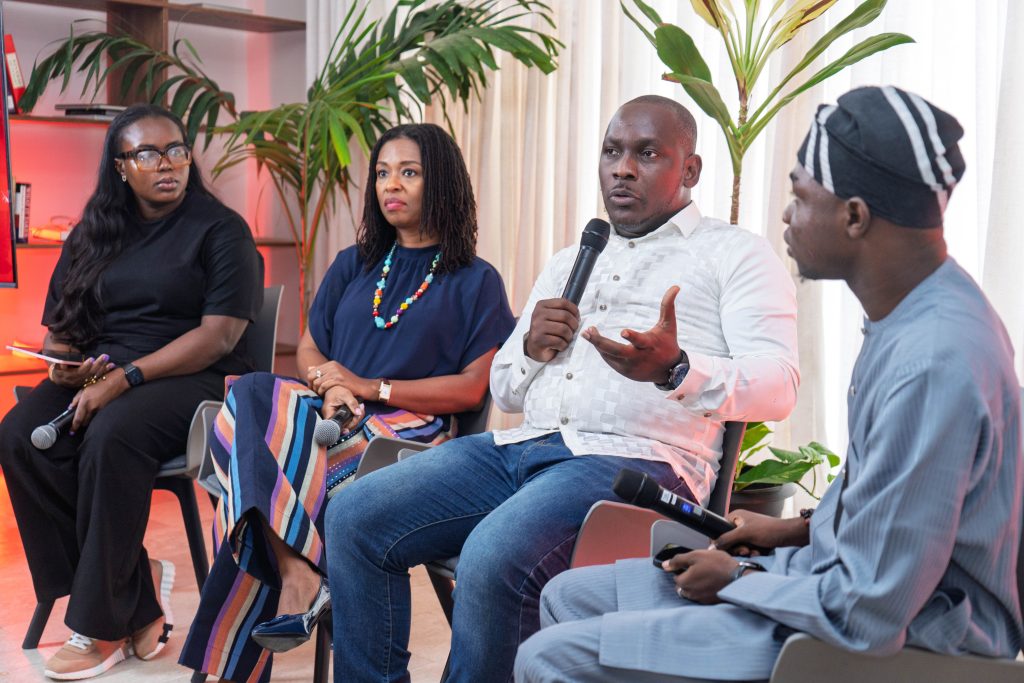
Lola Masha, partner at Antler, Segun Cole, Chief Executive Officer (CEO) of Maasai VC, and Dieko Ojo, investment associate at Novastar, sat with TechCabal’s Senior Editor, Ganiu Oloruntade, to reflect on the lessons from recent funding trends and the strategies founders and investors are adopting to navigate a more disciplined environment.
Dieko Ojo, Lola Masha, Segun Cole, and Ganiu Oloruntade at the SOTIA launch roundtable session. Image: Maryam Shittu.
According to the SOTIA report, Africa’s tech ecosystem raised $3.42 billion across 502 deals, a 53% year-on-year increase in funding, but an 8% decline in deal count from 546 in 2024. Masha argued that the drop reflects a shift in investor behaviour, as fewer bets are being placed and greater scrutiny is being applied to how businesses are built and scaled. This change in investor behaviour, she suggested, has forced a rethink of what growth means.
Rather than chasing scale at all costs, investors are focused on whether companies understand the fundamentals of their business.
“What investors are looking for is that you understand the unit economics, you’re not simply growing for the sake of growth, and you’ve thought about how your margin can, at some point in the (very short) future, keep the business going,” she said. “Investors expect a level of discipline and a bit of sophistication, from a knowledge perspective on what it takes to scale a business.”
This demand for discipline has introduced a new level of intensity for founders. The panellists agreed that pressure has always existed in venture building, but its nature has changed. Where founders once had time to experiment under generous capital conditions, today’s environment compresses timelines and magnifies consequences. For Ojo, this intensity is unavoidable.
“The pressure doesn’t go away,” she said. “It changes. And for you to want to take that leap of faith to start a business, you need to have come to terms with the fact that you will be under pressure.”
Although much of the pressure falls on founders, Cole reminded the room that it often originates from the obligations VCs themselves face.
“Investors are loyal to their LPs (Limited Partners),” he said, explaining that while investors may empathise with a founder’s vision, their primary loyalty is to the limited partners who gave them capital. That loyalty shapes how patient investors can afford to be with founders, particularly when capital is scarce.
Faced with these pressures, the panellists argued that founders and investors are responding with more practical strategies, one of which is mergers and acquisitions (M&A). The SOTIA report recorded 67 M&A transactions in 2025, numbers that have now been framed as tools for both survival and expansion.
“M&A is no longer a distress signal,” Cole said, noting that acquisitions are increasingly driven by regulatory access, licensing, and regional scale. In many cases, African companies are acquiring smaller firms to accelerate their entry into new markets, rather than starting from scratch.
Get The Best African Tech Newsletters In Your Inbox
Select your country Nigeria Ghana Kenya South Africa Egypt Morocco Tunisia Algeria Libya Sudan Ethiopia Somalia Djibouti Eritrea Uganda Tanzania Rwanda Burundi Democratic Republic of the Congo Republic of the Congo Central African Republic Chad Cameroon Gabon Equatorial Guinea São Tomé and Príncipe Angola Zambia Zimbabwe Botswana Namibia Lesotho Eswatini Mozambique Madagascar Mauritius Seychelles Comoros Cape Verde Guinea-Bissau Senegal The Gambia Guinea Sierra Leone Liberia Côte d'Ivoire Burkina Faso Mali Niger Benin Togo Other
Select your gender Male Female Others
Subscribe
Masha cautioned that not all acquisitions look the same from the outside, acknowledging that some deals are defensive rather than strategic. Regardless of motivation, she argued, the common thread is an emphasis on preserving long-term value.
“Founders are thinking about the best interest of the business… whether it’s because you don’t want your business to die or because it makes strategic sense,” she said. “The point is, you are creating value right at the stage that you’re at for your shareholders.”
As the session wrapped, panellists agreed that fewer deals do not necessarily signal a weaker ecosystem. Instead, they reflect greater selectivity ahead of the new financial year.
“Not everybody’s going to get money this year,” Ojo said, “but there will be a focus on sustainable companies and sustainable growth.”
For Masha, that selectivity is a sign of progress. “Are we in the promised land? Not yet. Are we on the right path? Absolutely,” Masha said. “We’re seeing a very good signal that the ecosystem is maturing, both on the founder side, investor side, and other stakeholders.”
Disclaimer: The articles reposted on this site are sourced from public platforms and are provided for informational purposes only. They do not necessarily reflect the views of MEXC. All rights remain with the original authors. If you believe any content infringes on third-party rights, please contact [email protected] for removal. MEXC makes no guarantees regarding the accuracy, completeness, or timeliness of the content and is not responsible for any actions taken based on the information provided. The content does not constitute financial, legal, or other professional advice, nor should it be considered a recommendation or endorsement by MEXC.


 Dieko Ojo, Lola Masha, Segun Cole, and Ganiu Oloruntade at the SOTIA launch roundtable session. Image: Maryam Shittu.