BlackRock has filed an S-1 for an “iShares Bitcoin Premium Income ETF,” a product that aims to track bitcoin’s price while generating option premium by systematicallyBlackRock has filed an S-1 for an “iShares Bitcoin Premium Income ETF,” a product that aims to track bitcoin’s price while generating option premium by systematically

BlackRock Files Bitcoin Premium Income ETF: What It Could Mean For BTC

2026/01/27 12:00
3 min read
For feedback or concerns regarding this content, please contact us at [email protected]

BlackRock has filed an S-1 for an “iShares Bitcoin Premium Income ETF,” a product that aims to track bitcoin’s price while generating option premium by systematically selling calls tied primarily to its own spot bitcoin ETF, IBIT. For BTC-linked derivatives markets, the filing is being read less as a directional catalyst and more as another potential source of mechanical volatility supply.

Bloomberg ETF analyst Eric Balchunas flagged the document on X, noting that key commercial details are still missing. “BlackRock just dropped the official S-1 for it’s upcoming iShares Bitcoin Premium Income ETF.. no fee or ticker yet,” Balchunas wrote. “The strategy is to ‘track performance of the price of bitcoin while providing premium income through an actively managed strategy of writing (selling) call options primarily on IBIT shares and, from time to time, on ETP Indices.’”

Here’s What It Could Mean For Bitcoin

The basic premise is familiar to anyone who has watched covered-call equity ETFs: sell upside to monetize implied volatility. In bitcoin’s case, the underlying options are written on an ETF wrapper rather than directly on BTC, but the economic effect is similar, steady call overwriting can increase supply of short-dated upside exposure and compress the premiums available to sellers over time, particularly if multiple products pursue comparable programs.

That dynamic was the focus of commentary from Wintermute’s head of OTC trading, Jake Ostrovskis, who framed the filing as additive to an already crowded volatility-selling landscape. “BTC vols already suffer from significant oversupply following the rollout of ETFs, SP’s & options on IBIT,” Ostrovskis posted. “Now add more mechanical vol selling and the only logical outcome is further steady decline in yield from market-implied premiums.”

The implication is not that bitcoin’s price must fall because a premium-income ETF exists, but that the “income” component could become harder to sustain at attractive levels if implied volatility continues to be leaned on by systematic call sellers. In that world, headline yields may drift lower, and the payoff profile becomes increasingly path-dependent, premium capture in quiet regimes can look reliable, but it can also leave investors structurally underexposed to sharp upside moves if BTC trends higher through the strikes being sold.

For market participants trying to extract option premia from BTC exposure, Ostrovskis argued the edge shifts away from simply being short vol and toward execution and distribution. “Structuring/timing + leaning on axes via OTC desks will become increasingly important to optimise returns on otherwise dormant assets,” he wrote, pointing to the growing role of bespoke structuring, strike selection, tenor management, and liquidity access as the trade becomes more crowded.

If BlackRock proceeds and demand materializes, the next question for traders will be how much incremental call supply the strategy represents relative to existing IBIT options activity and whether that supply concentrates in specific expiries or strikes. Either way, the filing underscores a broader maturation trend: as BTC exposure becomes more ETF-native, the center of gravity for volatility pricing may continue to migrate toward the wrapper’s options market, with implied premiums increasingly shaped by systematic flows rather than discretionary views.

At press time, Bitcoin traded at $87,633.
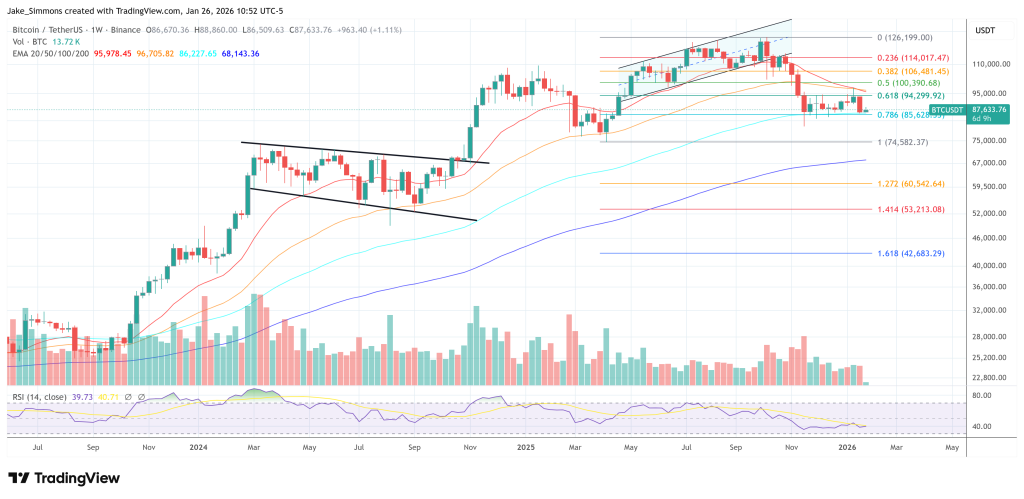
Bitcoin price chart
Disclaimer: The articles reposted on this site are sourced from public platforms and are provided for informational purposes only. They do not necessarily reflect the views of MEXC. All rights remain with the original authors. If you believe any content infringes on third-party rights, please contact [email protected] for removal. MEXC makes no guarantees regarding the accuracy, completeness, or timeliness of the content and is not responsible for any actions taken based on the information provided. The content does not constitute financial, legal, or other professional advice, nor should it be considered a recommendation or endorsement by MEXC.

You May Also Like

The Channel Factories We’ve Been Waiting For

The Channel Factories We’ve Been Waiting For

The post The Channel Factories We’ve Been Waiting For appeared on BitcoinEthereumNews.com. Visions of future technology are often prescient about the broad strokes while flubbing the details. The tablets in “2001: A Space Odyssey” do indeed look like iPads, but you never see the astronauts paying for subscriptions or wasting hours on Candy Crush.  Channel factories are one vision that arose early in the history of the Lightning Network to address some challenges that Lightning has faced from the beginning. Despite having grown to become Bitcoin’s most successful layer-2 scaling solution, with instant and low-fee payments, Lightning’s scale is limited by its reliance on payment channels. Although Lightning shifts most transactions off-chain, each payment channel still requires an on-chain transaction to open and (usually) another to close. As adoption grows, pressure on the blockchain grows with it. The need for a more scalable approach to managing channels is clear. Channel factories were supposed to meet this need, but where are they? In 2025, subnetworks are emerging that revive the impetus of channel factories with some new details that vastly increase their potential. They are natively interoperable with Lightning and achieve greater scale by allowing a group of participants to open a shared multisig UTXO and create multiple bilateral channels, which reduces the number of on-chain transactions and improves capital efficiency. Achieving greater scale by reducing complexity, Ark and Spark perform the same function as traditional channel factories with new designs and additional capabilities based on shared UTXOs.  Channel Factories 101 Channel factories have been around since the inception of Lightning. A factory is a multiparty contract where multiple users (not just two, as in a Dryja-Poon channel) cooperatively lock funds in a single multisig UTXO. They can open, close and update channels off-chain without updating the blockchain for each operation. Only when participants leave or the factory dissolves is an on-chain transaction…
Share
BitcoinEthereumNews2025/09/18 00:09
The Virtual Hospital: How IT Infrastructure is Powering the Next Wave of Remote Patient Monitoring

The Virtual Hospital: How IT Infrastructure is Powering the Next Wave of Remote Patient Monitoring

Introduction to the Virtual Hospital Revolution The healthcare industry is undergoing a transformative shift as virtual hospitals emerge at the forefront of patient
Share
Techbullion2026/03/20 14:45
People have their uses: Agentic Wallet and the next decade of wallets

People have their uses: Agentic Wallet and the next decade of wallets

Written by: Lacie Zhang, Bitget Wallet Researcher In 1984, Apple (Macintosh) killed the command line with a mouse. In 2026, Agent is killing the mouse. This is
Share
PANews2026/03/20 14:13