

Chainalysis: Crypto Money Laundering Surged to $82 Billion in 2025
Illicit cryptocurrency money laundering activity climbed to over $82 billion in 2025, marking an eightfold increase from $10 billion in 2020, according to blockchain analysis firm Chainalysis.
The considerable growth reflects increased accessibility and liquidity of cryptocurrencies, associated with significant changes in laundering operations. Chinese-language money laundering networks (CMLNs) have surged to become dominant players, processing $16.1 billion—approximately $44 million daily across more than 1,799 active wallets—and now account for roughly 20% of known illicit laundering activity, according to the firm’s report.
This represents growth 7,325 times faster than inflows to centralized exchanges since 2020.
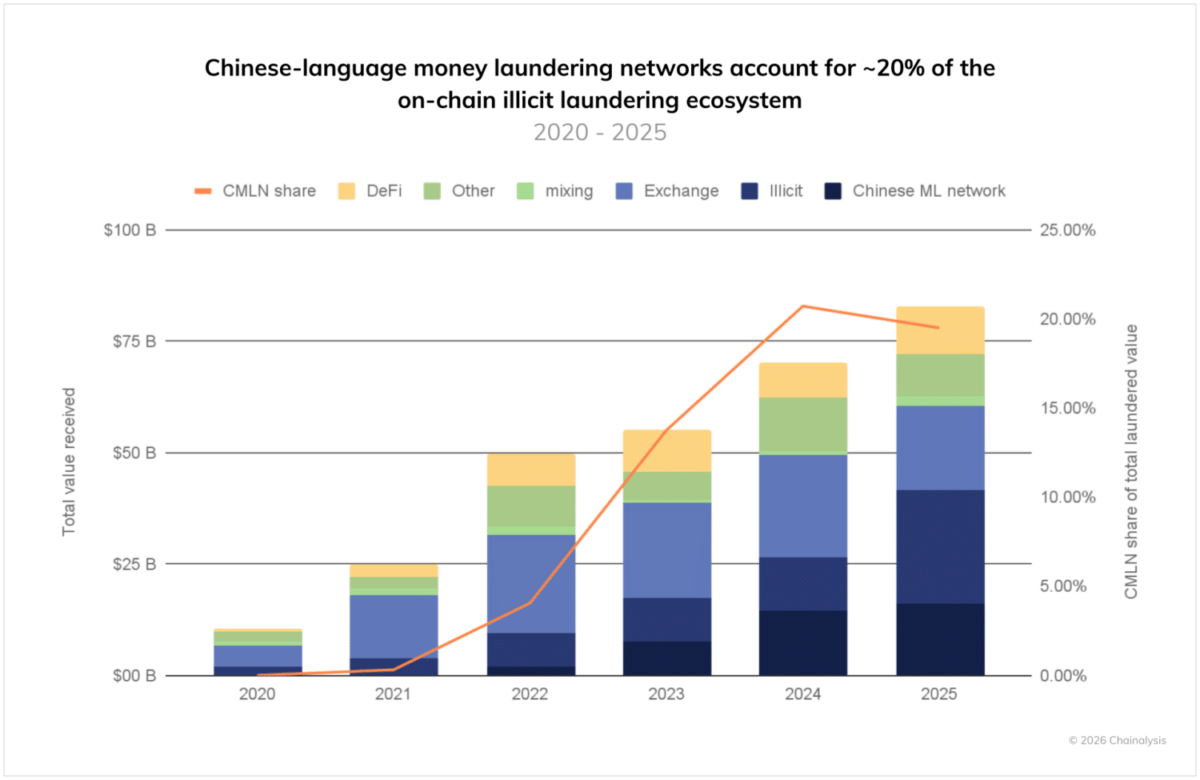
A graphic showing the value of money laundering from different sources and how CMLN dominates | Source: Chainalysis
How CMLNs Operate: Six Service Types Fueling Illicit Transfers
Chainalysis identified six distinct service types within the CMLN ecosystem: running point brokers, money mules, informal over-the-counter desks, Black U services, gambling platforms, and money movement services.
The networks primarily exploit China’s capital controls, with wealthy individuals seeking to move money out of China providing the liquidity pool to service organized crime groups. Chris Urben, Managing Director at Nardello & Co, explained that “the biggest change in Chinese money laundering networks in recent years is a rapid transition to crypto from reliance on informal value transfer systems.”
Authorities Crack Down But Networks Prove Resilient
China officially banned cryptocurrency trading in 2021, yet underground banking operations persist. In 2024, Chinese authorities prosecuted 3,032 individuals linked to crypto-related money laundering cases. Earlier in January 2026, South Korean customs dismantled a $102 million crypto remittance ring that used WeChat Pay and Alipay to disguise illegal transfers, with a Chinese national in his thirties coordinating the network.
Meanwhile, Cambodia has become another focal point, with Chainalysis reporting over $49 billion in crypto transactions linked to Huione Guarantee, a platform within the Cambodian conglomerate that serves CMLN vendors.
According to Chainalysis, combating these operations, which are highly resilient and adaptable, requires coordinated public-private partnerships that combine law enforcement’s legal authorities with blockchain analytics expertise to increase the cost and risk of operating large-scale laundering services.
nextThe post Chainalysis: Crypto Money Laundering Surged to $82 Billion in 2025 appeared first on Coinspeaker.


You May Also Like

Drake Mentions Bitcoin in New Song: Crypto Culture Impact

Bitcoin treasury sell-off accelerates as Riot, Bhutan, and public companies exit positions




