Wayfinder is centered around navigation paths and $PROMPT staking, while Daydreams is centered around the Hierarchical Task Network (HTN) and has yet to touch on token economics.Wayfinder is centered around navigation paths and $PROMPT staking, while Daydreams is centered around the Hierarchical Task Network (HTN) and has yet to touch on token economics.

Parallel's AI Agent Platform Wayfinder: Benefiting from on-chain game agents and integrating DeFi multi-scenario applications

2025/01/12 15:38

Author: bankless

Compiled by: Zen, PANews

Wayfinder is an emerging project dedicated to revolutionizing agents in an on-chain environment. The project is designed around $PROMPT and will hold a Token Generation Event (TGE) in Q1 2025.

As the industry continues to grow interest and attention in Wayfinder, this article will explain what Wayfinder is, how it works, and how to earn $PROMPT by staking $PRIME.

What is Wayfinder

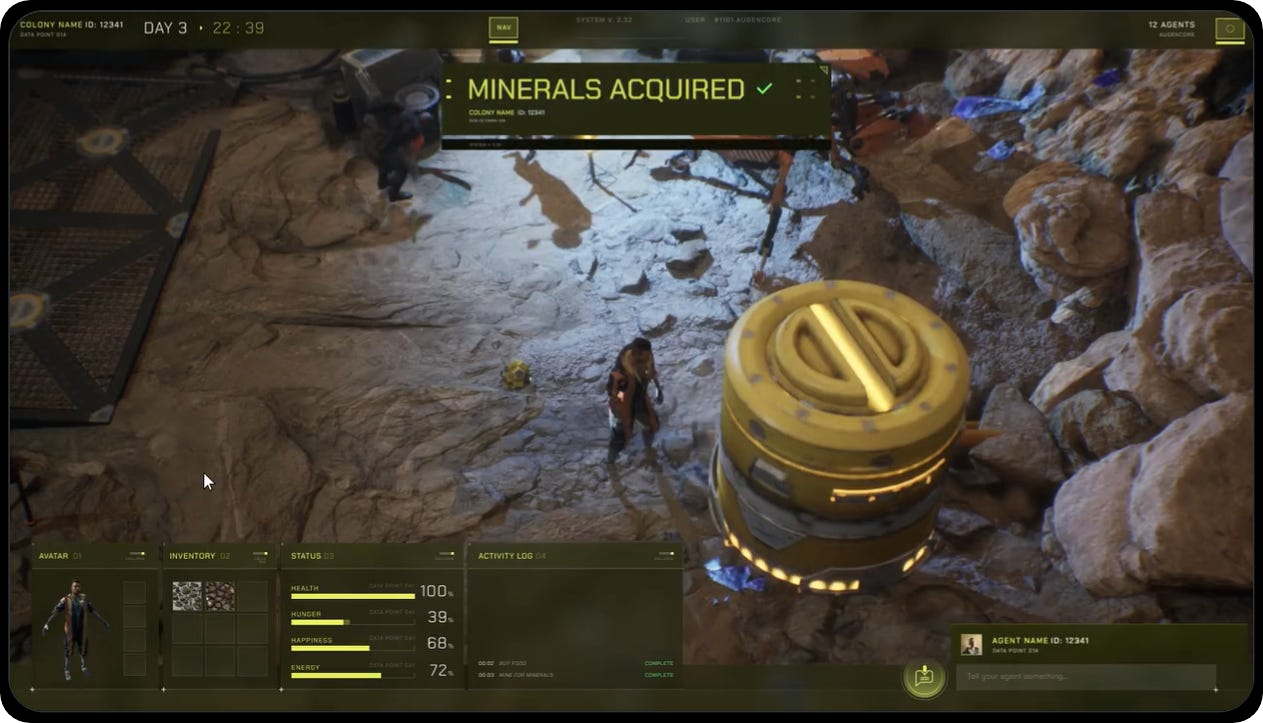
In April 2023, researchers at Stanford University published a paper detailing a case study in which 25 AI players simulated human behavior in an RPG game. This research inspired the developers of the Parallel card game to begin experimenting with developing an AI-centric game, which eventually developed into the upcoming Parallel Colony.

The idea is to create a new gaming paradigm where human players can control and benefit from a never-ending stream of gaming agents with unique personalities that learn from experience, accumulate resources on-chain, and influence and battle each other.

In order to realize Colony's vision, the Parallel team decided to develop a dedicated AI infrastructure. This decision led to the release of the Wayfinder white paper and the launch of the Wayfinder platform. Currently, the Wayfinder platform is online, but it is still in the closed Alpha testing phase, and its infrastructure is still under development.

It is worth noting that although Colony catalyzed the birth of Wayfinder, Wayfinder is designed not only to serve Colony or games. The system has on-chain compatibility and once opened, it will support various on-chain agents on multiple networks such as Ethereum, Solana, Base, etc.

How Wayfinder works

In the Wayfinder ecosystem, users can create agents to interact with blockchain applications on their behalf. For example, operations such as exchange, minting, cross-chain bridging, deployment, etc. can be completed through natural language instructions without manual clicks.

To help agents navigate in the on-chain environment, Wayfinder introduces Wayfinding Paths, which are predefined workflows. These paths are like roadmaps, providing navigation guidance for specific goals (such as completing a cross-chain DeFi revenue strategy).
Parallel's AI Agent Platform Wayfinder: Benefiting from on-chain game agents and integrating DeFi multi-scenario applications

This design facilitates an ever-growing knowledge graph that serves as a form of collective memory for Wayfinder agents, enabling them to continually self-improve without having to repeat mistakes or make decisions from scratch.

At the heart of the system is the upcoming native token $PROMPT, which can be used for staking to propose and maintain navigation paths and be rewarded through bounties or usage fees for new paths. $PROMPT may also be used to purchase advanced proxy features such as expanded storage, etc.

Earn $PROMPT by staking $PRIME

The planned total supply of $PROMPT is 1 billion, of which 45% will be allocated to community members who need to stake Parallel's token $PRIME within Wayfinder.

Staking activity has begun in June 2024 and will last until June 2027. The longer the lockup period, the greater the multiplier of the points allocated to $PROMPT that users will eventually receive. The specific benefits are not yet clear, but if the market value of $PROMPT reaches billions of dollars, this could bring considerable returns.

To participate, users only need to prepare some $PRIME on Ethereum or Base and follow the steps below:

  • Go to cache.wayfinder.ai
  • Log in using wallet to sign verification message
  • Click the Cache PRIME button, then click Cache PRIME again
  • Read the tips about choosing a lockup period and click “I Got It” – make sure not to stake any funds you can’t access right away!
  • Enter the amount of PRIME you want to stake and click “Next”
  • Select the desired lockup period, ranging from 21 days to 3 years, and click the “Preview PRIME Stake” button
  • Finally confirm the settings, click "Cache PRIME", and complete the transaction with your wallet
  • After staking, you can track your scores and badges in Wayfinder’s Overview page and deposit and withdraw them after the staking period ends.

Summarize

Wayfinder and a16z's Daydreams technology solve the same problem: how to enable on-chain agents to continuously learn and independently complete complex goals.

The core difference between the two lies in their unique architectural approaches. Wayfinder is centered around navigation paths and $PROMPT staking, while Daydreams is centered around the Hierarchical Task Network (HTN) and has yet to touch on token economics.

If you are into top on-chain games, are interested in AI, and expect these fields to become more popular and further intersect in the coming years, Wayfinder may be one of the interesting opportunities at the moment.


Disclaimer: The articles reposted on this site are sourced from public platforms and are provided for informational purposes only. They do not necessarily reflect the views of MEXC. All rights remain with the original authors. If you believe any content infringes on third-party rights, please contact [email protected] for removal. MEXC makes no guarantees regarding the accuracy, completeness, or timeliness of the content and is not responsible for any actions taken based on the information provided. The content does not constitute financial, legal, or other professional advice, nor should it be considered a recommendation or endorsement by MEXC.

You May Also Like

Headwind Helps Best Wallet Token

Headwind Helps Best Wallet Token

The post Headwind Helps Best Wallet Token appeared on BitcoinEthereumNews.com. Google has announced the launch of a new open-source protocol called Agent Payments Protocol (AP2) in partnership with Coinbase, the Ethereum Foundation, and 60 other organizations. This allows AI agents to make payments on behalf of users using various methods such as real-time bank transfers, credit and debit cards, and, most importantly, stablecoins. Let’s explore in detail what this could mean for the broader cryptocurrency markets, and also highlight a presale crypto (Best Wallet Token) that could explode as a result of this development. Google’s Push for Stablecoins Agent Payments Protocol (AP2) uses digital contracts known as ‘Intent Mandates’ and ‘Verifiable Credentials’ to ensure that AI agents undertake only those payments authorized by the user. Mandates, by the way, are cryptographically signed, tamper-proof digital contracts that act as verifiable proof of a user’s instruction. For example, let’s say you instruct an AI agent to never spend more than $200 in a single transaction. This instruction is written into an Intent Mandate, which serves as a digital contract. Now, whenever the AI agent tries to make a payment, it must present this mandate as proof of authorization, which will then be verified via the AP2 protocol. Alongside this, Google has also launched the A2A x402 extension to accelerate support for the Web3 ecosystem. This production-ready solution enables agent-based crypto payments and will help reshape the growth of cryptocurrency integration within the AP2 protocol. Google’s inclusion of stablecoins in AP2 is a massive vote of confidence in dollar-pegged cryptocurrencies and a huge step toward making them a mainstream payment option. This widens stablecoin usage beyond trading and speculation, positioning them at the center of the consumption economy. The recent enactment of the GENIUS Act in the U.S. gives stablecoins more structure and legal support. Imagine paying for things like data crawls, per-task…
Share
BitcoinEthereumNews2025/09/18 01:27
Bitcoin devs cheer block reconstruction stats, ignore security budget concerns

Bitcoin devs cheer block reconstruction stats, ignore security budget concerns

The post Bitcoin devs cheer block reconstruction stats, ignore security budget concerns appeared on BitcoinEthereumNews.com. This morning, Bitcoin Core developers celebrated improved block reconstruction statistics for node operators while conveniently ignoring the reason for these statistics — the downward trend in fees for Bitcoin’s security budget. Reacting with heart emojis and thumbs up to a green chart showing over 80% “successful compact block reconstructions without any requested transactions,” they conveniently omitted red trend lines of the fees that Bitcoin users pay for mining security which powered those green statistics. Block reconstructions occur when a node requests additional information about transactions within a compact block. Although compact blocks allow nodes to quickly relay valid bundles of transactions across the internet, the more frequently that nodes can reconstruct without extra, cumbersome transaction requests from their peers is a positive trend. Because so many nodes switched over in August to relay transactions bidding 0.1 sat/vB across their mempools, nodes now have to request less transaction data to reconstruct blocks containing sub-1 sat/vB transactions. After nodes switched over in August to accept and relay pending transactions bidding less than 1 sat/vB, disparate mempools became harmonized as most nodes had a better view of which transactions would likely join upcoming blocks. As a result, block reconstruction times improved, as nodes needed less information about these sub-1 sat/vB transactions. In July, several miners admitted that user demand for Bitcoin blockspace had persisted at such a low that they were willing to accept transaction fees of just 0.1 satoshi per virtual byte — 90% lower than their prior 1 sat/vB minimum. With so many blocks partially empty, they succumbed to the temptation to accept at least something — even 1 billionth of one bitcoin (BTC) — rather than $0 to fill up some of the excess blockspace. Read more: Bitcoin’s transaction fees have fallen to a multi-year low Green stats for block reconstruction after transaction fees crash After…
Share
BitcoinEthereumNews2025/09/18 04:07