Crypto phishing websites are becoming increasingly difficult to stop, and big tech is not doing enough to stop them.Crypto phishing websites are becoming increasingly difficult to stop, and big tech is not doing enough to stop them.

DeFi user loses $1.2m on fake Uniswap site as phishing scams flood Google Ads

2 min read

One DeFi user lost over $1.23 million after falling victim to a scam that utilizes Google Ads to promote fraudulent websites.

Crypto scams are becoming increasingly rampant, and major platforms appear to be doing insufficiently to prevent them. On Monday, July 21, one DeFi user lost over $1.23 million in Uniswap NFTs after signing a malicious transaction on a phishing website. What is worse, scam sites like these are rampant on the Google Ads platform.

https://twitter.com/realScamSniffer/status/1947198066907582590

According to Scam Sniffer, the user in question accessed a phishing website meant to look the same as the Uniswap platform. Once there, they signed a malicious transaction which included a line that automatically approves all further transfers. After that, the attackers were able to access all NFTs on Uniswap V3 and transfer them to their wallets.

Phishing sites rampant on Google Ads

While Scam Sniffer did not confirm the domain used in the attack, phishing sites like these are rampant online. Notably, attackers use Punycode URLs, which use the Cyrillic alphabet to make the URL appear almost identical to a legitimate one.

For the scam to work, users don’t have to share their private wallet keys with the attackers. Instead, just signing a malicious smart contract is enough to authorize the attacker to gain access to all the assets on a user’s wallet.

Scammers then serve these URLs through direct messages and Google Ads. Notably, these ads appear as top results on Google for several major DeFi platforms. Google also profits from these types of scams, collecting revenue every time a user clicks on a malicious site.
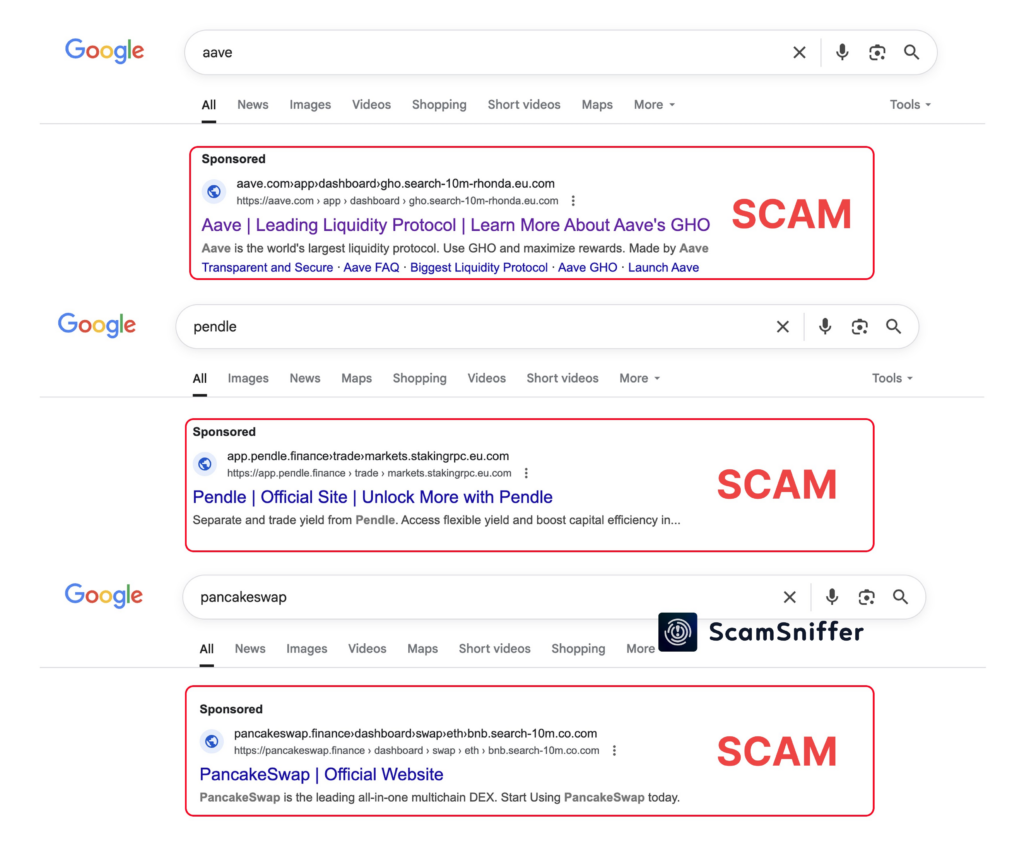
Google page showing results for several popular crypto platforms, with phishing sites as top ad results

The ubiquity of these scam sites on Google Ads suggests that the tech giant does not do adequate vetting when it comes to its advertisers.


Market Opportunity
LETSTOP Logo
LETSTOP Price(STOP)
$0.01821
$0.01821$0.01821
-0.38%
USD
LETSTOP (STOP) Live Price Chart
Disclaimer: The articles reposted on this site are sourced from public platforms and are provided for informational purposes only. They do not necessarily reflect the views of MEXC. All rights remain with the original authors. If you believe any content infringes on third-party rights, please contact [email protected] for removal. MEXC makes no guarantees regarding the accuracy, completeness, or timeliness of the content and is not responsible for any actions taken based on the information provided. The content does not constitute financial, legal, or other professional advice, nor should it be considered a recommendation or endorsement by MEXC.

You May Also Like

XRPR and DOJE ETFs debut on American Cboe exchange

XRPR and DOJE ETFs debut on American Cboe exchange

The post XRPR and DOJE ETFs debut on American Cboe exchange appeared on BitcoinEthereumNews.com. Today is a historical milestone for two of the biggest cryptocurrencies, XRP and Dogecoin. REX-Osprey announced the official listing of two spot exchange-traded funds (ETFs) that track the price of XRP and Dogecoin in the United States. The new crypto funds are available for US investors on the Cboe BZX Exchange. The REX-Osprey XRP ETF is trading with ticker XRPR, while the DOGE ETF is listed with ticker DOJE. The first XRP and DOGE ETFs were listed today, and they provide direct spot exposure to Dogecoin and XRP. XRPR and DOJE are gates to crypto exposure XRPR provides exposure to XRP, the native token of the XRP Ledger, which is a blockchain that enables fast and low-cost cross-border transactions. DOJE, on the other hand, is the first-ever Dogecoin ETF. It offers investors regulated access to the first memecoin that built global recognition through its Shiba Inu mascot and active online community. Both funds use a structure under the Investment Company Act of 1940, which governs open-end mutual funds and ETFs in the US. This law was designed to protect investors from fraud, conflicts of interest, and poor oversight. This route gives investors the protections of a regulated open-end ETF. Each fund will hold a majority of its assets in spot XRP or DOGE, while also investing at least 40% in other crypto ETFs and ETPs, including those traded outside the United States. According to the SEC filing, XRPR charges an expense ratio of 0.75%, while DOJE charges 1.50%. The funds may also use a Cayman Islands subsidiary to buy crypto directly. This setup copies REX-Osprey’s Solana + Staking ETF (SSK), which launched in July and quickly grew past $275 million in assets. Greg King, the CEO and founder of REX Financial and Osprey Funds, said, “Investors look to ETFs as…
Share
BitcoinEthereumNews2025/09/19 03:14
Over 60% of crypto press releases linked to high-risk or scam projects: Report

Over 60% of crypto press releases linked to high-risk or scam projects: Report

A data analysis shows crypto press release wires are dominated by scam-linked projects, hype-driven content and low-impact announcements, raising concerns about
Share
Crypto.news2026/02/04 22:02
Outlook remains cautious – TD Securities

Outlook remains cautious – TD Securities

The post Outlook remains cautious – TD Securities appeared on BitcoinEthereumNews.com. TD Securities analysts anticipate that the Bank of England’s Monetary Policy
Share
BitcoinEthereumNews2026/02/04 22:15




