

US Crypto Bill Nears Senate Vote as Lawmakers Debate SEC vs CFTC
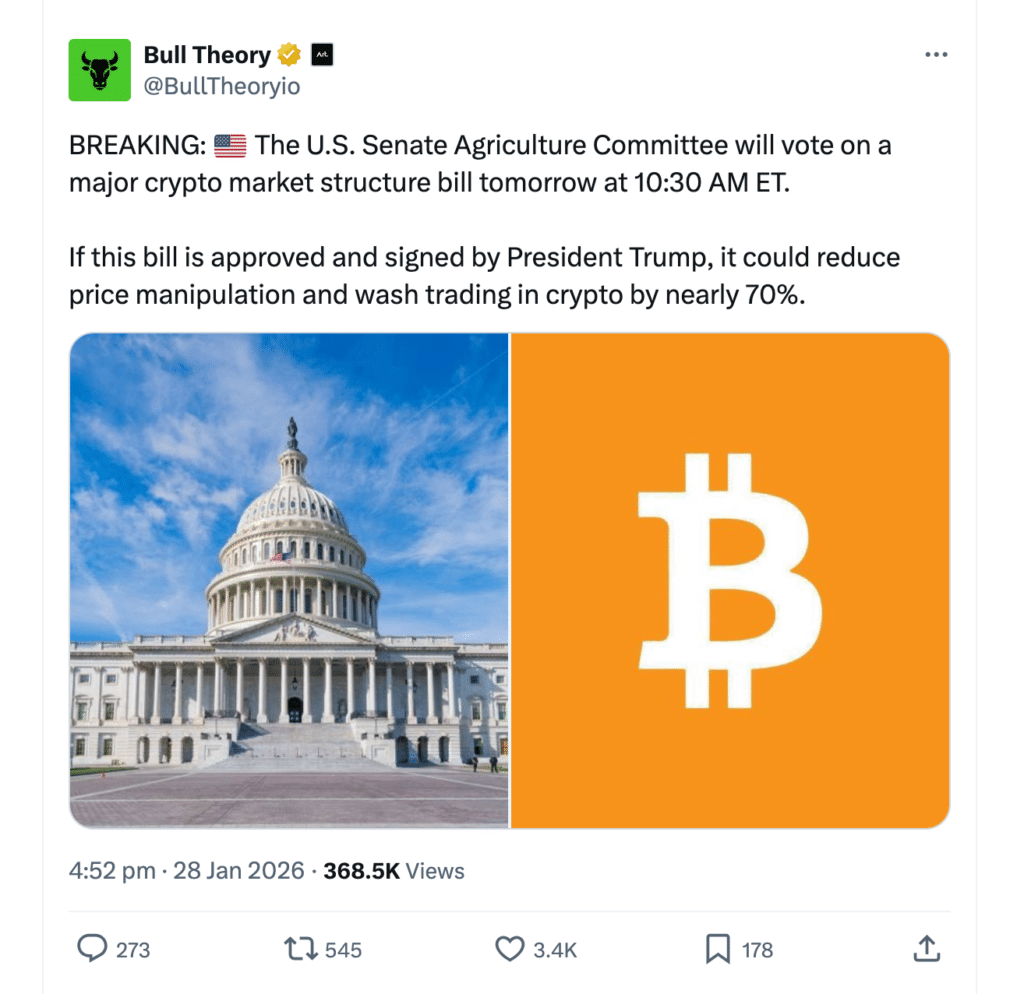
Washington’s legislative machinery is moving closer to what could be a watershed moment for cryptocurrency oversight. The US Crypto Bill, formally known as the Digital Commodity Intermediaries Act, has been rescheduled for markup by the Senate Agriculture Committee on January 29, following delays caused by severe winter weather that swept across the nation earlier this month.
This legislation attempts to answer a question that’s plagued the crypto industry for years: who’s actually in charge? The crypto market bill would clarify whether the Securities and Exchange Commission or the Commodity Futures Trading Commission holds primary authority over cryptocurrency markets. Right now, that ambiguity has created headaches for companies trying to comply with regulations and enforcement agencies attempting to police the space.
Why the Delay?
The markup was originally scheduled for late January. Winter storms weren’t the only factor pushing things back, though. Disagreements over specific provisions in the proposed legislation also played a role. The Agriculture Committee needed additional time to work toward bipartisan consensus while juggling Congress’s packed agenda.
The rescheduling reflects the complex political dynamics at play in Washington, particularly with a government funding deadline looming at the end of January and the US Senate trying to establish workable rules for an asset class now worth over a trillion dollars.
What’s Actually in This US Crypto Bill?
At its core, the US Crypto Bill aims to end the regulatory confusion that’s made life difficult for everyone involved in digital assets. The current system has companies guessing about which rules apply to them and which agency they need to answer to.
The proposed framework would establish clear lines of authority. This matters because regulatory uncertainty has been cited as one of the biggest obstacles to institutional adoption of cryptocurrencies in the United States. Companies have struggled to build compliant products when the rules themselves remain unclear.
Key Amendments Shaping Today’s Senate Deliberations
Several important amendments will be debated before the committee votes. Senator Michael Bennet of Colorado has put forward ethics provisions designed to prevent conflicts of interest among federal officials who own or invest in cryptocurrencies. This addresses concerns about regulators and lawmakers having personal financial stakes in the very assets they’re supposed to be overseeing.
Senator Amy Klobuchar from Minnesota proposed an amendment that would delay implementation until the CFTC confirms four commissioners. Her reasoning? The agency needs adequate staffing to handle its expanded responsibilities under the new framework. Without sufficient personnel, even good regulations could fail in practice.
Other amendments on the table include measures to prohibit taxpayer bailouts for crypto issuers, enhance anti-fraud protections at cryptocurrency ATMs, and restrict U.S. market access for entities connected to foreign adversaries. Each of these provisions reflects specific concerns that have emerged as the crypto market has matured.
 US Crypto Bill Nears Senate Vote as Lawmakers Debate SEC vs CFTC 3
Bipartisan Dynamics in the Senate Crypto Bill Debate
The legislation has attracted support from both sides of the aisle at different points. Many Republicans and Democrats agree that America needs comprehensive regulatory structures that protect investors without strangling innovation. That’s the easy part.
The harder part involves the details. Some lawmakers favor stringent regulations with robust enforcement mechanisms. Others advocate for lighter-touch rules that give businesses more room to experiment and grow. The lead-up to the January 29 vote has centered on finding compromises that address these competing priorities.
Senator Kirsten Gillibrand took to X (formerly Twitter) to emphasize the need for clear, consistent guidelines in the crypto market. She argued that well-defined regulations would protect investors while allowing businesses to operate with confidence, ensuring everyone understands their legal obligations. This push for regulatory clarity has become the bill’s central theme as lawmakers work to stabilize markets ahead of the upcoming vote.
 US Crypto Bill Nears Senate Vote as Lawmakers Debate SEC vs CFTC 4
Industry Perspectives and Stakeholder Reactions
Responses from the crypto industry have been mixed. Advocates for digital assets have emphasized that clarity would encourage institutional participation and boost economic activity in the United States. The reasoning makes sense: big financial institutions and traditional companies have been reluctant to dive into crypto partly because they’re not sure what rules they’d be breaking.
But support hasn’t been universal. Coinbase, one of the largest cryptocurrency exchanges in America, initially backed the Senate Banking Committee’s version of the legislation. The company later withdrew its support over concerns about provisions that could limit tokenized securities and potentially stifle decentralized finance innovation.
This reversal illustrates the tension inherent in crypto regulation. Even well-intentioned reforms can spark fierce debates about whether the priority should be consumer protection or enabling innovation. Finding the right balance has proven elusive.
The Clock Is Ticking
The January 31 government funding deadline adds another layer of pressure. Congress needs to pass critical legislation, potentially including the crypto market bill, before funding lapses threaten to disrupt legislative work. If the markup gets delayed or derailed, legislative momentum could stall until much later in the year or longer. That would mean continued regulatory uncertainty for an industry desperate for clear federal guidelines to attract investment and facilitate growth.
Timing matters in politics, and the crypto industry has been waiting for meaningful federal legislation for years. Missing this window could set efforts back significantly.
What Happens If the Markup Succeeds?
Assuming the markup produces a strong bipartisan recommendation, the US Crypto Bill would advance to consideration by the full US Senate. That would represent a major step forward for U.S. crypto regulatory reform.
Success could foster a more stable environment for companies and investors operating in digital asset markets. Clear definitions of regulatory authority and compliance requirements might reduce legal risk. That clarity could attract institutional capital that’s been sitting on the sidelines due to regulatory ambiguity. Big money has been reluctant to enter the space when the rules remain unclear—that could change.
Of course, passage through the committee doesn’t guarantee enactment. The bill would still need approval from the full Senate, reconciliation with any House version, and ultimately the president’s signature. Each of those steps presents additional opportunities for modification or obstruction.
What This Means Going Forward
The January 29 markup of the US Crypto Bill represents more than a procedural step in Washington’s legislative calendar. It’s a potential turning point that could shape how the federal government regulates digital assets for years to come. The crypto market is watching closely as the Senate committee evaluates crucial amendments before any potential vote by the full chamber.
For anyone involved in cryptocurrency, whether as an investor, developer, business owner, or simply someone interested in the technology, these developments warrant attention. The regulatory framework that emerges from this process will determine how crypto operates in America’s legal and financial system.
Observers should track each development carefully. The voting process will reveal much about the future trajectory of cryptocurrency regulation in the United States. While outcomes remain uncertain, the significance of this moment is clear.
Key Terms to Know
Agriculture Committee: The Senate committee that oversees the Commodity Futures Trading Commission and has jurisdiction over significant portions of crypto regulation.
CFTC (Commodity Futures Trading Commission): The federal agency responsible for regulating commodity markets, which has authority over certain digital assets classified as commodities.
CLARITY Act: Proposed federal legislation aimed at defining regulatory frameworks for digital assets.
Markup: A committee session where members review, amend, and vote on legislation before it advances.
SEC (Securities and Exchange Commission): The federal agency that regulates securities markets, whose role in digital asset oversight has been a subject of ongoing debate.
Stablecoin: A cryptocurrency designed to maintain a stable value by pegging it to a reserve asset like the U.S. dollar.
Frequently Asked Questions About the US Crypto Bill
What exactly is the U.S. crypto bill?
The term refers to legislation that would establish federal regulatory authority over digital assets by clarifying which agency, the SEC or CFTC, has oversight responsibility.
Why did they reschedule the markup to January 29?
Severe winter weather combined with ongoing negotiations over specific amendments forced the committee to push back the originally scheduled date.
What’s the bill trying to accomplish?
It aims to establish clear regulatory authority for federal agencies overseeing digital assets while creating standardized procedures for how those assets are managed and traded.
How might this affect crypto regulation?
If successful, the bill would establish clearer rules that reduce legal uncertainty for businesses and increase institutional confidence in the U.S. market.
What are the main amendments being considered?
Key amendments address ethics guidelines for officials who own crypto, CFTC staffing requirements, anti-fraud measures, and restrictions on participation by entities linked to foreign adversaries.
References
BullTheoryio tweet
Sen. Gillibrand tweet
Read More: US Crypto Bill Nears Senate Vote as Lawmakers Debate SEC vs CFTC">US Crypto Bill Nears Senate Vote as Lawmakers Debate SEC vs CFTC


You May Also Like

Solana Remains Above Its $75 Support Level

Silver Price Rally Faces Dump Risk as Leverage and Thin Liquidity Build Up




