Talos, the New York–based digital asset infrastructure provider, has secured a $45 million extension to its Series B round, lifting the round’s total proximity Talos, the New York–based digital asset infrastructure provider, has secured a $45 million extension to its Series B round, lifting the round’s total proximity

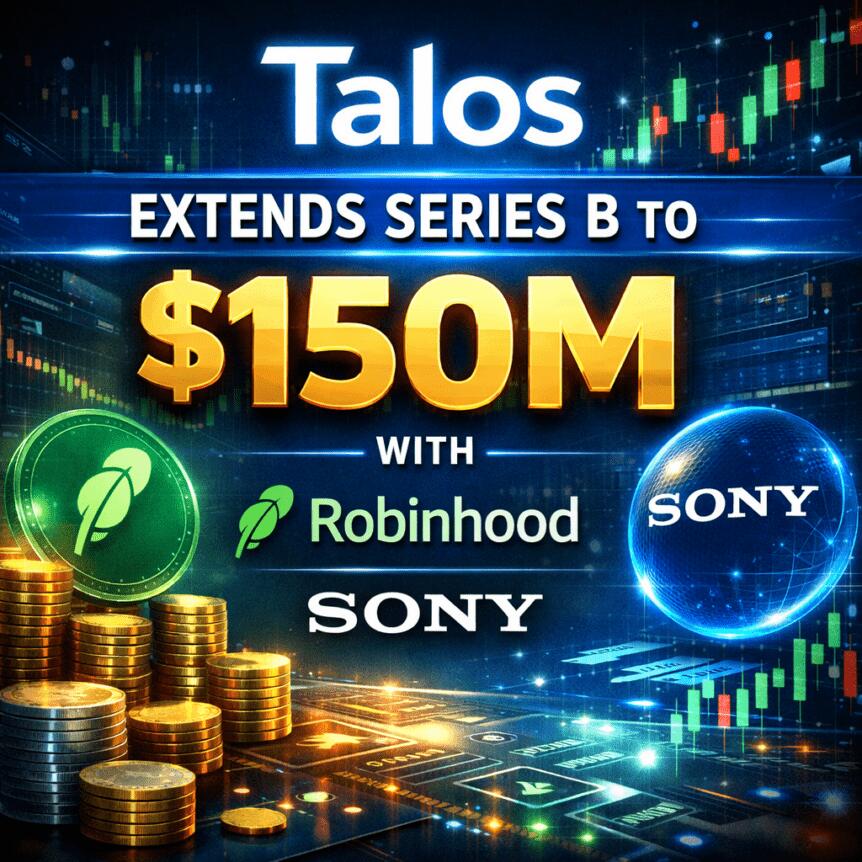
Talos Extends Series B to $150M, with Robinhood and Sony backing
Talos Extends Series B To $150m, With Robinhood And Sony Backing

Talos, the New York–based digital asset infrastructure provider, has secured a $45 million extension to its Series B round, lifting the round’s total proximity to $150 million and valuing the company at roughly $1.5 billion. The extension brings in new strategic investors including Robinhood Markets, Sony Innovation Fund, IMC, QCP and Karatage, while retaining participating backers such as a16z crypto, BNY Mellon and Fidelity Investments. Talos said the fresh capital would accelerate product development across its trading, portfolio management, execution, treasury and settlement tools, and help broaden support for tokenized traditional assets on its platform. Founded in 2018, Talos has positioned itself as a backbone for institutional crypto operations, offering software that enables clients to trade, manage and settle digital asset positions across exchanges, OTC desks, custodians and other liquidity providers.

The company highlighted that revenue and its client base have doubled over the past two years, and it has expanded its ecosystem through an integration with BlackRock’s Aladdin system. In addition to organic growth, Talos has pursued acquisitions to broaden its reach, most notably acquiring the blockchain analytics firm Coin Metrics in a $100 million deal in July. The strategic investors joining the round reflect a broader trend of traditional financial institutions and fintechs seeking deeper exposure to crypto infrastructure and regulated, enterprise-grade rails.

The fundraising dovetails with a broader push by payments and infrastructure players to secure the tooling needed for institutional-grade crypto markets—from settlement and custody to risk controls and compliance. Talos’ leadership argues that the market has moved beyond basic trading tools toward end-to-end workflows that can accommodate regulated assets and tokenized securities, a shift that has implications for liquidity, capital efficiency and governance in a sector still finding its regulatory footing.

The company noted that its revenue trajectory and client base have benefited from expanding integrations, including a link-up with BlackRock’s Aladdin platform, which signals growing interoperability between crypto-native tech stacks and traditional asset management systems. Beyond organic expansion, Talos has used acquisitions to broaden its data, analytics and settlement capabilities, positioning itself as a go-to provider for institutions seeking a unified, scalable operating model for digital assets.

In relation to the strategic funding, Talos’ chief executive Anton Katz said the round was extended to accommodate high levels of interest from strategic partners, underscoring the continued appetite among traditional institutions to engage with crypto infrastructure on a deeper level. The company’s 2018 founding story remains central to its narrative: it built software that enables institutional clients to trade, manage and settle digital asset positions across a network of counterparties, custodians and liquidity providers, aiming to streamline processes that have historically been fragmented and manual.

Key takeaways

  • Talos extended its Series B by $45 million, bringing the round to approximately $150 million and valuing the company around $1.5 billion.
  • New strategic investors include Robinhood Markets, Sony Innovation Fund, IMC, QCP and Karatage, with a16z crypto, BNY Mellon and Fidelity Investments continuing as backers.
  • The funds are earmarked for expanded product development across trading, portfolio management, execution, treasury and settlement tools, plus support for tokenized traditional assets.
  • Talos has doubled revenue and client counts over the past two years and added integration with BlackRock’s Aladdin system.
  • The company completed the $100 million Coin Metrics acquisition in July, broadening its data and analytics capabilities in support of institutional workflows.

Sentiment: Neutral

Market context: The ongoing interest in crypto infrastructure funding reflects a shift toward regulated, scalable rails that can support institutional appetite for digital assets, even as market liquidity and macro sentiment fluctuate.

Why it matters

The Talos extension underscores a broader trend in crypto markets: the maturation of infrastructure providers that can deliver enterprise-grade, compliant workflows for institutions. By expanding capacity across trading, portfolio management, execution, treasury and settlement, Talos aims to reduce the friction and risk that have historically accompanied institutional participation in digital assets. As more institutions seek to integrate crypto into their traditional risk and compliance frameworks, providers that can demonstrate interoperability with established platforms—like BlackRock’s Aladdin—become increasingly indispensable.

The strategic investor lineup signals confidence from diverse corners of the financial world. Robinhood Markets brings a retail-leaning fintech perspective that, when paired with traditional institutions like Fidelity and BNY Mellon, can help Talos bridge customer segments while maintaining robust risk controls. Sony Innovation Fund’s participation points to a broader tech and media ecosystem interest in crypto rails, while IMC, QCP and Karatage bring trading expertise and capital markets insight that can accelerate product-market fit for institutional clients.

The Coin Metrics acquisition, announced earlier in the year, extends Talos’ footprint into data-driven decision-making and on-chain analytics. In a space where data integrity and visibility are critical for risk management and regulatory reporting, the addition of robust analytics can improve settlement accuracy, reconciliation, and governance. The Aladdin integration further reinforces the narrative that risk platforms historically used by traditional asset managers can be extended into crypto markets, reducing the friction that has often deterred larger funds from participating in digital asset markets.

What to watch next

  • Timing and impact of the Series B extension: when the additional capital is fully deployed and how it translates into product milestones.
  • Milestones related to BlackRock Aladdin integration: concrete use cases, pilots, and client-adoption signals.
  • Progress of tokenized traditional assets: approvals, custody readiness, and regulatory-compliant issuance pipelines.
  • Impact of Coin Metrics integration: new data products, analytics dashboards, and cross-platform interoperability.
  • Potential future funding rounds or strategic partnerships central to expanding Talos’ footprint across equities, fixed income or cross-border settlement rails.

Sources & verification

  • PR Newswire — Talos extends Series B to $150m in strategic fundraise
  • Talos official site — The Talos Story
  • Coin Metrics acquisition coverage — July announcement
  • Embedded YouTube video in Talos materials

Talos expands Series B as institutional crypto rails attract strategic partners

Talos’ latest capital raise marks a meaningful step in the ongoing consolidation and professionalization of crypto infrastructure. The $45 million extension to the Series B round increases the total size of the financing and reaffirms investor confidence in Talos’ ability to deliver scaleable, compliant technology for institutional clients. The new investors—Robinhood Markets, Sony Innovation Fund, IMC, QCP and Karatage—join a lineup that already included heavyweights such as a16z crypto, Fidelity and BNY Mellon, underscoring a convergence of fintech, asset management and traditional trading ecosystems around crypto rails.

From a product perspective, the funds target expanded development across the core modules that institutions rely on to operate digital asset programs. Talos’ platform is designed to manage the full lifecycle of crypto positions—from order routing and execution to settlement and treasury management—while connecting with a variety of counterparties, exchanges and custodians. The emphasis on tokenized traditional assets reflects a broader industry push to bring real-world assets onto blockchain-based settlement rails, enabling more efficient, auditable, and regulated processes. The expansion equips Talos to push further into this space, offering clients a unified environment where tokenized securities and other regulated assets can be traded and settled with the same controls that financial institutions expect for conventional markets.

The Aladdin integration with BlackRock is a notable milestone. It signals a practical alignment between crypto-native infrastructure and legacy risk platforms, potentially easing onboarding for multi-asset managers who require consolidated risk dashboards and governance controls. This interoperability can lower the barriers for institutions to participate in digital asset markets at scale, as it aligns crypto operations with the governance and reporting standards familiar to traditional funds.

Beyond product development, the strategic investor cohort points to a broader ecosystem-building effort. Robinhood Markets’ involvement can help Talos deepen its reach into the retail-to-institution continuum, while Sony’s Innovation Fund and IMC bring long-standing capital markets experience to bear on Talos’ product roadmap. QCP and Karatage, both aligned with high-frequency and quantitative trading, add complementary expertise to optimize execution workflows and liquidity access. This mix of backers suggests a shared belief that robust, regulated rails are essential to sustaining institutional confidence in crypto markets as they continue to evolve.

In July, Talos completed its acquisition of Coin Metrics for $100 million, expanding its data and analytics capabilities at a time when reliable on-chain data and risk metrics are increasingly essential for institutional diligence. The combination of data, analytics, and settlement tooling can create a more cohesive platform for clients seeking end-to-end visibility and control over digital asset programs. Taken together, the fundraising and acquisitions highlight a strategic trajectory that prioritizes scale, interoperability and regulatory alignment—factors that many market participants deem crucial for the next phase of crypto market maturation.

As competition in crypto infrastructure heats up, Talos’ path illustrates how platform providers are seeking to differentiate themselves through scale and robust, enterprise-grade features. The firm’s leadership has portrayed this move not merely as a funding exercise but as a signal of the industry’s transition toward higher-capital, higher-assurance rails that can sustain longer-cycle adoption in a regulatory-tinged environment. For institutional investors and builders alike, Talos’ progress will be a useful lens into how the crypto market is evolving beyond the hype of early-stage funding and toward a more integrated financial services ecosystem.

This article was originally published as Talos Extends Series B to $150M, with Robinhood and Sony backing on Crypto Breaking News – your trusted source for crypto news, Bitcoin news, and blockchain updates.


Disclaimer: The articles reposted on this site are sourced from public platforms and are provided for informational purposes only. They do not necessarily reflect the views of MEXC. All rights remain with the original authors. If you believe any content infringes on third-party rights, please contact [email protected] for removal. MEXC makes no guarantees regarding the accuracy, completeness, or timeliness of the content and is not responsible for any actions taken based on the information provided. The content does not constitute financial, legal, or other professional advice, nor should it be considered a recommendation or endorsement by MEXC.

You May Also Like

21Shares Launches JitoSOL Staking ETP on Euronext for European Investors

21Shares Launches JitoSOL Staking ETP on Euronext for European Investors

21Shares launches JitoSOL staking ETP on Euronext, offering European investors regulated access to Solana staking rewards with additional yield opportunities.Read
Share
Coinstats2026/01/30 12:53
Digital Asset Infrastructure Firm Talos Raises $45M, Valuation Hits $1.5 Billion

Digital Asset Infrastructure Firm Talos Raises $45M, Valuation Hits $1.5 Billion

Robinhood, Sony and trading firms back Series B extension as institutional crypto trading platform expands into traditional asset tokenization
Share
Blockhead2026/01/30 13:30
Summarize Any Stock’s Earnings Call in Seconds Using FMP API

Summarize Any Stock’s Earnings Call in Seconds Using FMP API

Turn lengthy earnings call transcripts into one-page insights using the Financial Modeling Prep APIPhoto by Bich Tran Earnings calls are packed with insights. They tell you how a company performed, what management expects in the future, and what analysts are worried about. The challenge is that these transcripts often stretch across dozens of pages, making it tough to separate the key takeaways from the noise. With the right tools, you don’t need to spend hours reading every line. By combining the Financial Modeling Prep (FMP) API with Groq’s lightning-fast LLMs, you can transform any earnings call into a concise summary in seconds. The FMP API provides reliable access to complete transcripts, while Groq handles the heavy lifting of distilling them into clear, actionable highlights. In this article, we’ll build a Python workflow that brings these two together. You’ll see how to fetch transcripts for any stock, prepare the text, and instantly generate a one-page summary. Whether you’re tracking Apple, NVIDIA, or your favorite growth stock, the process works the same — fast, accurate, and ready whenever you are. Fetching Earnings Transcripts with FMP API The first step is to pull the raw transcript data. FMP makes this simple with dedicated endpoints for earnings calls. If you want the latest transcripts across the market, you can use the stable endpoint /stable/earning-call-transcript-latest. For a specific stock, the v3 endpoint lets you request transcripts by symbol, quarter, and year using the pattern: https://financialmodelingprep.com/api/v3/earning_call_transcript/{symbol}?quarter={q}&year={y}&apikey=YOUR_API_KEY here’s how you can fetch NVIDIA’s transcript for a given quarter: import requestsAPI_KEY = "your_api_key"symbol = "NVDA"quarter = 2year = 2024url = f"https://financialmodelingprep.com/api/v3/earning_call_transcript/{symbol}?quarter={quarter}&year={year}&apikey={API_KEY}"response = requests.get(url)data = response.json()# Inspect the keysprint(data.keys())# Access transcript contentif "content" in data[0]: transcript_text = data[0]["content"] print(transcript_text[:500]) # preview first 500 characters The response typically includes details like the company symbol, quarter, year, and the full transcript text. If you aren’t sure which quarter to query, the “latest transcripts” endpoint is the quickest way to always stay up to date. Cleaning and Preparing Transcript Data Raw transcripts from the API often include long paragraphs, speaker tags, and formatting artifacts. Before sending them to an LLM, it helps to organize the text into a cleaner structure. Most transcripts follow a pattern: prepared remarks from executives first, followed by a Q&A session with analysts. Separating these sections gives better control when prompting the model. In Python, you can parse the transcript and strip out unnecessary characters. A simple way is to split by markers such as “Operator” or “Question-and-Answer.” Once separated, you can create two blocks — Prepared Remarks and Q&A — that will later be summarized independently. This ensures the model handles each section within context and avoids missing important details. Here’s a small example of how you might start preparing the data: import re# Example: using the transcript_text we fetched earliertext = transcript_text# Remove extra spaces and line breaksclean_text = re.sub(r'\s+', ' ', text).strip()# Split sections (this is a heuristic; real-world transcripts vary slightly)if "Question-and-Answer" in clean_text: prepared, qna = clean_text.split("Question-and-Answer", 1)else: prepared, qna = clean_text, ""print("Prepared Remarks Preview:\n", prepared[:500])print("\nQ&A Preview:\n", qna[:500]) With the transcript cleaned and divided, you’re ready to feed it into Groq’s LLM. Chunking may be necessary if the text is very long. A good approach is to break it into segments of a few thousand tokens, summarize each part, and then merge the summaries in a final pass. Summarizing with Groq LLM Now that the transcript is clean and split into Prepared Remarks and Q&A, we’ll use Groq to generate a crisp one-pager. The idea is simple: summarize each section separately (for focus and accuracy), then synthesize a final brief. Prompt design (concise and factual) Use a short, repeatable template that pushes for neutral, investor-ready language: You are an equity research analyst. Summarize the following earnings call sectionfor {symbol} ({quarter} {year}). Be factual and concise.Return:1) TL;DR (3–5 bullets)2) Results vs. guidance (what improved/worsened)3) Forward outlook (specific statements)4) Risks / watch-outs5) Q&A takeaways (if present)Text:<<<{section_text}>>> Python: calling Groq and getting a clean summary Groq provides an OpenAI-compatible API. Set your GROQ_API_KEY and pick a fast, high-quality model (e.g., a Llama-3.1 70B variant). We’ll write a helper to summarize any text block, then run it for both sections and merge. import osimport textwrapimport requestsGROQ_API_KEY = os.environ.get("GROQ_API_KEY") or "your_groq_api_key"GROQ_BASE_URL = "https://api.groq.com/openai/v1" # OpenAI-compatibleMODEL = "llama-3.1-70b" # choose your preferred Groq modeldef call_groq(prompt, temperature=0.2, max_tokens=1200): url = f"{GROQ_BASE_URL}/chat/completions" headers = { "Authorization": f"Bearer {GROQ_API_KEY}", "Content-Type": "application/json", } payload = { "model": MODEL, "messages": [ {"role": "system", "content": "You are a precise, neutral equity research analyst."}, {"role": "user", "content": prompt}, ], "temperature": temperature, "max_tokens": max_tokens, } r = requests.post(url, headers=headers, json=payload, timeout=60) r.raise_for_status() return r.json()["choices"][0]["message"]["content"].strip()def build_prompt(section_text, symbol, quarter, year): template = """ You are an equity research analyst. Summarize the following earnings call section for {symbol} ({quarter} {year}). Be factual and concise. Return: 1) TL;DR (3–5 bullets) 2) Results vs. guidance (what improved/worsened) 3) Forward outlook (specific statements) 4) Risks / watch-outs 5) Q&A takeaways (if present) Text: <<< {section_text} >>> """ return textwrap.dedent(template).format( symbol=symbol, quarter=quarter, year=year, section_text=section_text )def summarize_section(section_text, symbol="NVDA", quarter="Q2", year="2024"): if not section_text or section_text.strip() == "": return "(No content found for this section.)" prompt = build_prompt(section_text, symbol, quarter, year) return call_groq(prompt)# Example usage with the cleaned splits from Section 3prepared_summary = summarize_section(prepared, symbol="NVDA", quarter="Q2", year="2024")qna_summary = summarize_section(qna, symbol="NVDA", quarter="Q2", year="2024")final_one_pager = f"""# {symbol} Earnings One-Pager — {quarter} {year}## Prepared Remarks — Key Points{prepared_summary}## Q&A Highlights{qna_summary}""".strip()print(final_one_pager[:1200]) # preview Tips that keep quality high: Keep temperature low (≈0.2) for factual tone. If a section is extremely long, chunk at ~5–8k tokens, summarize each chunk with the same prompt, then ask the model to merge chunk summaries into one section summary before producing the final one-pager. If you also fetched headline numbers (EPS/revenue, guidance) earlier, prepend them to the prompt as brief context to help the model anchor on the right outcomes. Building the End-to-End Pipeline At this point, we have all the building blocks: the FMP API to fetch transcripts, a cleaning step to structure the data, and Groq LLM to generate concise summaries. The final step is to connect everything into a single workflow that can take any ticker and return a one-page earnings call summary. The flow looks like this: Input a stock ticker (for example, NVDA). Use FMP to fetch the latest transcript. Clean and split the text into Prepared Remarks and Q&A. Send each section to Groq for summarization. Merge the outputs into a neatly formatted earnings one-pager. Here’s how it comes together in Python: def summarize_earnings_call(symbol, quarter, year, api_key, groq_key): # Step 1: Fetch transcript from FMP url = f"https://financialmodelingprep.com/api/v3/earning_call_transcript/{symbol}?quarter={quarter}&year={year}&apikey={api_key}" resp = requests.get(url) resp.raise_for_status() data = resp.json() if not data or "content" not in data[0]: return f"No transcript found for {symbol} {quarter} {year}" text = data[0]["content"] # Step 2: Clean and split clean_text = re.sub(r'\s+', ' ', text).strip() if "Question-and-Answer" in clean_text: prepared, qna = clean_text.split("Question-and-Answer", 1) else: prepared, qna = clean_text, "" # Step 3: Summarize with Groq prepared_summary = summarize_section(prepared, symbol, quarter, year) qna_summary = summarize_section(qna, symbol, quarter, year) # Step 4: Merge into final one-pager return f"""# {symbol} Earnings One-Pager — {quarter} {year}## Prepared Remarks{prepared_summary}## Q&A Highlights{qna_summary}""".strip()# Example runprint(summarize_earnings_call("NVDA", 2, 2024, API_KEY, GROQ_API_KEY)) With this setup, generating a summary becomes as simple as calling one function with a ticker and date. You can run it inside a notebook, integrate it into a research workflow, or even schedule it to trigger after each new earnings release. Free Stock Market API and Financial Statements API... Conclusion Earnings calls no longer need to feel overwhelming. With the Financial Modeling Prep API, you can instantly access any company’s transcript, and with Groq LLM, you can turn that raw text into a sharp, actionable summary in seconds. This pipeline saves hours of reading and ensures you never miss the key results, guidance, or risks hidden in lengthy remarks. Whether you track tech giants like NVIDIA or smaller growth stocks, the process is the same — fast, reliable, and powered by the flexibility of FMP’s data. Summarize Any Stock’s Earnings Call in Seconds Using FMP API was originally published in Coinmonks on Medium, where people are continuing the conversation by highlighting and responding to this story
Share
Medium2025/09/18 14:40