Regulators in Washington signaled a shift toward coordinated crypto oversight as the US CFTC said it would join the Securities and Exchange Commission’s ongoingRegulators in Washington signaled a shift toward coordinated crypto oversight as the US CFTC said it would join the Securities and Exchange Commission’s ongoing

CFTC Teams Up with SEC for Agency’s Project Crypto
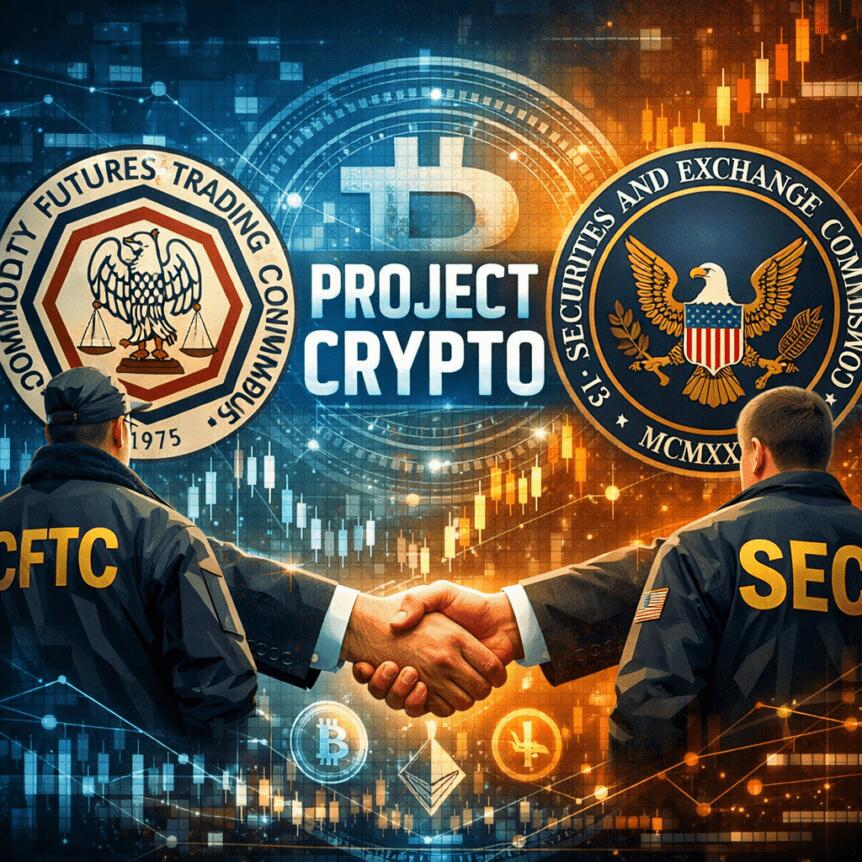
Cftc Teams Up With Sec For Agency's Project Crypto

Regulators in Washington signaled a shift toward coordinated crypto oversight as the US CFTC said it would join the Securities and Exchange Commission’s ongoing Project Crypto initiative. In remarks prepared for an SEC-CFTC discussion on harmonizing digital asset regulation, CFTC Chair Michael Selig said the agency would partner with the SEC to articulate a clear taxonomy for crypto assets, define jurisdiction more precisely, and reduce duplicative compliance requirements that raise costs and confuse market participants. The move comes as Congress debates a digital asset market structure bill and as markets watch for clearer guidance on how different assets are regulated. This collaboration signals a practical step toward a more streamlined and predictable regulatory environment for innovative finance in the United States, with implications for traders, developers, and traditional financial institutions alike.

Key takeaways

  • The CFTC will align with the SEC on Project Crypto to establish a unified taxonomy for digital assets and reduce regulatory fragmentation across markets.
  • Officials argue that consolidating rules should lower barriers to entry, curb duplication, and deter regulatory arbitrage without sacrificing market integrity.
  • The remarks come as the Senate Agriculture Committee advanced a digital asset market structure bill, highlighting cross‑agency and cross‑branch momentum toward a formal framework.
  • Both agencies emphasize modernization to “future‑proof” US markets against tomorrow’s innovations while preserving core protections for investors.
  • <li The discussion touches on prediction markets and other event contracts, with the CFTC signaling a review of existing rules to provide clearer standards for market participants.

Tickers mentioned: $BTC, $ETH

Sentiment: Neutral

Market context: The regulatory dialogue around crypto remains central to liquidity and risk sentiment in 2025–2026, with lawmakers weighing how to balance innovation with investor protection amid ongoing debates on jurisdiction, enforcement, and product clarity.

Why it matters

At the center of the discussion is a push to avoid the current patchwork of rules that can slow innovation and raise costs for crypto developers and participants. By pursuing a shared framework, the SEC and CFTC intend to minimize duplicative compliance obligations and ensure consistent application of rules across spot markets, derivatives, and new tokenized products. The effort acknowledges that fragmentation can deter capital formation and complicate compliance, ultimately affecting everyday users who rely on crypto services for payments, liquidity, and access to investment opportunities.

For investors, the joint initiative could translate into clearer disclosures, more reliable enforcement signals, and a more predictable regulatory baseline. The aim is not to relax safeguards but to reduce regulatory friction that can obscure accountability and invite regulatory arbitrage—where market participants exploit jurisdictional gaps to avoid stricter rules. In this sense, the project echoes a broader policy objective to shore up market integrity while preserving competitive dynamics for innovation hubs, including decentralized finance and tokenized asset markets.

Academics and industry observers have long argued that the lack of a cohesive taxonomy complicates risk assessment and compliance programs. Clearer categorization of crypto assets helps exchange operators, wallet providers, and liquidity pools determine which agency oversees which activity and what standards apply. The conversation also intersects with legislative efforts on market structure that seek to formalize roles between agencies, potentially shaping how platforms list and trade digital commodities and related derivatives. In short, harmonization efforts are as much about governance clarity as they are about regulatory efficiency.

The remarks also touch on the evolving treatment of other market concepts, including event contracts and prediction markets. Selig indicated that the CFTC would reexamine existing rules that have restricted certain political and sporting event contracts, aiming to strike a balance between market certainty and compliance with ongoing litigation. This is part of a broader trend toward modernizing the agency’s toolkit to accommodate new financial products while maintaining robust consumer protections.

As regulators move to sharpen the boundaries of oversight, the industry will be watching how harmonization efforts translate into practical guidance. The SEC’s Project Crypto, first unveiled in mid‑2023 and subsequent to a July launch noted in industry coverage, seeks to separate certainty from ambiguity in a rapidly evolving landscape. The joint push is also linked to broader congressional activity around a market structure framework, including the Digital Commodity Intermediaries Act, which aims to codify who does what in a redefined digital asset ecosystem. The conversation reflects a realization among policymakers that a coherent framework could better guide innovation, while ensuring that investors have access to consistent protections and transparent market data.

In framing the discussion, Selig emphasized that the goal was not to erase statutory boundaries but to remove duplication that fails to improve market integrity. This echoes a recurring theme in regulator rhetoric: cooperation and clarity, rather than turf battles, will better serve the public and the industry. The push also acknowledges the modern reality of a global crypto market, where cross‑border activity and rapidly evolving products demand a coherent domestic structure that can adapt without sacrificing core safeguards.

What to watch next

  • Follow the SEC and CFTC for a joint framework or taxonomy release resulting from Project Crypto collaboration, and monitor any cross‑agency white papers or public guidance updates.
  • Legislative progress on the Digital Commodity Intermediaries Act, including potential votes in the Senate and alignment with the Banking Committee, will shape the regulatory timetable.
  • Nomination developments for CFTC commissioners and other leadership positions could influence the pace and direction of market‑structure reforms.
  • Any concrete policy clarifications on prediction markets, event contracts, and other crypto‑adjacent products will signal how the agencies intend to regulate novel financial instruments.

Sources & verification

  • SEC Officials discuss harmonization of crypto regulation: sec.gov/newsroom/meetings-events/sec-cftc-harmonization-us-financial-leadership-crypto-era
  • Project Crypto launch context and SEC leadership remarks: cointelegraph.com/news/sec-chair-atkins-announces-project-crypto
  • Live Senate markup and bipartisan momentum on crypto market structure bills: cointelegraph.com/news/live-senate-markup-crypto-market-structure-bill
  • Discussion of issuer vs third‑party tokenized securities and related guidance: cointelegraph.com/news/sec-breaks-down-tokenized-securities-into-two-categories-new-guidance
  • How crypto laws changed in 2025 — and how they’ll change in 2026 (magazine feature cited in coverage): cointelegraph.com/magazine/how-crypto-laws-changed-2025-further-2026

Harmonizing oversight and the road ahead

The partnership between the CFTC and SEC represents a pragmatic response to a market that has long argued for clarity over ambiguity. By pursuing a shared taxonomy and a coordinated regulatory posture, the agencies aim to reduce compliance duplication and eliminate conflicting interpretations that can deter legitimate investment, innovation, and market participation. The approach is not about loosening protections but about delivering predictable rules that can withstand rapid technological shifts. For participants—from exchanges and wallet providers to developers and institutional traders—clearer lines of authority and standardized expectations could lower the cost of compliance and improve risk assessment.

In parallel, the political process around market structure legislation continues to unfold, with lawmakers weighing amendments and governance standards that could influence regulatory dynamics for years to come. The tension between immediate oversight fixes and longer‑term governance reforms remains a central theme as regulators seek to balance rapid innovation with investor protection. If the harmonization effort succeeds, it could set a template for how the United States governs digital assets in a way that preserves market integrity while inviting responsible innovation and participation from global firms and retail investors alike.

This article was originally published as CFTC Teams Up with SEC for Agency’s Project Crypto on Crypto Breaking News – your trusted source for crypto news, Bitcoin news, and blockchain updates.


Disclaimer: The articles reposted on this site are sourced from public platforms and are provided for informational purposes only. They do not necessarily reflect the views of MEXC. All rights remain with the original authors. If you believe any content infringes on third-party rights, please contact [email protected] for removal. MEXC makes no guarantees regarding the accuracy, completeness, or timeliness of the content and is not responsible for any actions taken based on the information provided. The content does not constitute financial, legal, or other professional advice, nor should it be considered a recommendation or endorsement by MEXC.

You May Also Like

21Shares Launches JitoSOL Staking ETP on Euronext for European Investors

21Shares Launches JitoSOL Staking ETP on Euronext for European Investors

21Shares launches JitoSOL staking ETP on Euronext, offering European investors regulated access to Solana staking rewards with additional yield opportunities.Read
Share
Coinstats2026/01/30 12:53
Digital Asset Infrastructure Firm Talos Raises $45M, Valuation Hits $1.5 Billion

Digital Asset Infrastructure Firm Talos Raises $45M, Valuation Hits $1.5 Billion

Robinhood, Sony and trading firms back Series B extension as institutional crypto trading platform expands into traditional asset tokenization
Share
Blockhead2026/01/30 13:30
Summarize Any Stock’s Earnings Call in Seconds Using FMP API

Summarize Any Stock’s Earnings Call in Seconds Using FMP API

Turn lengthy earnings call transcripts into one-page insights using the Financial Modeling Prep APIPhoto by Bich Tran Earnings calls are packed with insights. They tell you how a company performed, what management expects in the future, and what analysts are worried about. The challenge is that these transcripts often stretch across dozens of pages, making it tough to separate the key takeaways from the noise. With the right tools, you don’t need to spend hours reading every line. By combining the Financial Modeling Prep (FMP) API with Groq’s lightning-fast LLMs, you can transform any earnings call into a concise summary in seconds. The FMP API provides reliable access to complete transcripts, while Groq handles the heavy lifting of distilling them into clear, actionable highlights. In this article, we’ll build a Python workflow that brings these two together. You’ll see how to fetch transcripts for any stock, prepare the text, and instantly generate a one-page summary. Whether you’re tracking Apple, NVIDIA, or your favorite growth stock, the process works the same — fast, accurate, and ready whenever you are. Fetching Earnings Transcripts with FMP API The first step is to pull the raw transcript data. FMP makes this simple with dedicated endpoints for earnings calls. If you want the latest transcripts across the market, you can use the stable endpoint /stable/earning-call-transcript-latest. For a specific stock, the v3 endpoint lets you request transcripts by symbol, quarter, and year using the pattern: https://financialmodelingprep.com/api/v3/earning_call_transcript/{symbol}?quarter={q}&year={y}&apikey=YOUR_API_KEY here’s how you can fetch NVIDIA’s transcript for a given quarter: import requestsAPI_KEY = "your_api_key"symbol = "NVDA"quarter = 2year = 2024url = f"https://financialmodelingprep.com/api/v3/earning_call_transcript/{symbol}?quarter={quarter}&year={year}&apikey={API_KEY}"response = requests.get(url)data = response.json()# Inspect the keysprint(data.keys())# Access transcript contentif "content" in data[0]: transcript_text = data[0]["content"] print(transcript_text[:500]) # preview first 500 characters The response typically includes details like the company symbol, quarter, year, and the full transcript text. If you aren’t sure which quarter to query, the “latest transcripts” endpoint is the quickest way to always stay up to date. Cleaning and Preparing Transcript Data Raw transcripts from the API often include long paragraphs, speaker tags, and formatting artifacts. Before sending them to an LLM, it helps to organize the text into a cleaner structure. Most transcripts follow a pattern: prepared remarks from executives first, followed by a Q&A session with analysts. Separating these sections gives better control when prompting the model. In Python, you can parse the transcript and strip out unnecessary characters. A simple way is to split by markers such as “Operator” or “Question-and-Answer.” Once separated, you can create two blocks — Prepared Remarks and Q&A — that will later be summarized independently. This ensures the model handles each section within context and avoids missing important details. Here’s a small example of how you might start preparing the data: import re# Example: using the transcript_text we fetched earliertext = transcript_text# Remove extra spaces and line breaksclean_text = re.sub(r'\s+', ' ', text).strip()# Split sections (this is a heuristic; real-world transcripts vary slightly)if "Question-and-Answer" in clean_text: prepared, qna = clean_text.split("Question-and-Answer", 1)else: prepared, qna = clean_text, ""print("Prepared Remarks Preview:\n", prepared[:500])print("\nQ&A Preview:\n", qna[:500]) With the transcript cleaned and divided, you’re ready to feed it into Groq’s LLM. Chunking may be necessary if the text is very long. A good approach is to break it into segments of a few thousand tokens, summarize each part, and then merge the summaries in a final pass. Summarizing with Groq LLM Now that the transcript is clean and split into Prepared Remarks and Q&A, we’ll use Groq to generate a crisp one-pager. The idea is simple: summarize each section separately (for focus and accuracy), then synthesize a final brief. Prompt design (concise and factual) Use a short, repeatable template that pushes for neutral, investor-ready language: You are an equity research analyst. Summarize the following earnings call sectionfor {symbol} ({quarter} {year}). Be factual and concise.Return:1) TL;DR (3–5 bullets)2) Results vs. guidance (what improved/worsened)3) Forward outlook (specific statements)4) Risks / watch-outs5) Q&A takeaways (if present)Text:<<<{section_text}>>> Python: calling Groq and getting a clean summary Groq provides an OpenAI-compatible API. Set your GROQ_API_KEY and pick a fast, high-quality model (e.g., a Llama-3.1 70B variant). We’ll write a helper to summarize any text block, then run it for both sections and merge. import osimport textwrapimport requestsGROQ_API_KEY = os.environ.get("GROQ_API_KEY") or "your_groq_api_key"GROQ_BASE_URL = "https://api.groq.com/openai/v1" # OpenAI-compatibleMODEL = "llama-3.1-70b" # choose your preferred Groq modeldef call_groq(prompt, temperature=0.2, max_tokens=1200): url = f"{GROQ_BASE_URL}/chat/completions" headers = { "Authorization": f"Bearer {GROQ_API_KEY}", "Content-Type": "application/json", } payload = { "model": MODEL, "messages": [ {"role": "system", "content": "You are a precise, neutral equity research analyst."}, {"role": "user", "content": prompt}, ], "temperature": temperature, "max_tokens": max_tokens, } r = requests.post(url, headers=headers, json=payload, timeout=60) r.raise_for_status() return r.json()["choices"][0]["message"]["content"].strip()def build_prompt(section_text, symbol, quarter, year): template = """ You are an equity research analyst. Summarize the following earnings call section for {symbol} ({quarter} {year}). Be factual and concise. Return: 1) TL;DR (3–5 bullets) 2) Results vs. guidance (what improved/worsened) 3) Forward outlook (specific statements) 4) Risks / watch-outs 5) Q&A takeaways (if present) Text: <<< {section_text} >>> """ return textwrap.dedent(template).format( symbol=symbol, quarter=quarter, year=year, section_text=section_text )def summarize_section(section_text, symbol="NVDA", quarter="Q2", year="2024"): if not section_text or section_text.strip() == "": return "(No content found for this section.)" prompt = build_prompt(section_text, symbol, quarter, year) return call_groq(prompt)# Example usage with the cleaned splits from Section 3prepared_summary = summarize_section(prepared, symbol="NVDA", quarter="Q2", year="2024")qna_summary = summarize_section(qna, symbol="NVDA", quarter="Q2", year="2024")final_one_pager = f"""# {symbol} Earnings One-Pager — {quarter} {year}## Prepared Remarks — Key Points{prepared_summary}## Q&A Highlights{qna_summary}""".strip()print(final_one_pager[:1200]) # preview Tips that keep quality high: Keep temperature low (≈0.2) for factual tone. If a section is extremely long, chunk at ~5–8k tokens, summarize each chunk with the same prompt, then ask the model to merge chunk summaries into one section summary before producing the final one-pager. If you also fetched headline numbers (EPS/revenue, guidance) earlier, prepend them to the prompt as brief context to help the model anchor on the right outcomes. Building the End-to-End Pipeline At this point, we have all the building blocks: the FMP API to fetch transcripts, a cleaning step to structure the data, and Groq LLM to generate concise summaries. The final step is to connect everything into a single workflow that can take any ticker and return a one-page earnings call summary. The flow looks like this: Input a stock ticker (for example, NVDA). Use FMP to fetch the latest transcript. Clean and split the text into Prepared Remarks and Q&A. Send each section to Groq for summarization. Merge the outputs into a neatly formatted earnings one-pager. Here’s how it comes together in Python: def summarize_earnings_call(symbol, quarter, year, api_key, groq_key): # Step 1: Fetch transcript from FMP url = f"https://financialmodelingprep.com/api/v3/earning_call_transcript/{symbol}?quarter={quarter}&year={year}&apikey={api_key}" resp = requests.get(url) resp.raise_for_status() data = resp.json() if not data or "content" not in data[0]: return f"No transcript found for {symbol} {quarter} {year}" text = data[0]["content"] # Step 2: Clean and split clean_text = re.sub(r'\s+', ' ', text).strip() if "Question-and-Answer" in clean_text: prepared, qna = clean_text.split("Question-and-Answer", 1) else: prepared, qna = clean_text, "" # Step 3: Summarize with Groq prepared_summary = summarize_section(prepared, symbol, quarter, year) qna_summary = summarize_section(qna, symbol, quarter, year) # Step 4: Merge into final one-pager return f"""# {symbol} Earnings One-Pager — {quarter} {year}## Prepared Remarks{prepared_summary}## Q&A Highlights{qna_summary}""".strip()# Example runprint(summarize_earnings_call("NVDA", 2, 2024, API_KEY, GROQ_API_KEY)) With this setup, generating a summary becomes as simple as calling one function with a ticker and date. You can run it inside a notebook, integrate it into a research workflow, or even schedule it to trigger after each new earnings release. Free Stock Market API and Financial Statements API... Conclusion Earnings calls no longer need to feel overwhelming. With the Financial Modeling Prep API, you can instantly access any company’s transcript, and with Groq LLM, you can turn that raw text into a sharp, actionable summary in seconds. This pipeline saves hours of reading and ensures you never miss the key results, guidance, or risks hidden in lengthy remarks. Whether you track tech giants like NVIDIA or smaller growth stocks, the process is the same — fast, reliable, and powered by the flexibility of FMP’s data. Summarize Any Stock’s Earnings Call in Seconds Using FMP API was originally published in Coinmonks on Medium, where people are continuing the conversation by highlighting and responding to this story
Share
Medium2025/09/18 14:40