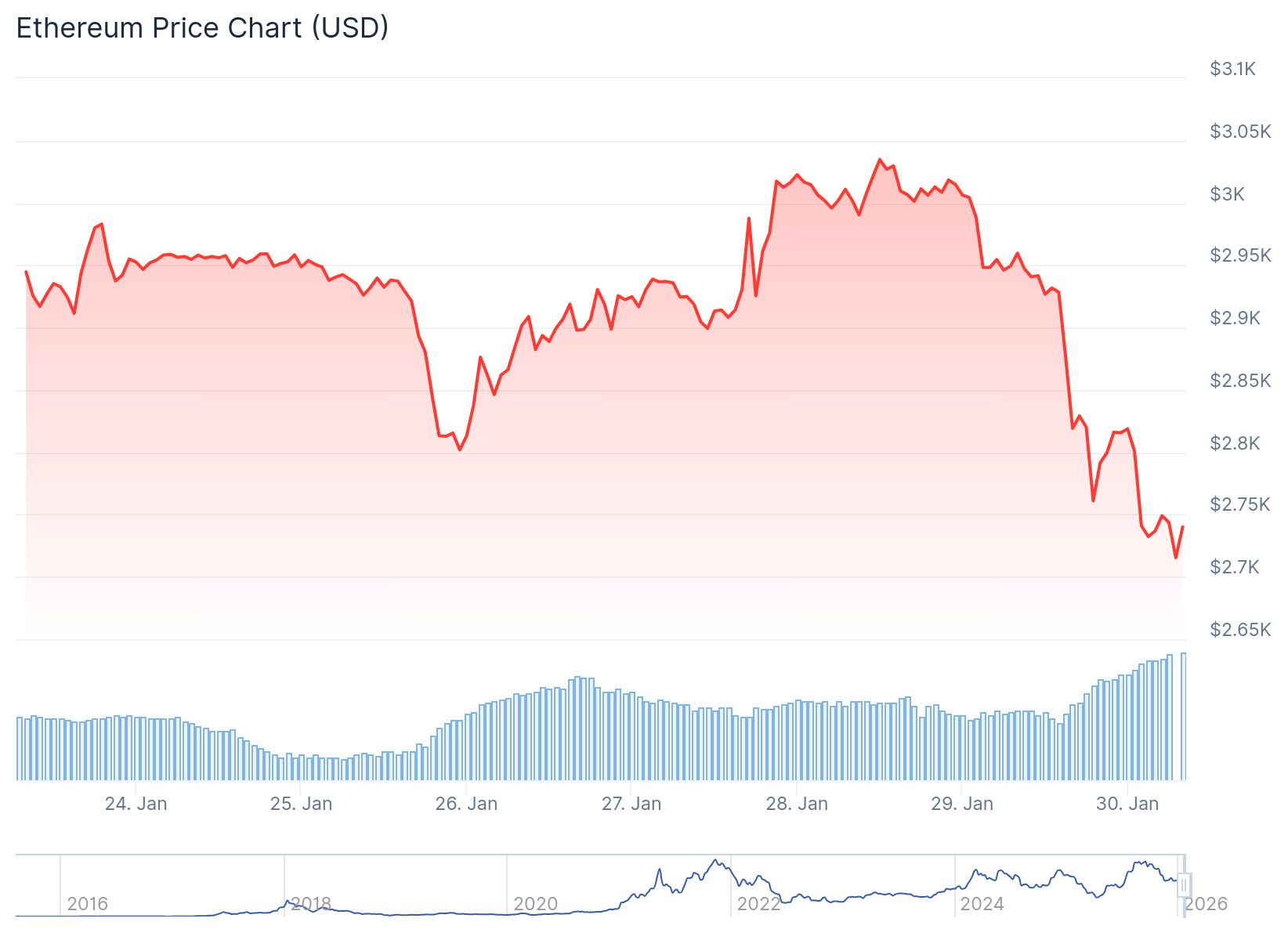
TLDR Ethereum price dropped 10% after failing to break above $3,050, falling to a low of $2,680 ETH is currently trading around $2,730 and struggling to hold theTLDR Ethereum price dropped 10% after failing to break above $3,050, falling to a low of $2,680 ETH is currently trading around $2,730 and struggling to hold the

Ethereum (ETH) Price: Can Bulls Hold $2,700 After $416 Million Liquidation Event?

3 min read

TLDR

  • Ethereum price dropped 10% after failing to break above $3,050, falling to a low of $2,680
  • ETH is currently trading around $2,730 and struggling to hold the $2,700 support level
  • The DAO Security Fund launched with over $200 million from unclaimed 2016 hack refunds to improve Ethereum security
  • Over $416 million in Ethereum liquidations occurred in the past 24 hours, with $391 million in long positions
  • Key resistance sits at $2,820 with a bearish trend line, while immediate support is at $2,700

Ethereum price experienced a sharp decline this week, dropping 10% after failing to maintain levels above $2,880. The cryptocurrency fell to a low of $2,680 before stabilizing around $2,730.
Ethereum (ETH) PriceEthereum (ETH) Price

The price movement follows a rejection at the $3,050 resistance level. ETH broke below the $2,820 support zone and continued falling through $2,750.

Currently, Ethereum is trading below the $2,800 mark and the 100-hour Simple Moving Average. A steep bearish trend line has formed with resistance at $2,820 on the hourly chart.

The past 24 hours saw $416.8 million in liquidations across Ethereum positions. Long liquidations accounted for $391 million of this total, according to Coinglass data.

Source: Coinglass

Bulls are now defending the $2,700 support level. The price briefly broke below this level before recovering slightly. The 23.6% Fibonacci retracement level from the recent decline provides minimal support.

The DAO Security Fund Initiative

Developer Griff Green announced the launch of The DAO Security Fund this week. The fund will use over $200 million in unclaimed funds from the 2016 DAO hack to support Ethereum security initiatives.

These funds were originally set aside to refund victims of the infamous 2016 hack. The value has grown from $6 million in 2016 to over $200 million today.

Green stated the fund will support security improvements including wallet user experience, incident response, Layer 2 and bridge security, and core protocol security.

The Ethereum Foundation’s “Trillion Dollar Security” initiative will guide funding rounds. Distribution will occur through quadratic funding, retroactive funding, and rank-choice voting mechanisms.

Technical Outlook

Immediate resistance for Ethereum sits at $2,765, followed by the key $2,820 level where the bearish trend line is positioned. The next major resistance is at $2,860.

A clear move above $2,860 could push the price toward $2,900 and potentially $3,000. However, if bulls fail to defend $2,700, the next support level is at $2,680.

A break below $2,680 could send Ethereum toward $2,625, which previously served as support during November’s price decline. Further downside targets include $2,550 and $2,500.

The Relative Strength Index is trending downward below neutral levels. The Stochastic Oscillator is in oversold territory, indicating strong bearish momentum but also suggesting a potential short-term reversal.

The fund will stake 70,500 ETH from an Extrabalance contract and 4,600 ETH from DAO and ETH tokens. Curators include Ethereum co-founder Vitalik Buterin, MetaMask’s Taylor Monahan, and Dappnode’s Pol Lanski.

The 2016 DAO hack resulted in a hard fork that split Ethereum into the main chain and Ethereum Classic. The DAO had raised about $150 million worth of ETH before the exploit occurred.

The post Ethereum (ETH) Price: Can Bulls Hold $2,700 After $416 Million Liquidation Event? appeared first on CoinCentral.


Disclaimer: The articles reposted on this site are sourced from public platforms and are provided for informational purposes only. They do not necessarily reflect the views of MEXC. All rights remain with the original authors. If you believe any content infringes on third-party rights, please contact [email protected] for removal. MEXC makes no guarantees regarding the accuracy, completeness, or timeliness of the content and is not responsible for any actions taken based on the information provided. The content does not constitute financial, legal, or other professional advice, nor should it be considered a recommendation or endorsement by MEXC.

You May Also Like

FCA komt in 2026 met aangepaste cryptoregels voor Britse markt

FCA komt in 2026 met aangepaste cryptoregels voor Britse markt

De Britse financiële waakhond, de FCA, komt in 2026 met nieuwe regels speciaal voor crypto bedrijven. Wat direct opvalt: de toezichthouder laat enkele klassieke financiële verplichtingen los om beter aan te sluiten op de snelle en grillige wereld van digitale activa. Tegelijkertijd wordt er extra nadruk gelegd op digitale beveiliging,... Het bericht FCA komt in 2026 met aangepaste cryptoregels voor Britse markt verscheen het eerst op Blockchain Stories.
Share
Coinstats2025/09/18 00:33
Cashing In On University Patents Means Giving Up On Our Innovation Future

Cashing In On University Patents Means Giving Up On Our Innovation Future

The post Cashing In On University Patents Means Giving Up On Our Innovation Future appeared on BitcoinEthereumNews.com. “It’s a raid on American innovation that would deliver pennies to the Treasury while kneecapping the very engine of our economic and medical progress,” writes Pipes. Getty Images Washington is addicted to taxing success. Now, Commerce Secretary Howard Lutnick is floating a plan to skim half the patent earnings from inventions developed at universities with federal funding. It’s being sold as a way to shore up programs like Social Security. In reality, it’s a raid on American innovation that would deliver pennies to the Treasury while kneecapping the very engine of our economic and medical progress. Yes, taxpayer dollars support early-stage research. But the real payoff comes later—in the jobs created, cures discovered, and industries launched when universities and private industry turn those discoveries into real products. By comparison, the sums at stake in patent licensing are trivial. Universities collectively earn only about $3.6 billion annually in patent income—less than the federal government spends on Social Security in a single day. Even confiscating half would barely register against a $6 trillion federal budget. And yet the damage from such a policy would be anything but trivial. The true return on taxpayer investment isn’t in licensing checks sent to Washington, but in the downstream economic activity that federally supported research unleashes. Thanks to the bipartisan Bayh-Dole Act of 1980, universities and private industry have powerful incentives to translate early-stage discoveries into real-world products. Before Bayh-Dole, the government hoarded patents from federally funded research, and fewer than 5% were ever licensed. Once universities could own and license their own inventions, innovation exploded. The result has been one of the best returns on investment in government history. Since 1996, university research has added nearly $2 trillion to U.S. industrial output, supported 6.5 million jobs, and launched more than 19,000 startups. Those companies pay…
Share
BitcoinEthereumNews2025/09/18 03:26
Trump foe devises plan to starve him of what he 'craves' most

Trump foe devises plan to starve him of what he 'craves' most

A longtime adversary of President Donald Trump has a plan for a key group to take away what Trump craves the most — attention. EX-CNN journalist Jim Acosta, who
Share
Rawstory2026/02/04 01:19



