Circle Targets Banks With New Enterprise Blockchain — Can It Win?
Circle Internet Group has unveiled an aggressive 2026 roadmap centered on Arc, its Layer-1 blockchain designed to serve as an “Economic Operating System” for global finance.
The company aims to push Arc from testnet toward production while scaling its Circle Payments Network and StableFX applications to capture enterprise market share in stablecoin-powered settlement.
The strategy comes as Circle faces mounting competition from Tether, which generated $5.2 billion in revenue during 2025 and now controls 60.1% of the $311 billion stablecoin market through USDT.
Circle’s USDC holds 24.2% market share at $72.4 billion circulation, trailing significantly despite 108% year-over-year growth.
Arc Testnet Processes 150M Transactions
Arc’s public testnet has processed more than 150 million transactions since launching in October 2025, with close to 1.5 million transacting wallets and average settlement times around 0.5 seconds, according to Circle’s latest product update.
The network attracted over 100 institutional participants, including BlackRock, Goldman Sachs, BNY Mellon, Société Générale, and Visa during its first 90 days.
Circle Chief Product & Technology Officer Nikhil Chandhok said the company is working toward production readiness by “evolving the validator set toward greater distribution” and “standing up a governance model that aligns with institutional risk and compliance expectations.“
The blockchain uses USDC as its native gas token and provides deterministic sub-second finality specifically designed for regulated financial operations.
The company has integrated Arc with its Cross-Chain Transfer Protocol, which now connects 19 blockchains and has processed $126 billion in cumulative volume as of December 2025.
Circle introduced Gateway, a chain-agnostic system that unifies USDC balances across networks, and launched Build, a suite of AI developer tools alongside App Kits, to accelerate application development.
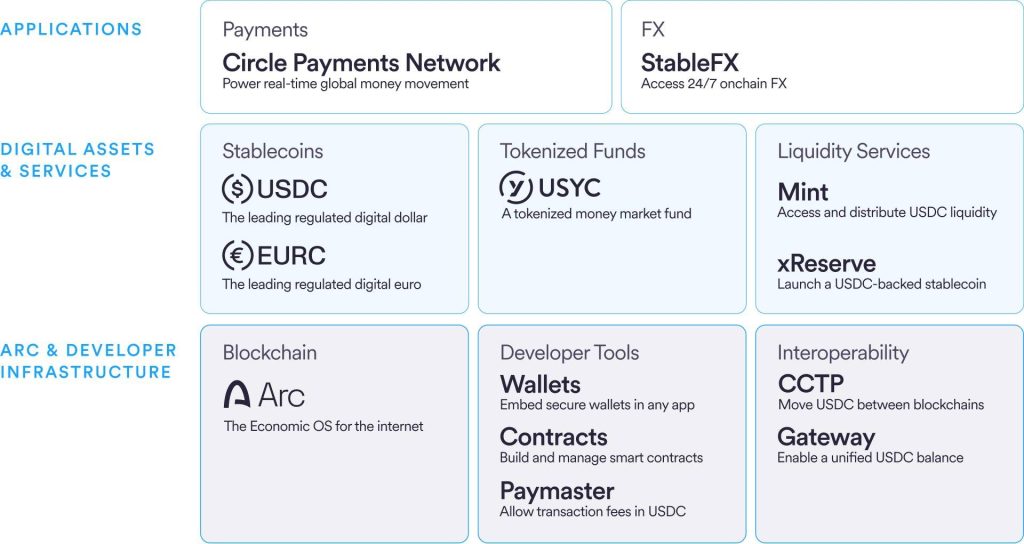 Source: Circle
Tether’s Dominance and Federal Push Pressure Circle’s Market Position
Circle’s enterprise offensive unfolds as Tether expands beyond stablecoins into traditional finance, recently accumulating 140 tons of gold worth $23 billion and launching USAT, a federally regulated stablecoin under America’s new GENIUS Act framework.
Tether CEO Paolo Ardoino told Bloomberg that the company is “soon becoming basically one of the biggest, let’s say, gold central banks in the world,” while buying more than a ton per week.
Tether emerged as the most profitable crypto entity in 2025, capturing 41.9% of all stablecoin-related revenue and maintaining its position as the third-largest digital asset globally at $186.8 billion market value.
 Source: Coingecko
The company holds more U.S. Treasuries than Germany, South Korea, or Australia, cementing its role as a macroeconomic participant.
Meanwhile, Circle’s Circle Payments Network has enrolled 29 financial institutions since launching in May 2025, with 55 undergoing eligibility reviews and 500 in the pipeline.
The network operates across eight countries and reached $3.4 billion in annualized transaction volumes, partnering with Binance, Corpay, FIS, Fiserv, and OKX.
Major Financial Institutions Signal Blockchain Settlement Shift
BlackRock is staffing up for its next crypto expansion phase, posting digital asset roles across New York, London, and Singapore with managing director positions offering up to $350,000 annually.
The asset manager accepted its tokenized BUIDL fund as collateral at Binance and identified Bitcoin exposure as a core portfolio building block for 2025.
Visa also announced in December 2025 that it will allow U.S. financial institutions to settle transactions using USDC on Solana, offering “seven-day availability and improved resilience during weekends and holidays.“
Initial participants, Cross River Bank and Lead Bank, are already settling with Visa in USDC, with a broader U.S. rollout planned through 2026.
“Financial institutions are preparing to use stablecoins as part of their treasury operations,” said Rubail Birwadker, Visa’s Global Head of Growth Products and Strategic Partnerships.
The payments giant is serving as a design partner for Arc and plans to operate a validator node once the blockchain launches.
Circle’s partnership strategy extends to Asia, where the company signed a memorandum of understanding with LianLian Global in December 2025 to explore stablecoin-backed payment infrastructure for international merchants.
The collaboration will assess how USDC can “support faster and more resilient transactions especially in high-volume international payment flows,” according to the announcement.
The company’s tokenized money market fund, USYC, expanded more than 200% since June 2025 to approximately $1.6 billion in assets as of January 2026, while StableFX launched on Arc testnet to enable 24/7 institutional stablecoin foreign exchange trading.
Circle reported $214 million net income for Q3 2025 as USDC circulation surged to $73.7 billion.
Chandhok emphasized that Arc and the broader platform aim to make “value moves with the same openness, reliability, determinism, and speed as information,” positioning Circle to compete as stablecoins become “the connective tissue of the global digital economy.“


You May Also Like

Iran mediators propose 45-day ceasefire amid low US-Iran resolution odds: FT

Bitcoin hits weekly low on oil fears as analyst teases $10K BTC price target