

XRP whales shift to systematic participation, earning 3,000+ XRP a day without relying on market moves
Disclosure: This article does not represent investment advice. The content and materials featured on this page are for educational purposes only.
Structured, system-driven participation is reshaping XRP engagement as tokenized U.S. Treasuries and real-world assets grow on the XRPL.
- The XRPL now hosts over $1 billion in tokenized assets, including $150 million in U.S. Treasury tokens, signaling growing institutional interest.
- SolStaking offers multi-asset cloud staking with fixed-term contracts and automated settlement, shifting focus from speculative trading to rule-based participation.
- Real-world assets like bonds, commodities, and infrastructure underpin SolStaking contracts, providing stable income streams mapped on-chain for long-term operational reliability.
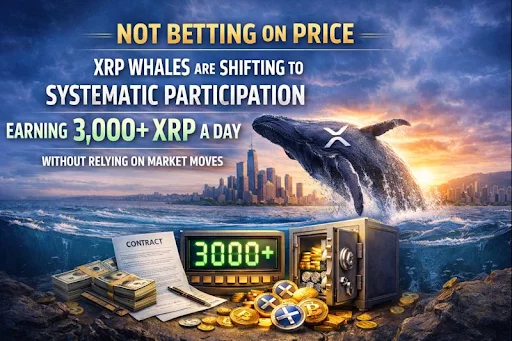
Over the past year, the scale of U.S. Treasury tokenization on the XRP Ledger (XRPL) has grown to approximately $150 million, pushing the total value of tokenized assets on the network beyond $1 billion. At the same time, as regulatory discussions continue to intensify, the number of wallets holding more than 1 million XRP has rebounded since the beginning of the year. Together, these trends suggest that large holders are moving away from pure price speculation and toward more long-term, structured participation models.
When “betting on the price” is no longer the only option
As real-world assets (RWAs) begin to settle on XRPL and regulatory pathways become clearer, the way participants engage with XRP is changing.
For larger capital holders, relying solely on market volatility no longer satisfies the need for consistency, control, and structural stability. The market’s focus is shifting away from questions like “How high is the next move?” and toward a more practical one: Is there a participation model that doesn’t depend on market direction and can run sustainably over the long term?
Once participation shifts from emotional decision-making to system-based execution, the outcome changes as well. Returns are defined by rules, not by price predictions. That’s why more and more participation models today are built around fixed terms, clearly defined rules, and automatic settlement through contracts.
SolStaking Contract Structure Examples
| Contract Type | Starting Amount | Duration | Estimated Settlement |
| Trial Plan | 100 USD | 2 days | ~108 USD |
| TRX Income Plan | 3,000 USD | 15 days | ~3,585 USD |
| XRP Flagship Plan | 30,000 USD | 30 days | ~44,400 USD |
| BTC Flagship Plan | 300,000 USD | 50 days | ~630,000 USD |
Actual settlement depends on contract terms and system operation.
With sufficient capital and the right contract configuration, the system model can generate results in the range of 3,000+ XRP per day, driven primarily by structural design and operational efficiency, not by market price movements.
What is SolStaking?
SolStaking is a platform that provides multi-asset cloud staking services. Its core purpose is not to forecast markets, but to build sustainable, system-based participation frameworks.
At the infrastructure level, SolStaking features:
- U.S.-registered operating entity: Sol Investments, LLC
- Full asset segregation: User staking assets are strictly separated from operating funds
- Independent audits: Conducted regularly by PwC
- Custody insurance: Provided by Lloyd’s of London
- Enterprise-grade security architecture: Multi-layer encryption, system isolation, and 24/7 risk monitoring
These elements are designed not for short-term performance, but for long-term operational stability.
The role of real-world assets
Unlike models that rely purely on on-chain price fluctuations, SolStaking incorporates real-world assets (RWAs) as foundational support within its system.
These assets include, but are not limited to: large-scale AI data center operations, sovereign and investment-grade bonds, physical gold and commodities, industrial metal inventories, logistics and cold-chain infrastructure, as well as agricultural and clean energy projects.
RWA projects operate off-chain, generating relatively stable income streams. Verified data is then mapped on-chain, where smart contracts execute and settle automatically according to predefined rules—with no manual intervention required.
How to get started
The participation process is straightforward and fully system-driven:
- Visit the official SolStaking platform and complete account registration
- Deposit XRP, BTC, ETH, or SOL, then select a suitable cloud staking contract
- Once the contract is activated, returns are settled according to the rules and credited to user accounts; asset and earnings status can be viewed at any time
The platform supports deposits and withdrawals in multiple assets, including: USDT, BTC, ETH, XRP, USDC, SOL, LTC, and DOGE. Users can switch between contract types as needed and withdraw earnings once conditions are met.
Conclusion
As the scale of real-world assets on XRPL, regulatory progress, and the number of million-XRP wallets all shift simultaneously, the participation narrative around XRP is clearly evolving.
This is no longer just about betting on price movements. It’s about entering a structured, system-based participation phase. What SolStaking provides is one concrete way to engage with this transition.
To learn more about SolStaking, visit the official website. Business inquiries: [email protected]
Disclosure: This content is provided by a third party. Neither crypto.news nor the author of this article endorses any product mentioned on this page. Users should conduct their own research before taking any action related to the company.


You May Also Like
Trump’s “ Extremely Hard” Hits Hard On Bitcoin, But Some Altcoins Make It Through
Cryptocurrency Trends 2025: The Top 5 Digital Assets Dominating Social Media and AI Search




