The U.S. Senate Banking Committee has introduced a long-awaited draft bill to reshape how digital assets are classified and regulated in the United States. Titled the Responsible Financial Innovation Act of 2025 , the draft introduced by Senate Banking Chair Tim Scott (R-SC), alongside Senators Cynthia Lummis (R-WY), Bill Hagerty (R-TN), and Bernie Moreno (R-OH), seeks to create a comprehensive legal framework for digital assets, addressing long-standing regulatory uncertainty in the crypto space. New Senate Crypto Bill Proposes Clear Framework for Token Classification and Oversight The legislation, released just days after the GENIUS Act was signed into law, builds on momentum from the House-passed CLARITY Act and incorporates key elements from the bipartisan Lummis-Gillibrand initiative. Source: Responsible Financial Innovation Act of 2025 One of the bill’s most consequential provisions is the explicit recognition that digital assets, referred to as “ancillary assets,” are not inherently securities. It clarifies that secondary market transactions involving these tokens should not automatically fall under securities laws. However, exceptions apply: if a token’s value is closely tied to promises of profit through managerial efforts, securities laws could still be triggered. In addition, the draft legislation attempts to resolve the persistent jurisdictional tension between the SEC and CFTC. Under the proposed framework, most digital assets would be regulated as commodities, falling primarily under the Commodity Futures Trading Commission (CFTC), while the SEC would retain oversight of investment contracts and investor protection matters. The bill instructs the SEC to modernize disclosure rules and adapt its record-keeping systems to account for blockchain-based financial activity, ensuring compatibility with Web3 ecosystems. Beyond token classification, the legislation spans more than 35 areas of focus. It includes requests for public feedback on topics such as stablecoin regulation, custody frameworks, DeFi exemptions, and illicit finance concerns, including tactics like “ pig butchering” scams . The draft also proposes a “safe harbor” for forward-looking statements, shielding developers from premature enforcement actions, provided their projects meet certain transparency and decentralization standards. Additionally, developers who do not custody user funds could be exempt from some registration requirements, an important provision for open-source innovators. Senator Tim Scott emphasized the bill’s collaborative approach, saying, “This bill gives Congress the opportunity to hear from industry and regulators alike before finalizing a legal framework that protects consumers and encourages responsible innovation.” Stakeholder input is now being solicited, particularly on areas where the SEC and CFTC’s jurisdiction may overlap, with Senate Banking Committee hearings expected in the coming weeks as lawmakers move toward introducing a finalized version. Senate Push for Market Structure Reform Gains Momentum After GENIUS Act Signing Momentum for U.S. crypto legislation continued to build this week with the new draft legislation after President Donald Trump signed the GENIUS Act into law , marking a landmark moment in federal regulation. 🏛️U.S. President Donald Trump signed the GENIUS Act into law on Friday afternoon in a landmark bill signing at the White House. https://t.co/WWqbXyzetr — Cryptonews.com (@cryptonews) July 18, 2025 The GENIUS Act, passed with broad bipartisan support, provides the first federal framework for stablecoin issuers and will take effect 18 months after signing or 120 days after federal regulators, including the Treasury and the Federal Reserve, issue final rules. Alongside the GENIUS Act, two other major proposals, the CLARITY Act and the Anti-CBDC Surveillance State Act, are advancing in Congress. The CLARITY Act was recently approved by the House Agriculture Committee. Meanwhile, the Anti-CBDC Act seeks to block any retail digital dollar issued by the Federal Reserve. 🇺🇸 GENIUS Act, Anti-CBDC Act, and CLARITY Act pass crucial procedural vote 215-211 in Congress after Trump's decisive Oval Office intervention rescues stalled crypto agenda. #GeniusAct #Trump https://t.co/Lm2tCBbimp — Cryptonews.com (@cryptonews) July 16, 2025 Industry executives are watching closely. Ian De Bode of Ondo Finance described the new legislation as “the beginning of a new regulatory era,” pointing to bipartisan cooperation and the role of key figures like Patrick McHenry. Senator Tim Scott said lawmakers are planning to finalize crypto market structure legislation by September 30 . With the GENIUS Act now law and several other bills in motion, the U.S. digital asset space is edging closer to a defined regulatory framework, one that could reshape the crypto sector heading into 2026.The U.S. Senate Banking Committee has introduced a long-awaited draft bill to reshape how digital assets are classified and regulated in the United States. Titled the Responsible Financial Innovation Act of 2025 , the draft introduced by Senate Banking Chair Tim Scott (R-SC), alongside Senators Cynthia Lummis (R-WY), Bill Hagerty (R-TN), and Bernie Moreno (R-OH), seeks to create a comprehensive legal framework for digital assets, addressing long-standing regulatory uncertainty in the crypto space. New Senate Crypto Bill Proposes Clear Framework for Token Classification and Oversight The legislation, released just days after the GENIUS Act was signed into law, builds on momentum from the House-passed CLARITY Act and incorporates key elements from the bipartisan Lummis-Gillibrand initiative. Source: Responsible Financial Innovation Act of 2025 One of the bill’s most consequential provisions is the explicit recognition that digital assets, referred to as “ancillary assets,” are not inherently securities. It clarifies that secondary market transactions involving these tokens should not automatically fall under securities laws. However, exceptions apply: if a token’s value is closely tied to promises of profit through managerial efforts, securities laws could still be triggered. In addition, the draft legislation attempts to resolve the persistent jurisdictional tension between the SEC and CFTC. Under the proposed framework, most digital assets would be regulated as commodities, falling primarily under the Commodity Futures Trading Commission (CFTC), while the SEC would retain oversight of investment contracts and investor protection matters. The bill instructs the SEC to modernize disclosure rules and adapt its record-keeping systems to account for blockchain-based financial activity, ensuring compatibility with Web3 ecosystems. Beyond token classification, the legislation spans more than 35 areas of focus. It includes requests for public feedback on topics such as stablecoin regulation, custody frameworks, DeFi exemptions, and illicit finance concerns, including tactics like “ pig butchering” scams . The draft also proposes a “safe harbor” for forward-looking statements, shielding developers from premature enforcement actions, provided their projects meet certain transparency and decentralization standards. Additionally, developers who do not custody user funds could be exempt from some registration requirements, an important provision for open-source innovators. Senator Tim Scott emphasized the bill’s collaborative approach, saying, “This bill gives Congress the opportunity to hear from industry and regulators alike before finalizing a legal framework that protects consumers and encourages responsible innovation.” Stakeholder input is now being solicited, particularly on areas where the SEC and CFTC’s jurisdiction may overlap, with Senate Banking Committee hearings expected in the coming weeks as lawmakers move toward introducing a finalized version. Senate Push for Market Structure Reform Gains Momentum After GENIUS Act Signing Momentum for U.S. crypto legislation continued to build this week with the new draft legislation after President Donald Trump signed the GENIUS Act into law , marking a landmark moment in federal regulation. 🏛️U.S. President Donald Trump signed the GENIUS Act into law on Friday afternoon in a landmark bill signing at the White House. https://t.co/WWqbXyzetr — Cryptonews.com (@cryptonews) July 18, 2025 The GENIUS Act, passed with broad bipartisan support, provides the first federal framework for stablecoin issuers and will take effect 18 months after signing or 120 days after federal regulators, including the Treasury and the Federal Reserve, issue final rules. Alongside the GENIUS Act, two other major proposals, the CLARITY Act and the Anti-CBDC Surveillance State Act, are advancing in Congress. The CLARITY Act was recently approved by the House Agriculture Committee. Meanwhile, the Anti-CBDC Act seeks to block any retail digital dollar issued by the Federal Reserve. 🇺🇸 GENIUS Act, Anti-CBDC Act, and CLARITY Act pass crucial procedural vote 215-211 in Congress after Trump's decisive Oval Office intervention rescues stalled crypto agenda. #GeniusAct #Trump https://t.co/Lm2tCBbimp — Cryptonews.com (@cryptonews) July 16, 2025 Industry executives are watching closely. Ian De Bode of Ondo Finance described the new legislation as “the beginning of a new regulatory era,” pointing to bipartisan cooperation and the role of key figures like Patrick McHenry. Senator Tim Scott said lawmakers are planning to finalize crypto market structure legislation by September 30 . With the GENIUS Act now law and several other bills in motion, the U.S. digital asset space is edging closer to a defined regulatory framework, one that could reshape the crypto sector heading into 2026.

Senate Shakes Up Crypto With Major New Market Structure Draft

4 min read

The U.S. Senate Banking Committee has introduced a long-awaited draft bill to reshape how digital assets are classified and regulated in the United States.

Titled the Responsible Financial Innovation Act of 2025, the draft introduced by Senate Banking Chair Tim Scott (R-SC), alongside Senators Cynthia Lummis (R-WY), Bill Hagerty (R-TN), and Bernie Moreno (R-OH), seeks to create a comprehensive legal framework for digital assets, addressing long-standing regulatory uncertainty in the crypto space.

New Senate Crypto Bill Proposes Clear Framework for Token Classification and Oversight

The legislation, released just days after the GENIUS Act was signed into law, builds on momentum from the House-passed CLARITY Act and incorporates key elements from the bipartisan Lummis-Gillibrand initiative.
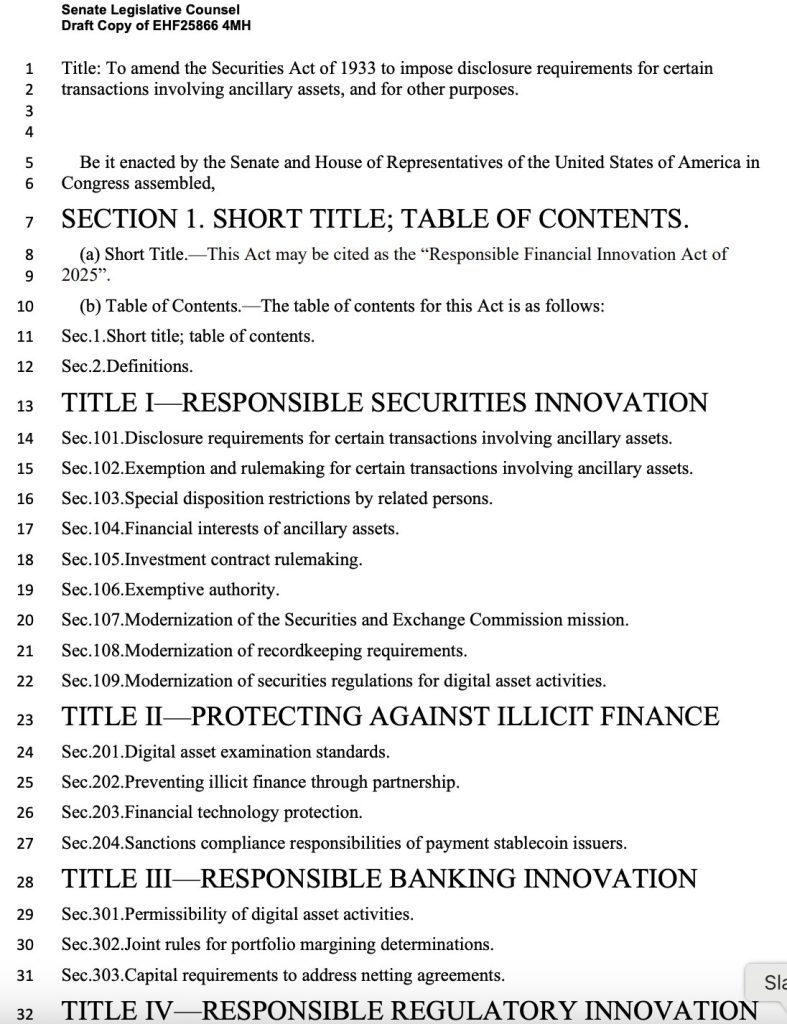
Source: Responsible Financial Innovation Act of 2025

One of the bill’s most consequential provisions is the explicit recognition that digital assets, referred to as “ancillary assets,” are not inherently securities. It clarifies that secondary market transactions involving these tokens should not automatically fall under securities laws.

However, exceptions apply: if a token’s value is closely tied to promises of profit through managerial efforts, securities laws could still be triggered.

In addition, the draft legislation attempts to resolve the persistent jurisdictional tension between the SEC and CFTC. Under the proposed framework, most digital assets would be regulated as commodities, falling primarily under the Commodity Futures Trading Commission (CFTC), while the SEC would retain oversight of investment contracts and investor protection matters.

The bill instructs the SEC to modernize disclosure rules and adapt its record-keeping systems to account for blockchain-based financial activity, ensuring compatibility with Web3 ecosystems.

Beyond token classification, the legislation spans more than 35 areas of focus. It includes requests for public feedback on topics such as stablecoin regulation, custody frameworks, DeFi exemptions, and illicit finance concerns, including tactics like “pig butchering” scams.

The draft also proposes a “safe harbor” for forward-looking statements, shielding developers from premature enforcement actions, provided their projects meet certain transparency and decentralization standards.

Additionally, developers who do not custody user funds could be exempt from some registration requirements, an important provision for open-source innovators.

Senator Tim Scott emphasized the bill’s collaborative approach, saying, “This bill gives Congress the opportunity to hear from industry and regulators alike before finalizing a legal framework that protects consumers and encourages responsible innovation.”

Stakeholder input is now being solicited, particularly on areas where the SEC and CFTC’s jurisdiction may overlap, with Senate Banking Committee hearings expected in the coming weeks as lawmakers move toward introducing a finalized version.

Senate Push for Market Structure Reform Gains Momentum After GENIUS Act Signing

Momentum for U.S. crypto legislation continued to build this week with the new draft legislation after President Donald Trump signed the GENIUS Act into law, marking a landmark moment in federal regulation.

The GENIUS Act, passed with broad bipartisan support, provides the first federal framework for stablecoin issuers and will take effect 18 months after signing or 120 days after federal regulators, including the Treasury and the Federal Reserve, issue final rules.

Alongside the GENIUS Act, two other major proposals, the CLARITY Act and the Anti-CBDC Surveillance State Act, are advancing in Congress. The CLARITY Act was recently approved by the House Agriculture Committee. Meanwhile, the Anti-CBDC Act seeks to block any retail digital dollar issued by the Federal Reserve.

Industry executives are watching closely. Ian De Bode of Ondo Finance described the new legislation as “the beginning of a new regulatory era,” pointing to bipartisan cooperation and the role of key figures like Patrick McHenry.

Senator Tim Scott said lawmakers are planning to finalize crypto market structure legislation by September 30.

With the GENIUS Act now law and several other bills in motion, the U.S. digital asset space is edging closer to a defined regulatory framework, one that could reshape the crypto sector heading into 2026.


Market Opportunity
Threshold Logo
Threshold Price(T)
$0.008097
$0.008097$0.008097
-0.45%
USD
Threshold (T) Live Price Chart
Disclaimer: The articles reposted on this site are sourced from public platforms and are provided for informational purposes only. They do not necessarily reflect the views of MEXC. All rights remain with the original authors. If you believe any content infringes on third-party rights, please contact [email protected] for removal. MEXC makes no guarantees regarding the accuracy, completeness, or timeliness of the content and is not responsible for any actions taken based on the information provided. The content does not constitute financial, legal, or other professional advice, nor should it be considered a recommendation or endorsement by MEXC.

You May Also Like

Egrag Crypto: XRP Could be Around $6 or $7 by Mid-November Based on this Analysis

Egrag Crypto: XRP Could be Around $6 or $7 by Mid-November Based on this Analysis

Egrag Crypto forecasts XRP reaching $6 to $7 by November. Fractal pattern analysis suggests a significant XRP price surge soon. XRP poised for potential growth based on historical price patterns. The cryptocurrency community is abuzz after renowned analyst Egrag Crypto shared an analysis suggesting that XRP could reach $6 to $7 by mid-November. This prediction is based on the study of a fractal pattern observed in XRP’s past price movements, which the analyst believes is likely to repeat itself in the coming months. According to Egrag Crypto, the analysis hinges on fractal patterns, which are used in technical analysis to identify recurring market behavior. Using the past price charts of XRP, the expert has found a certain fractal that looks similar to the existing market structure. The trend indicates that XRP will soon experience a great increase in price, and the asset will probably reach the $6 or $7 range in mid-November. The chart shared by Egrag Crypto points to a rising trend line with several Fibonacci levels pointing to key support and resistance zones. This technical structure, along with the fractal pattern, is the foundation of the price forecast. As XRP continues to follow the predicted trajectory, the analyst sees a strong possibility of it reaching new highs, especially if the fractal behaves as expected. Also Read: Why XRP Price Remains Stagnant Despite Fed Rate Cut #XRP – A Potential Similar Set-Up! I've been analyzing the yellow fractal from a previous setup and trying to fit it into various formations. Based on the fractal formation analysis, it suggests that by mid-November, #XRP could be around $6 to $7! Fractals can indeed be… pic.twitter.com/HmIlK77Lrr — EGRAG CRYPTO (@egragcrypto) September 18, 2025 Fractal Analysis: The Key to XRP’s Potential Surge Fractals are a popular tool for market analysis, as they can reveal trends and potential price movements by identifying patterns in historical data. Egrag Crypto’s focus on a yellow fractal pattern in XRP’s price charts is central to the current forecast. Having contrasted the market scenario at the current period and how it was at an earlier time, the analyst has indicated that XRP might revert to the same price scenario that occurred at a later cycle in the past. Egrag Crypto’s forecast of $6 to $7 is based not just on the fractal pattern but also on broader market trends and technical indicators. The Fibonacci retracements and extensions will also give more insight into the price levels that are likely to be experienced in the coming few weeks. With mid-November in sight, XRP investors and traders will be keeping a close eye on the market to see if Egrag Crypto’s analysis is true. If the price targets are reached, XRP could experience one of its most significant rallies in recent history. Also Read: Top Investor Issues Advance Warning to XRP Holders – Beware of this Risk The post Egrag Crypto: XRP Could be Around $6 or $7 by Mid-November Based on this Analysis appeared first on 36Crypto.
Share
Coinstats2025/09/18 18:36
‘High Risk’ Projects Dominate Crypto Press Releases, Report Finds

‘High Risk’ Projects Dominate Crypto Press Releases, Report Finds

The post ‘High Risk’ Projects Dominate Crypto Press Releases, Report Finds appeared on BitcoinEthereumNews.com. More than six in 10 crypto press releases published
Share
BitcoinEthereumNews2026/02/04 13:09
Why Vitalik Says L2s Aren’t Ethereum Shards Now?

Why Vitalik Says L2s Aren’t Ethereum Shards Now?

The post Why Vitalik Says L2s Aren’t Ethereum Shards Now? appeared on BitcoinEthereumNews.com. Vitalik says Ethereum’s scaling and higher gas limits mean L2s no
Share
BitcoinEthereumNews2026/02/04 13:18