How can anyone turn $5000 into more than $400,000? — How to start an investment fund explained
FinancePolice aims to give clear, practical steps and referral sources so you can test scenarios yourself, understand regulatory triggers, and decide when it makes sense to seek legal or tax counsel.
What ‘how to start an investment fund’ really means and whether $5,000 is a meaningful start
When readers ask how to start an investment fund they often mean one of two things: either they want to manage other people,s money in a pooled vehicle, or they want to use their own $5,000 to try to grow capital. The phrase how to start an investment fund can point to very different legal, operational, and performance expectations depending on which path you mean.
Turning a personal $5,000 balance into something much larger through compound growth is mathematically possible, but the required annualized returns can be high and depend on time horizon and fees; for example, the compound interest math behind such targets is well explained in practical calculators and guides Investopedia compound interest guide.
Learn how FinancePolice can help you reach the right audience for sponsored content and partnership opportunities
Try a quick compound interest check with a simple online calculator or a spreadsheet template to see how different return rates and savings additions change outcomes.
Contact FinancePolice about advertising
There is a clear difference between growing your own account and forming a pooled investment vehicle that raises capital from others. A pooled vehicle brings governance, custody, reporting, and regulatory questions that do not apply when you manage a single brokerage account for yourself.
Five thousand dollars is a meaningful starting point for disciplined personal investing and learning to track performance, but it is a small base if your goal is to form a pooled fund that seeks outside capital, since fund formation and compliance costs typically require substantially more startup capital and infrastructure.
Short summary: $5,000 can seed personal investing and skill building, while starting a formal pooled fund usually needs more capital, a documented strategy, and regulatory readiness.

How compound interest works: the math behind turning 5,000 into 400,000
The compound interest formula shows how principal, return rate, and time combine: Future value equals present value times one plus the annual return to the power of years, adjusted if you add regular contributions. That basic formula and examples are useful when testing how different annualized returns affect growth Investopedia compound interest guide.
As a concrete check, reaching $400,000 from $5,000 over 30 years needs very high annualized performance; standard compound calculators illustrate that the implied annual return is roughly in the mid to high teens percent range, which is well above long run equity averages.
Shorter time horizons make the required return even larger, while adding regular savings lowers the needed rate. Working through a few scenarios with the formula helps you see which combinations are plausible given your time horizon and ability to add capital.
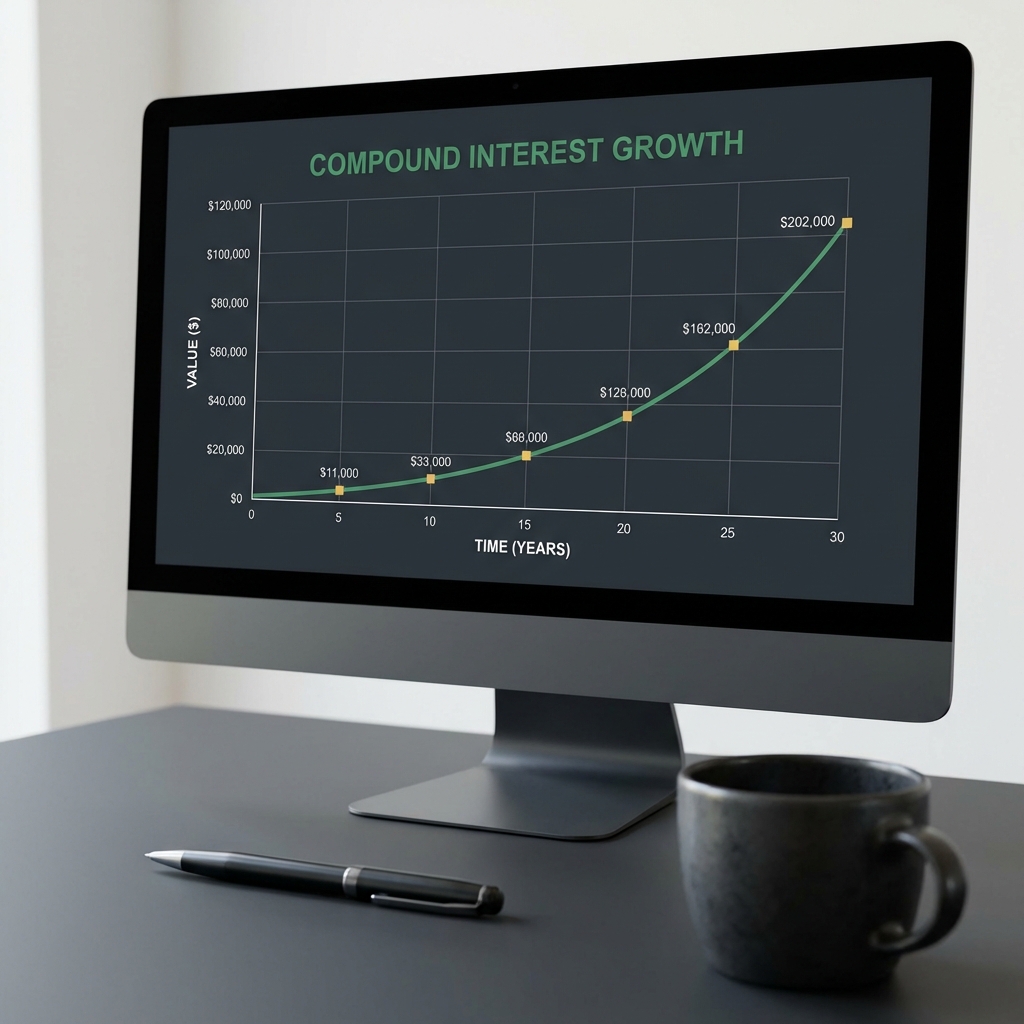
The compound interest formula and a simple calculator check
Use the formula A = P*(1+r)^n for a one time investment, and include an annuity term if you add yearly amounts. Writing the steps out and entering numbers into a spreadsheet is the clearest way to test whether a target is feasible for your situation.
If you want to verify a scenario, plug in your initial $5,000, a candidate annual return, and the number of years and observe the result. Simple sensitivity checks show how a few percentage points difference in annual return changes long term outcomes materially Investopedia compound interest guide.
Example annual return scenarios
To illustrate, one can compare three quick examples: a conservative long run stock return, an optimistic high return, and a mixed plan with savings added. Each example helps show why the combination of return, time, and contributions matters more than the starting balance alone.
Remember that nominal returns differ from real returns after inflation, and that most historical broad-market averages are often cited as nominal figures which should be adjusted when you consider purchasing power over decades Vanguard historical returns overview.
How to start an investment fund versus simple long term investing
Managing your own taxable or retirement brokerage account is straightforward: open an account, pick diversified funds or indexed strategies, and maintain a savings plan. By contrast, forming a pooled fund that accepts outside capital introduces governance, investor relations, and legal responsibilities.
Use $5,000 to learn and prove a repeatable strategy in your personal account, model realistic return and tax scenarios, and only pursue fund formation after you have a documented track record, enough startup capital to cover compliance, and legal counsel to address SEC private fund rules.
Differences in setup, access, and risk
A personal account gives liquidity and low setup cost, while a pooled vehicle can provide centralized decision making and potential access to private deals that individual investors cannot easily reach. Those access advantages often come with long lockups and less liquidity for participants Cambridge Associates private equity update.
Who benefits from a fund structure
A fund structure can add value when a manager has a repeatable edge, access to proprietary deal flow, or a strategy that scales better with more capital. For most beginners, however, disciplined personal investing and a longer time horizon may be a more practical way to grow capital from small starting amounts.
Regulatory and compliance basics when you start a fund in the U.S.
If you plan to raise outside capital, pooled vehicles commonly fall under SEC private fund rules and associated disclosure and reporting obligations; these rules are a primary reason why fund formation requires legal and compliance planning SEC private funds guidance.
The specific regulatory triggers depend on how you structure solicitations, investor eligibility, and governance. Many small founders underestimate how disclosure duties and potential registration obligations add to startup complexity and ongoing cost, which matters when you start an investment fund.
Practical implication: before you approach outside investors consider talking to counsel who understands private fund formation so you can map likely costs, timelines, and regulatory steps.
Realistic return sources: public markets, private equity, venture capital, and entrepreneurship
Long run U.S. equity returns have historically averaged roughly 10 percent nominal per year, which is a useful baseline for diversification-based scenarios rather than an expectation that any single strategy will repeatedly beat that figure Vanguard historical returns overview.
Private equity and venture capital sometimes show higher headline returns in some vintages, but those strategies typically come with wide dispersion across funds, long illiquidity, and fee and carry arrangements that reduce net investor returns Cambridge Associates private equity update.
Historical indexed returns vs private strategies
Public-market indexing offers transparent fees, liquidity, and predictable tax treatments, while private strategies may offer upside at the cost of access limits and concentrated risk. Comparing net-of-fees performance is essential because headline gross returns can be misleading for investors evaluating exposure.
PitchBook and similar reports highlight how venture returns vary greatly by vintage and by firm, which is why access to top quartile managers is often a limiting factor for retail investors considering a private path PitchBook 2024 annual venture report.
Business and entrepreneurial upside
Starting or scaling a business is a third route that can turn modest capital into much larger sums, but it requires time, skills, and a tolerance for operational risk. Business growth is often the way individuals achieve outsized outcomes, separate from pooled fund strategies.
For readers considering entrepreneurship, treat business investment as a different type of risk allocation, and be explicit about the time demand, required reinvestment, and possible need for outside capital or partners to scale. Consider using a small seed or testing a side hustle to build skills and cash flow.
How fees, carried interest, and taxes change the math
Fees and carried interest materially reduce investor take home returns, especially over decades. When evaluating any path that promises high gross returns, model the impact of management fees and carry on net performance because those drags compound as well Cambridge Associates private equity update.
Tax treatment also matters: different income types face different tax rules, and realized gains are subject to the tax code provisions that affect net outcomes. For practical tax guidance on treatment of investment income and expenses consult primary tax publications IRS Publication 550.
Common fee structures and their long term impact
Typical private fund arrangements include an annual management fee plus carried interest on profits, which can shift a meaningful share of long term gains away from investors and toward managers. Modeling net returns with realistic fee assumptions creates more honest expectations than relying on gross returns alone.
Even a few percentage points in extra fees each year can shave off a substantial fraction of long term compound growth, so build fee scenarios into any model you use to test whether $5,000 could realistically become a much larger amount under your plan.
Tax treatment basics that affect net returns
Taxes on dividends, interest, and capital gains each follow different rules and timing, and investors should include likely tax liabilities when forecasting net outcomes. Simple net-of-tax examples help show how nominal performance overstates investor take home if taxes are not accounted for IRS Publication 550.
Because tax rules change and depend on personal circumstances, use tax modeling only as an estimate and validate important decisions with a tax professional before you finalize investor communications or fund documents.
Practical steps for someone with 5,000 who is asking how to start an investment fund
Start with basics: build a three to six month emergency fund, practice a repeatable strategy in your personal account, and keep a clear performance record. These steps reduce personal risk and create a foundation for any future discussion about managing other people,s money.
A realistic short checklist for phase one includes: secure an emergency fund, open a brokerage account, set a documented strategy, and track every trade and decision. Demonstrated discipline and transparent record keeping are essential before you think about soliciting external capital SEC private funds guidance.
Milestones that suggest readiness to approach outside investors include a documented multi year track record, consistent risk controls, and an initial assets under management target that covers expected operational and compliance costs. With only $5,000, those milestones are usually still some way off unless you add capital or produce rapid, replicable gains.
estimate future value with initial investment, annual addition, and return
–
Use to test sensitivity to return and time
Formal fund formation usually requires legal counsel, baseline operating capital, and a plan for investor communications. Do not assume a $5,000 start covers those needs; plan instead to demonstrate a repeatable process and raise additional capital or partner with others when you are ready.
Model scenarios: saving plus diversified investing, concentrated bets, and entrepreneurial routes
Scenario A, diversified compounding: assume you add modest savings regularly to a diversified stock index allocation that tracks long run U.S. equity returns. Over decades this path uses time and disciplined savings more than a single high return year to build wealth, and it is grounded in historical averages rather than outlier performance Vanguard historical returns overview.
Scenario B, concentrated high risk or private exposure: venture and private equity can produce outsized gains for some funds, but outcomes show wide dispersion and long illiquidity. Success often depends on access, selection, and timing rather than a single repeatable rate you can count on PitchBook 2024 annual venture report.
Scenario C, entrepreneurial route: use the $5,000 as seed capital or skill investment for a side hustle that can be scaled. Business growth can create large step changes in net worth if product market fit and reinvestment align, but it requires operational work rather than passive compounding.
Each scenario has different risk profiles and timelines. For many readers the practical mix is disciplined saving plus exposure to diversified public markets, with selective entrepreneurial bets if they have relevant skills and capacity to run a business.
How to test an investment strategy before you accept outside capital
Run your strategy in a personal account and keep an auditable record. Paper trading or small live tests help you learn how the strategy behaves in different market conditions without exposing outside investors to early mistakes.
Track clear metrics such as annualized return, maximum drawdown, hit rate, and average holding period. These metrics are what prospective investors, or even a partner, will ask about when you present a track record.
Use conservative time windows to assess durability; many strategies that look good over a few months fail when stressed by a different market regime. Document stress tests and describe risk controls you will use if you scale capital.
Common mistakes and pitfalls when trying to scale a small amount into large wealth
Behavioral traps such as overconcentration, chasing hot sectors after short term success, or increasing leverage without adequate risk controls often derail plans to scale small capital into large outcomes. Avoid letting early wins drive outsized increases in risk.
Ignoring fees, carried interest, and taxes also creates a misleading picture of performance. Model net-of-fees outcomes and treat headline gross returns skeptically, since the difference compounds over long horizons Cambridge Associates private equity update.
Legal and compliance missteps are another common pitfall for founders who attempt to solicit capital without proper documentation or counsel. When you start an investment fund, regulatory readiness and clear governance mitigate the risk of costly follow up problems SEC private funds guidance.
Decision checklist: is starting a fund the right move for your situation?
Ask whether you have enough time horizon to support long term investing, a documented repeatable strategy, realistic startup capital to cover legal and operational costs, and a clear governance plan. If any of those are missing, consider alternative steps before forming a fund.
Simple go no go checklist: do you have a multi year track record, documented risk controls, baseline AUM target that covers costs, and access to potential investors who meet eligibility and suitability rules? If the answers are mostly no, focus on personal investing and track record building instead.
Where to find credible information and primary sources before you act
Start with regulator guidance and primary tax publications. The SEC,s overview of private fund requirements and the IRS,s guidance on investment income are two primary sources you should read when you plan to raise outside capital SEC private funds guidance.
For realistic return expectations consult long run return overviews from major index providers rather than marketing materials. Historical return summaries help you set baseline assumptions when you model scenarios Vanguard historical returns overview.
A realistic summary and next steps for readers thinking how to start an investment fund
Recap: $5,000 is a practical seed for disciplined personal investing and testing strategies, but a formal pooled fund usually needs more capital, documented performance, and compliance readiness before it can responsibly raise outside money.
Next actions: save to build an emergency cushion, practice and document a repeatable strategy in a personal account, model returns net of fees and taxes, and consult legal and tax counsel before soliciting investors.
One sentence takeaway: use $5,000 to learn, test, and document, and only consider fund formation once you have a clear track record, capital to cover startup costs, and regulatory advice.
Further reading and tools to model scenarios yourself
Use a compound interest calculator or spreadsheet template to test combinations of return, time, and savings; Investopedia and other primary calculators are convenient starting points for building scenarios Investopedia compound interest guide. For small, regular investing options see our roundup of best micro investment apps.
For private markets performance updates consult specialist reports from established research firms to understand dispersion and vintage effects, and save copies of model inputs so you can revisit assumptions as conditions change Cambridge Associates private equity update.
It is theoretically possible but requires sustained high annualized returns, a long time horizon, or regular additional savings; most realistic plans combine disciplined saving with diversified investing or entrepreneurship.
Yes, forming a pooled vehicle that accepts outside capital typically triggers regulatory and disclosure obligations that make legal counsel essential for compliance and governance planning.
Build an emergency fund, practice a documented investing strategy in a personal account, track performance, and model scenarios net of fees and taxes before considering outside capital.
When you are ready to scale or accept investors, consult primary SEC guidance and tax publications, and seek professional counsel to map the obligations and costs involved.
References
- https://www.investopedia.com/terms/c/compoundinterest.asp
- https://investor.vanguard.com/investing/how-to-invest/historical-returns
- https://www.cambridgeassociates.com/insight/updated-us-private-equity-performance/
- https://www.sec.gov/spotlight/private-funds
- https://www.irs.gov/publications/p550
- https://pitchbook.com/news/reports/2024-annual-venture
- https://www.sec.gov/resources-small-businesses/capital-raising-building-blocks/starting-private-fund
- https://financepolice.com/advertise/
- https://financepolice.com/category/investing/
- https://financepolice.com/businesses-you-can-start-with-1000/
- https://financepolice.com/best-micro-investment-apps/


You May Also Like

Oil reversal and crowded shorts keep crypto traders on edge

Sports is business: The financial undercurrents that aspiring sports journalists should understand