“If the token price still goes up, why take the risk?”“If the token price still goes up, why take the risk?”

Innovation in the crypto industry has slowed down. What other ambitious projects are there besides AI Agent?

2025/01/07 13:38

Innovation in the crypto industry has slowed down. What other ambitious projects are there besides AI Agent?

Original: Ignas

Compiled by: Yuliya, PANews

On the surface, cryptocurrencies appear to be booming: After years of exclusion, spot ETFs finally came online, and Bitcoin (BTC) and Ethereum (ETH) ETFs set new records for inflows. Trump's victory brought cryptocurrencies closer to mainstream power in the United States, and the crypto lobby successfully pushed Gary Gensler and skeptics out of office. Today, cryptocurrencies have become a recognized industry, and Bitcoin may even be considered a national reserve asset by some countries.

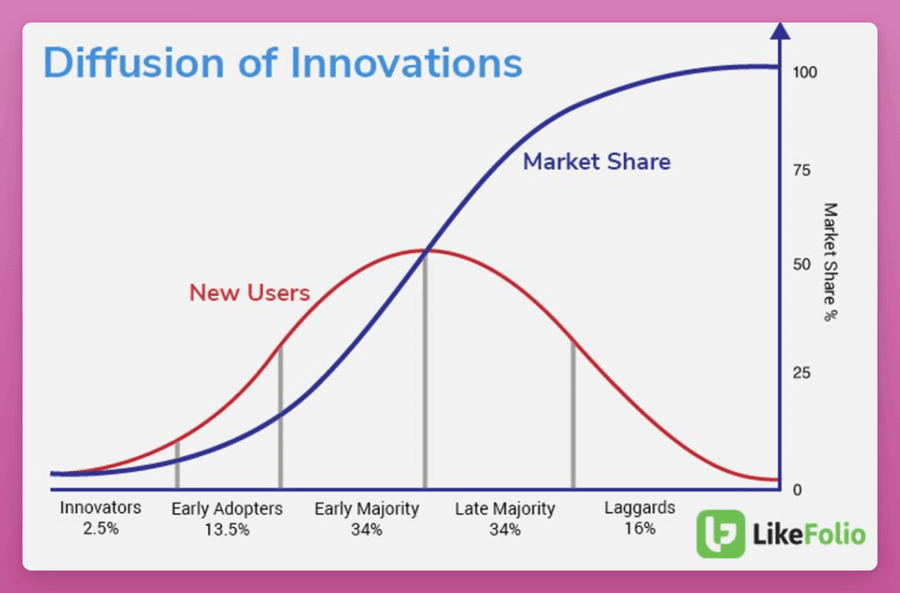
While the price outlook for cryptocurrencies is bullish, most of the gains are driven by external macro factors. However, the cryptocurrency industry’s internal innovation engine is gradually slowing down. As the industry matures, innovation will naturally slow down, but even if innovation slows down, prices may still rise.
Innovation in the crypto industry has slowed down. What other ambitious projects are there besides AI Agent?

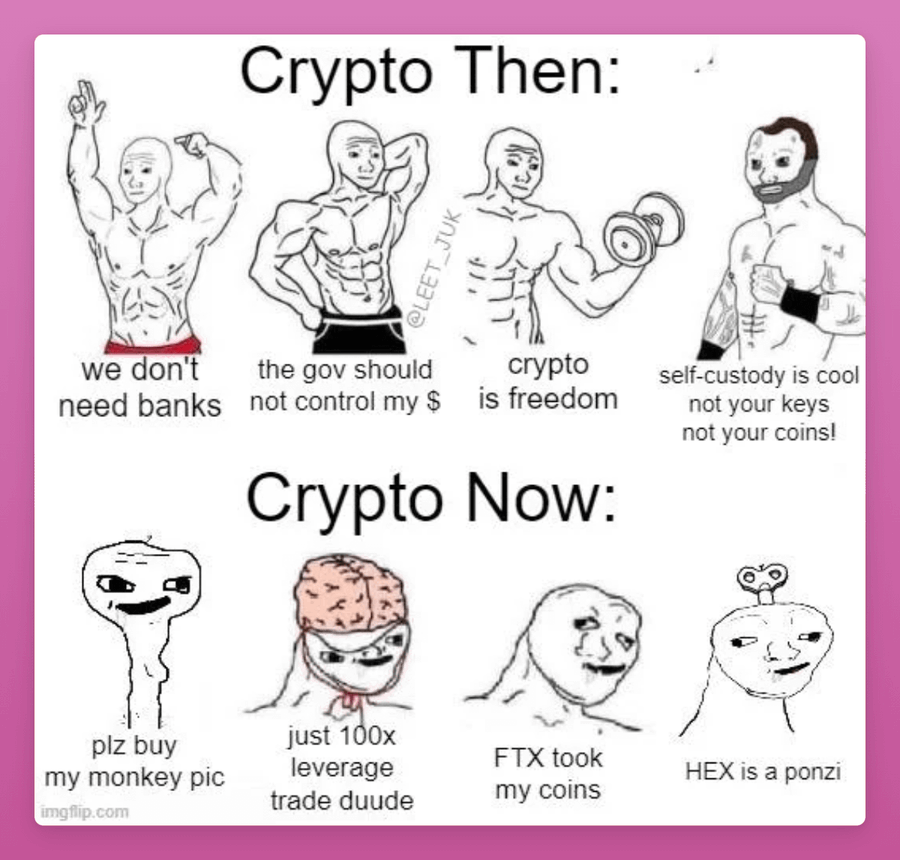
However, the slowdown in innovation is not the root problem, but a symptom. The real problem lies in waning ambition and growing risk aversion. Once upon a time, cryptocurrencies were driven by radical ideas that aimed to change the world. Today, the industry seems content to pursue regulatory approval and institutional adoption.

Innovation in the crypto industry has slowed down. What other ambitious projects are there besides AI Agent?

This is also supported by Vitalik Buterin in his 2023 blog post “Reclaiming the Cypherpunk Spirit of Ethereum” : “We are not just creating isolated tools and games, but building a more free and open society and economy in an all-round way, in which different parts of technology, society, and economy can be integrated with each other.”

Think about it: what is the innovation of the current cycle? AI x Crypto is one of them. But AI is an external innovation, without it, this cycle might be different and might continue to focus on meme coin trading.

The only real goal of Memecoin is to get rich quick, not to change the world . Once rich, the problems of the outside world no longer seem to bother the participants. It is worth noting that declarations such as "[project name] is the most egalitarian thing we have ever seen. It is ambitious and, if successful, can truly reshape the fabric of society" are no longer seen frequently. In contrast, the previous cycle did witness several radical innovations:

• Decentralized Finance (DeFi)

• Non-fungible tokens (NFTs)

• DeFi yield farms

• P2E games (such as Axie Infinity)

• Metaverse
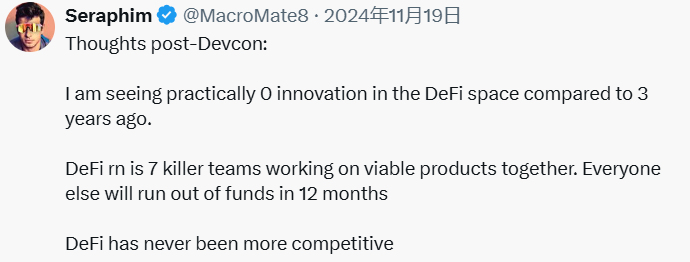
Innovation in the crypto industry has slowed down. What other ambitious projects are there besides AI Agent?

The 2020-2021 cycle was also the peak of innovation in token economics, with the emergence of innovative concepts such as Ampleforth's Rebasing Tokens, veTokenomics, (3,3) model, liquidity mining, and SNX as sUSD collateral, as well as the emergence of a variety of algorithmic stablecoins.

However, current crypto projects and the venture capital firms behind them prefer to adopt proven simple economic models to reduce risk, as they usually only have one chance at a token generation event (TGE). $EIGEN's Intersubjective Token is a rare innovative exception.

In contrast, the ICO boom in 2017 is considered the peak of the crypto industry's ambitions, when many projects attempted to decentralize everything, but most of them failed for being too radical, with only a few projects surviving and having to tone down their visions.

These crazy ideas have difficulty getting funding in today’s more risk-averse cryptocurrency industry, but these radical concepts once attracted a group of people who dreamed of changing the world.

Innovation in the crypto industry has slowed down. What other ambitious projects are there besides AI Agent?

In their book "Boom: Bubbles and the End of Stagnation", B. Hobart and T. Huber point out that transformative progress often comes from small groups with a unified vision, which are usually well-funded but lack strict accountability mechanisms. They believe that although financial bubbles are often seen as negative phenomena, history shows that many important breakthroughs were driven by bubbles.

While the days of low accountability are not over, regulation brings more risk aversion, and this cycle may be the last chance for a big bubble that can produce substantial innovation. The AI x Crypto bubble can produce at least one or two killer applications.

The most ambitious cryptocurrency projects currently underway

Despite this, there are many ambitious cryptocurrency projects today, including:

• Ethena : Integrating DeFi, CeFi and Traditional Finance (TradFi)

• Chainlink: bridging blockchain and real-world data for immutable smart contracts

• Pudgy Penguins: Leading Web3 IP Brand Expanding to Web2

• WorldCoin: Bringing everyone on-chain, potentially enabling UBI funded by AI

• Liquity/RAI: The final decentralized stablecoin

• Arweave/Filecoin: Permanent storage and censorship resistance

• Farcaster/Lens: Reimagining social media

• Polymarket: A source of truth in a world of fake news

• Bio protocol (DeSci): Revolutionizing science by changing incentives

• Bitcoin: Revolutionary Currency, Digital Gold

Among them, projects like WorldCoin’s eye-scanning Orb and Liquity v2 and $BOLD stablecoins, while radical, are exactly the risks ambitious protocols are willing to take. These projects demonstrate the most egalitarian ideas, are ambitious, and if successful, could reshape the fabric of society.

Ethereum’s Dilemma

Ethereum is absent from this list of innovative projects. Perhaps the evaluation of Ethereum is a bit harsh, but Vitalik’s vision of “Cyberpunk Ethereum” is almost invisible on social platforms.

The upcoming fork (upgrade) will only be minor changes for ordinary users. Ethereum has already given up on sharding and main chain expansion, and in the near future, the most it will do is slightly increase the gas limit of the block.

It seems that Ethereum has handed over transaction execution and ambitions to the second layer network (L2). The future development direction of Ethereum is still unclear.

Innovation in the crypto industry has slowed down. What other ambitious projects are there besides AI Agent?

In contrast, Solana's attitude is more radical. It chooses to continue to promote the "integrated blockchain" model and refuses to compromise.

However, Ethereum's future network expansion plans may prove that its modular path is correct. I hope Ethereum will be great again, and I also hope to see radical new ideas emerge.

Humans need boundaries

The world, especially the West, seems to be stagnating. From stagnant wages, music that seems repetitive, new iPhones that no longer feel new, to remade movies, people seem to be afraid of innovation because new content often means greater risk. In some ways, we are actually going backwards. For example, due to the grounding of Concorde, the flight time from London to New York is now longer than it was in the 1970s.

Yet cryptocurrency remains one of the fastest-growing and most innovative industries in the world, perhaps second only to AI.
Innovation in the crypto industry has slowed down. What other ambitious projects are there besides AI Agent?

Despite this, the pace of innovation and ambition in the industry is clearly declining. This is partly due to the maturity of the above-mentioned industries, but a deeper reason is that the limitations of many technologies seem to have been accepted and not challenged enough. For example:

  • It seems acceptable that DeFi and DAO are no longer fully decentralized. Instead of making DeFi decentralized, it is better to redefine it as on-chain finance and the problem will be solved.
  • Ethereum cannot scale at Layer 1 and its token economics lacks innovation, and these seem to be acceptable.
  • In the current market, the low market cap of $LQTY compared to $ENA shows that decentralized stablecoins are no longer really needed, and high yields are better.

Perhaps, the ambition to push boundaries is slowly wearing away with each passing cycle, and the crypto industry is becoming dull as a result. In short, if token prices are still rising, why take the risk?


Market Opportunity
TokenFi Logo
TokenFi Price(TOKEN)
$0.005863
$0.005863$0.005863
-7.06%
USD
TokenFi (TOKEN) Live Price Chart
Disclaimer: The articles reposted on this site are sourced from public platforms and are provided for informational purposes only. They do not necessarily reflect the views of MEXC. All rights remain with the original authors. If you believe any content infringes on third-party rights, please contact [email protected] for removal. MEXC makes no guarantees regarding the accuracy, completeness, or timeliness of the content and is not responsible for any actions taken based on the information provided. The content does not constitute financial, legal, or other professional advice, nor should it be considered a recommendation or endorsement by MEXC.

You May Also Like

The Role of Blockchain in Building Safer Web3 Gaming Ecosystems

The Role of Blockchain in Building Safer Web3 Gaming Ecosystems

The gaming industry is in the midst of a historic shift, driven by the rise of Web3. Unlike traditional games, where developers and publishers control assets and dictate in-game economies, Web3 gaming empowers players with ownership and influence. Built on blockchain technology, these ecosystems are decentralized by design, enabling true digital asset ownership, transparent economies, and a future where players help shape the games they play. However, as Web3 gaming grows, security becomes a focal point. The range of security concerns, from hacking to asset theft to vulnerabilities in smart contracts, is a significant issue that will undermine or erode trust in this ecosystem, limiting or stopping adoption. Blockchain technology could be used to create security processes around secure, transparent, and fair Web3 gaming ecosystems. We will explore how security is increasing within gaming ecosystems, which challenges are being overcome, and what the future of security looks like. Why is Security Important in Web3 Gaming? Web3 gaming differs from traditional gaming in that players engage with both the game and assets with real value attached. Players own in-game assets that exist as tokens or NFTs (Non-Fungible Tokens), and can trade and sell them. These game assets usually represent significant financial value, meaning security failure could represent real monetary loss. In essence, without security, the promises of owning “something” in Web3, decentralized economies within games, and all that comes with the term “fair” gameplay can easily be eroded by fraud, hacking, and exploitation. This is precisely why the uniqueness of blockchain should be emphasized in securing Web3 gaming. How Blockchain Ensures Security in Web3 Gaming?
  1. Immutable Ownership of Assets Blockchain records can be manipulated by anyone. If a player owns a sword, skin, or plot of land as an NFT, it is verifiably in their ownership, and it cannot be altered or deleted by the developer or even hacked. This has created a proven track record of ownership, providing control back to the players, unlike any centralised gaming platform where assets can be revoked.
  2. Decentralized Infrastructure Blockchain networks also have a distributed architecture where game data is stored in a worldwide network of nodes, making them much less susceptible to centralised points of failure and attacks. This decentralised approach makes it exponentially more difficult to hijack systems or even shut off the game’s economy.
  3. Secure Transactions with Cryptography Whether a player buys an NFT or trades their in-game tokens for other items or tokens, the transactions are enforced by cryptographic algorithms, ensuring secure, verifiable, and irreversible transactions and eliminating the risks of double-spending or fraudulent trades.
  4. Smart Contract Automation Smart contracts automate the enforcement of game rules and players’ economic exchanges for the developer, eliminating the need for intermediaries or middlemen, and trust for the developer. For example, if a player completes a quest that promises a reward, the smart contract will execute and distribute what was promised.
  5. Anti-Cheating and Fair Gameplay The naturally transparent nature of blockchain makes it extremely simple for anyone to examine a specific instance of gameplay and verify the economic outcomes from that play. Furthermore, multi-player games that enforce smart contracts on things like loot sharing or win sharing can automate and measure trustlessness and avoid cheating, manipulations, and fraud by developers.
  6. Cross-Platform Security Many Web3 games feature asset interoperability across platforms. This interoperability is made viable by blockchain, which guarantees ownership is maintained whenever assets transition from one game or marketplace to another, thereby offering protection to players who rely on transfers for security against fraud. Key Security Dangers in Web3 Gaming Although blockchain provides sound first principles of security, the Web3 gaming ecosystem is susceptible to threats. Some of the most serious threats include:
Smart Contract Vulnerabilities: Smart contracts that are poorly written or lack auditing will leave openings for exploitation and thereby result in asset loss. Phishing Attacks: Unintentionally exposing or revealing private keys or signing transactions that are not possible to reverse, under the assumption they were genuine transaction requests. Bridge Hacks: Cross-chain bridges, which allow players to move their assets between their respective blockchains, continually face hacks, requiring vigilance from players and developers. Scams and Rug Pulls: Rug pulls occur when a game project raises money and leaves, leaving player assets worthless. Regulatory Ambiguity: Global regulations remain unclear; risks exist for players and developers alike. While blockchain alone won’t resolve every issue, it remediates the responsibility of the first principles, more so when joined by processes such as auditing, education, and the right governance, which can improve their contribution to the security landscapes in game ecosystems. Real Life Examples of Blockchain Security in Web3 Gaming Axie Infinity (Ronin Hack): The Axie Infinity game and several projects suffered one of the biggest hacks thus far on its Ronin bridge; however, it demonstrated the effectiveness of multi-sig security and the effective utilization of decentralization. The industry benefited through learning and reflection, thus, as projects have implemented changes to reduce the risks of future hacks or misappropriation. Immutable X: This Ethereum scaling solution aims to ensure secure NFT transactions for gaming, allowing players to trade an asset without the burden of exorbitant fees and fears of being a victim of fraud. Enjin: Enjin is providing a trusted infrastructure for Web3 games, offering secure NFT creation and transfer while reiterating that ownership and an asset securely belong to the player. These examples indubitably illustrate that despite challenges to overcome, blockchain remains the foundational layer on which to build more secure Web3 gaming environments. Benefits of Blockchain Security for Players and Developers For Players: Confidence in true ownership of assets Transparency in in-game economies Protection against nefarious trades/scams For Developers: More trust between players and the platform Less reliance on centralized infrastructure Ability to attract wealth and players based on provable fairness By incorporating blockchain security within the mechanics of game design, developers can create and enforce resilient ecosystems where players feel reassured in investing time, money, and ownership within virtual worlds. The Future of Secure Web3 Gaming Ecosystems As the wisdom of blockchain technology and industry knowledge improves, the future for secure Web3 gaming looks bright. New growing trends include: Zero-Knowledge Proofs (ZKPs): A new wave of protocols that enable private transactions and secure smart contracts while managing user privacy with an element of transparency. Decentralized Identity Solutions (DID): Helping players control their identities and decrease account theft risks. AI-Enhanced Security: Identifying irregularities in user interactions by sampling pattern anomalies to avert hacks and fraud by time-stamping critical events. Interoperable Security Standards: Allowing secured and seamless asset transfers across blockchains and games. With these innovations, blockchain will not only secure gaming assets but also enhance the overall trust and longevity of Web3 gaming ecosystems. Conclusion Blockchain is more than a buzzword in Web3; it is the only way to host security, fairness, and transparency. With blockchain, players confirm immutable ownership of digital assets, there is a decentralized infrastructure, and finally, it supports smart contracts to automate code that protects players and developers from the challenges of digital economies. The threats, vulnerabilities, and scams that come from smart contracts still persist, but the industry is maturing with better security practices, cross-chain solutions, and increased formal cryptographic tools. In the coming years, blockchain will remain the base to digital economies and drive Web3 gaming environments that allow players to safely own, trade, and enjoy their digital experiences free from fraud and exploitation. While blockchain and gaming alone entertain, we will usher in an era of secure digital worlds where trust complements innovation. The Role of Blockchain in Building Safer Web3 Gaming Ecosystems was originally published in Coinmonks on Medium, where people are continuing the conversation by highlighting and responding to this story
Share
Medium2025/09/18 14:40
Coinbase Joins Ethereum Foundation to Back Open Intents Framework

Coinbase Joins Ethereum Foundation to Back Open Intents Framework

Coinbase Payments has joined the Open Intents Framework as a core contributor, working alongside Ethereum Foundation and other major players. The initiative aims to simplify complex multi-chain interactions through automated solver technology. The post Coinbase Joins Ethereum Foundation to Back Open Intents Framework appeared first on Coinspeaker.
Share
Coinspeaker2025/09/18 02:43
Top Streetwear Brands to Watch in 2026: Streetwear Studios Spotlight

Top Streetwear Brands to Watch in 2026: Streetwear Studios Spotlight

Introduction Streetwear has never been just about the clothes. It’s a cultural movement born in skate parks, underground music scenes, and urban streets—places
Share
Techbullion2026/01/05 13:06