Has Russia turned Kyrgyzstan’s booming crypto market into a backdoor for moving funds? A new report sheds light on how Kyrgyz-registered exchanges are helping Russian networks evade sanctions. According to TRM Labs, Kyrgyzstan’s crypto industry has exploded from near-zero to…Has Russia turned Kyrgyzstan’s booming crypto market into a backdoor for moving funds? A new report sheds light on how Kyrgyz-registered exchanges are helping Russian networks evade sanctions. According to TRM Labs, Kyrgyzstan’s crypto industry has exploded from near-zero to…

How Russia is using Kyrgyzstan’s crypto market to bypass sanctions: report

Has Russia turned Kyrgyzstan’s booming crypto market into a backdoor for moving funds? A new report sheds light on how Kyrgyz-registered exchanges are helping Russian networks evade sanctions.

Summary
  • TRM Labs says Kyrgyzstan-based crypto exchanges are helping Russian networks to reroute funds.
  • Kyrgyzstan’s crypto industry is thriving with billions in transactions, but weak oversight leaves it vulnerable to misuse.
  • The Russian ruble-backed stablecoin A7A5 and shell VASPs tied to sanctioned groups are at the center of this growing sanctions evasion network.

According to TRM Labs, Kyrgyzstan’s crypto industry has exploded from near-zero to billions in activity since passing its “On Virtual Assets” law back in 2022. By October 2024, authorities had issued 126 virtual asset service provider (VASP) licenses, with licensed platforms recording $4.2 billion in transactions in the first seven months of 2024 alone. 

But with the region’s relatively weak oversight on the local industry, the rapid growth has made it an attractive base for entities seeking to bypass sanctions.

Kyrgyz crypto exchanges under scrutiny

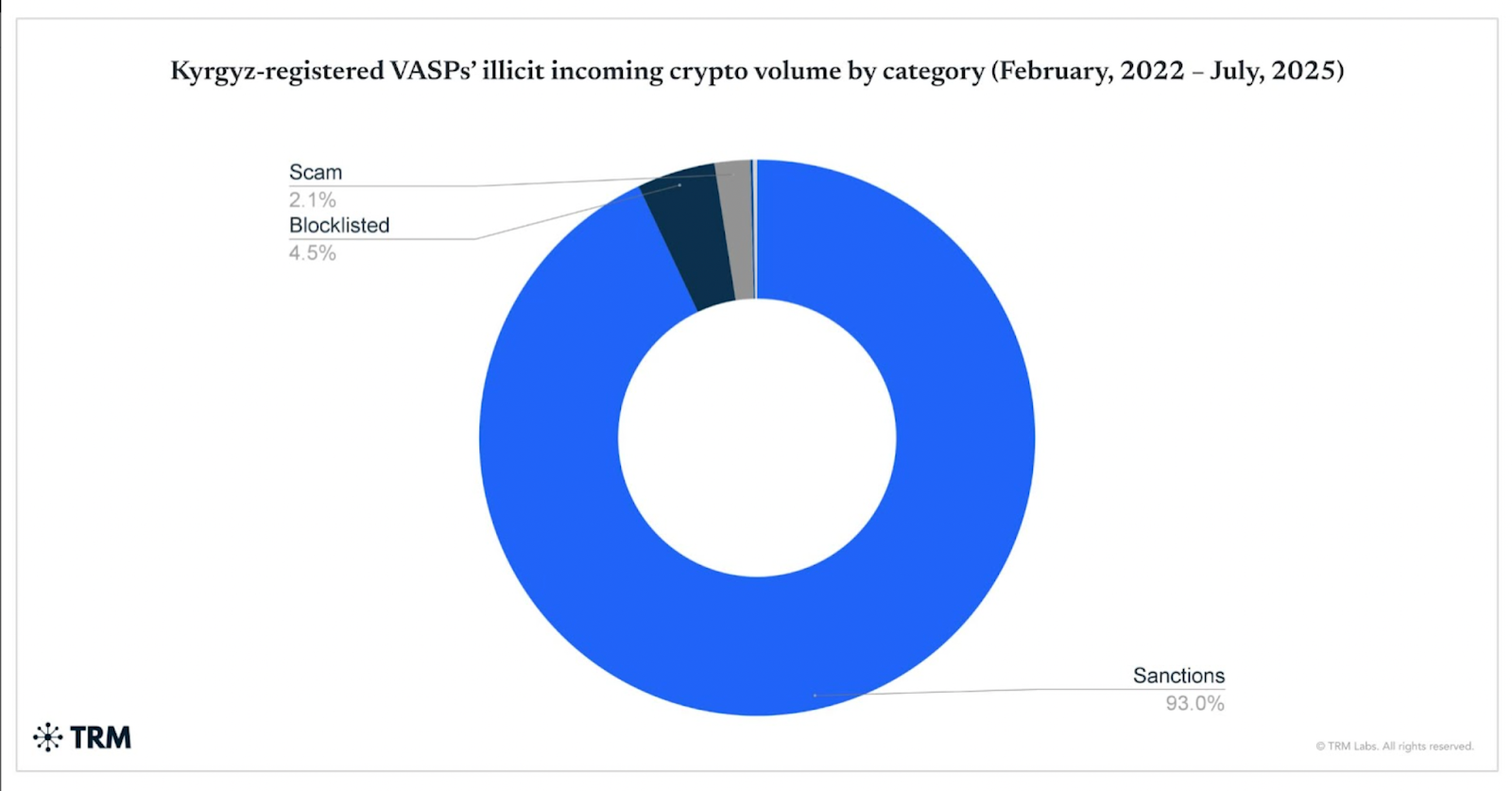
TRM Labs’ report points to crypto exchanges Grinex and Meer, which sprang up in Kyrgyzstan shortly after U.S.law enforcement disrupted Russia’s Garantex in March 2025. 

On-chain analysis suggests both firms, suspected to be successors, used similar wallet infrastructure and transaction patterns as Garantex, helping Russian users move funds through A7A5, a Russian ruble-tied stablecoin that has long come under scrutiny. 
How Russia is using Kyrgyzstan’s crypto market to bypass sanctions: report  - 1

Crypto.news reported earlier in June that an FT research revealed that the A7A5 stablecoin has quietly moved billions since launch, and has ties to sanctioned entities that suggest it may be part of broader efforts to bypass Western sanctions and enable cross-border payments for Russian entities.

Another exchange, Envoys Vision Digital Exchange (EVDE), was found to have ties to wallets linked to the Rusich Group, a sanctioned Russian paramilitary organization. Many of these platforms also display signs of being shell companies, including identical registration addresses, shared founders, and recycled contact information, suggesting coordinated or shared illicit control.

Why Kyrgyzstan must tighten controls

TRM Labs warns that while Kyrgyzstan may be exploited rather than complicit, weak oversight leaves the door wide open. 

Without tighter controls on VASP registrations, clearer ownership rules, and stronger checks on shell companies, Russia’s financial networks will keep exploiting the country’s crypto infrastructure. 

If left unaddressed, similar tactics could also spread to neighboring Kazakhstan and Uzbekistan, which are already rolling out crypto-friendly regulations, undermining international sanctions.


Market Opportunity
NEAR Logo
NEAR Price(NEAR)
$1.516
$1.516$1.516
-0.06%
USD
NEAR (NEAR) Live Price Chart
Disclaimer: The articles reposted on this site are sourced from public platforms and are provided for informational purposes only. They do not necessarily reflect the views of MEXC. All rights remain with the original authors. If you believe any content infringes on third-party rights, please contact [email protected] for removal. MEXC makes no guarantees regarding the accuracy, completeness, or timeliness of the content and is not responsible for any actions taken based on the information provided. The content does not constitute financial, legal, or other professional advice, nor should it be considered a recommendation or endorsement by MEXC.

You May Also Like

Santander’s Openbank Sparks Crypto Frenzy in Germany

Santander’s Openbank Sparks Crypto Frenzy in Germany

 In Germany, the digital bank Santander Openbank introduces trading in crypto, which offers BTC, ETH, LTC, POL, and ADA in the MiCA framework of the EU. Santander, the largest bank in Spain, has officially introduced cryptocurrency trading to its clients in Germany, using its digital division, Openbank.  With this new service, users can purchase, sell, […] The post Santander’s Openbank Sparks Crypto Frenzy in Germany appeared first on Live Bitcoin News.
Share
LiveBitcoinNews2025/09/18 04:30
The GENIUS Act Is Already Law. Banks Shouldn’t Try to Rewrite It Now

The GENIUS Act Is Already Law. Banks Shouldn’t Try to Rewrite It Now

The post The GENIUS Act Is Already Law. Banks Shouldn’t Try to Rewrite It Now appeared on BitcoinEthereumNews.com. Healthy competition drives innovation and better products for consumers; it is at the center of American economic leadership. Unfortunately, now that the bipartisan GENIUS Act has been signed into law, major legacy financial institutions seem to be having second thoughts about the innovations that stablecoins can bring to financial markets. Bank lobbying groups and public affairs teams have been peppering Congress with complaints about the law, urging members to reopen debate and introduce changes to the legislation that will ensure the stablecoin market doesn’t grow too quickly, protecting banks’ profits and stifling consumer choice. This reactionary response is both overblown and unnecessary. What legacy financial firms should do instead is embrace competition and offer exciting new products and services that consumers want, not try to kneecap emerging players through anti-innovation rules and regulations. The GENIUS Act was carefully designed with a thorough bipartisan process to strengthen consumer safeguards, ensure regulatory oversight, and preserve financial stability. Efforts to roll back its provisions are less about protecting families and more about protecting entrenched banking interests from the competition that helps ensure the U.S. banking system stays the strongest and most innovative in the world. Critics warn that allowing stablecoins to provide rewards could lead to massive deposit outflows from community banks, with figures as high as $6.6 trillion cited. But closer examination shows this fear is unfounded. A July 2025 analysis by consulting firm Charles River Associates found no statistically significant relationship between stablecoin adoption and community bank deposit outflows. In fact, the overwhelming majority of stablecoin reserves remain in the traditional financial system — either in commercial bank accounts or in short-term Treasuries — where they continue to support liquidity and credit in the broader U.S. economy. The dire estimates rely on unrealistic assumptions that every dollar of stablecoin issuance permanently…
Share
BitcoinEthereumNews2025/09/18 09:39
Grayscale’s GDLC Fund, Holding SOL and ADA, Receives SEC Approval for NYSE Listing

Grayscale’s GDLC Fund, Holding SOL and ADA, Receives SEC Approval for NYSE Listing

Grayscale’s GDLC Fund, holding BTC, ETH, XRP, SOL, and ADA, receives SEC approval to list on NYSE Arca, offering crypto exposure.   Grayscale’s Digital Large Cap Fund (GDLC) holds major cryptocurrencies like Bitcoin, Ethereum, XRP, Solana, and Cardano. The U.S. SEC has approved GDLC to list on NYSE Arca. This gives investors regulated access to […] The post Grayscale’s GDLC Fund, Holding SOL and ADA, Receives SEC Approval for NYSE Listing appeared first on Live Bitcoin News.
Share
LiveBitcoinNews2025/09/18 19:30