Ripple has been granted an Electronic Money Institution (EMI) license by Luxembourg’s financial industry regulator. The license allows the company to passport itsRipple has been granted an Electronic Money Institution (EMI) license by Luxembourg’s financial industry regulator. The license allows the company to passport its

Ripple Expands European Operations with Full Electronic Money Institution Approval

  • Ripple has been granted an Electronic Money Institution (EMI) license by Luxembourg’s financial industry regulator.
  • The license allows the company to passport its service across 27 EU member states without needing a separate approval for each country.

Ripple has gained an Electronic Money Institution (EMI) license to operate as a regulated financial company across the European Union. The California-based company received the license from the Commission de Surveillance du Secteur Financier, Luxembourg’s financial industry watchdog.

Ripple first announced its progress with the new license last week, revealing that it had received preliminary approval from the CSSF. This served as a green light for the company to meet certain conditions in order to receive the license.

The firm says it has since fulfilled all the requirements and has now officially received the approval.
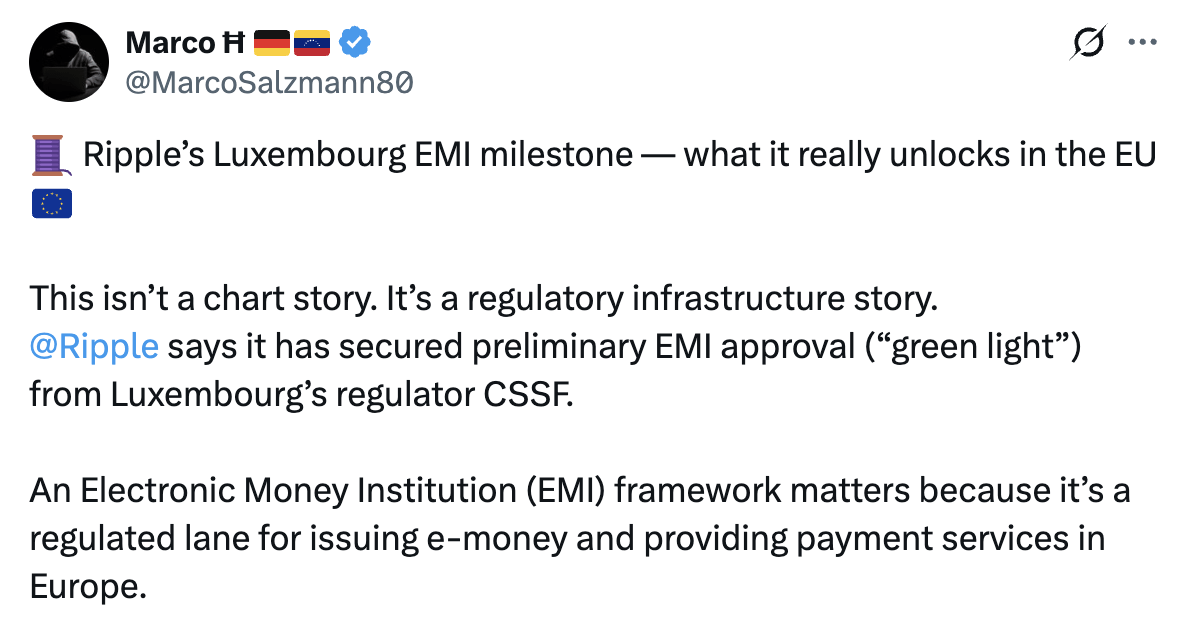
ripple emiImage courtesy of Marco Salzmann.

Cassie Craddock, Ripple’s managing director for UK and Europe, described the new license as “a transformative milestone that reinforces Ripple’s presence at the heart of European finance.”

She added:

The license allows the company to issue electronic money and provide financial services in the EU. Under the region’s passporting regulations, it can use the same license to serve customers in every country in the 27-member bloc without requiring any new approvals.

One of the provisions that companies must meet to obtain an EMI is that customer funds must be fully segregated from their own. This is important for any crypto firm as the sector has been hit by asset co-mingling on dozens of occasions, which almost always ends up in lost funds if the company blows up. One of the best-known examples is FTX, which went down with billions of dollars in customer funds, leading to the arrest and imprisonment of founder Sam Bankman-Fried and associates.

Ripple’s Expanding Regulatory Approvals

The Luxembourg license is the latest in a long line of approvals globally for Ripple, which has become one of the most compliant crypto firms. Last month, it received an EMI license from the UK’s Financial Conduct Authority. The FCA, known to be one of the strictest financial watchdogs, also registered the company as a crypto asset service provider.

Ripple now claims to have 75 financial service licenses globally. Commenting on the company’s progress, President Monica Long stated:

Long has predicted that this year will be the start of crypto’s “production era,” as we reported, and being a fully licensed financial services firm gives Ripple an edge over rivals as crypto goes mainstream.

XRP trades at $1.63, losing 14.6% over the past week.

]]>


Disclaimer: The articles reposted on this site are sourced from public platforms and are provided for informational purposes only. They do not necessarily reflect the views of MEXC. All rights remain with the original authors. If you believe any content infringes on third-party rights, please contact [email protected] for removal. MEXC makes no guarantees regarding the accuracy, completeness, or timeliness of the content and is not responsible for any actions taken based on the information provided. The content does not constitute financial, legal, or other professional advice, nor should it be considered a recommendation or endorsement by MEXC.

You May Also Like

The Staggering 89% Rejection Of Digital Assets

The Staggering 89% Rejection Of Digital Assets

The post The Staggering 89% Rejection Of Digital Assets appeared on BitcoinEthereumNews.com. Family Offices Crypto Avoidance: The Staggering 89% Rejection Of Digital
Share
BitcoinEthereumNews2026/02/03 06:12
Vitalik Buterin Reveals Ethereum’s Bold Plan to Stay Quantum-Secure and Simple!

Vitalik Buterin Reveals Ethereum’s Bold Plan to Stay Quantum-Secure and Simple!

Buterin unveils Ethereum’s strategy to tackle quantum security challenges ahead. Ethereum focuses on simplifying architecture while boosting security for users. Ethereum’s market stability grows as Buterin’s roadmap gains investor confidence. Ethereum founder Vitalik Buterin has unveiled his long-term vision for the blockchain, focusing on making Ethereum quantum-secure while maintaining its simplicity for users. Buterin presented his roadmap at the Japanese Developer Conference, and splits the future of Ethereum into three phases: short-term, mid-term, and long-term. Buterin’s most ambitious goal for Ethereum is to safeguard the blockchain against the threats posed by quantum computing.  The danger of such future developments is that the future may call into question the cryptographic security of most blockchain systems, and Ethereum will be able to remain ahead thanks to more sophisticated mathematical techniques to ensure the safety and integrity of its protocols. Buterin is committed to ensuring that Ethereum evolves in a way that not only meets today’s security challenges but also prepares for the unknowns of tomorrow. Also Read: Ethereum Giant The Ether Machine Takes Major Step Toward Going Public! However, in spite of such high ambitions, Buterin insisted that Ethereum also needed to simplify its architecture. An important aspect of this vision is to remove unnecessary complexity and make Ethereum more accessible and maintainable without losing its strong security capabilities. Security and simplicity form the core of Buterin’s strategy, as they guarantee that the users of Ethereum experience both security and smooth processes. Focus on Speed and Efficiency in the Short-Term In the short term, Buterin aims to enhance Ethereum’s transaction efficiency, a crucial step toward improving scalability and reducing transaction costs. These advantages are attributed to the fact that, within the mid-term, Ethereum is planning to enhance the speed of transactions in layer-2 networks. According to Butterin, this is part of Ethereum’s expansion, particularly because there is still more need to use blockchain technology to date. The other important aspect of Ethereum’s development is the layer-2 solutions. Buterin supports an approach in which the layer-2 networks are dependent on layer-1 to perform some essential tasks like data security, proof, and censorship resistance. This will enable the layer-2 systems of Ethereum to be concerned with verifying and sequencing transactions, which will improve the overall speed and efficiency of the network. Ethereum’s Market Stability Reflects Confidence in Long-Term Strategy Ethereum’s market performance has remained solid, with the cryptocurrency holding steady above $4,000. Currently priced at $4,492.15, Ethereum has experienced a slight 0.93% increase over the last 24 hours, while its trading volume surged by 8.72%, reaching $34.14 billion. These figures point to growing investor confidence in Ethereum’s long-term vision. The crypto community remains optimistic about Ethereum’s future, with many predicting the price could rise to $5,500 by mid-October. Buterin’s clear, forward-thinking strategy continues to build trust in Ethereum as one of the most secure and scalable blockchain platforms in the market. Also Read: Whales Dump 200 Million XRP in Just 2 Weeks – Is XRP’s Price on the Verge of Collapse? The post Vitalik Buterin Reveals Ethereum’s Bold Plan to Stay Quantum-Secure and Simple! appeared first on 36Crypto.
Share
Coinstats2025/09/18 01:22
Igor Runets Faces House Arrest In Devastating Blow To Russian Bitcoin Mining

Igor Runets Faces House Arrest In Devastating Blow To Russian Bitcoin Mining

The post Igor Runets Faces House Arrest In Devastating Blow To Russian Bitcoin Mining appeared on BitcoinEthereumNews.com. BitRiver Founder’s Arrest: Igor Runets
Share
BitcoinEthereumNews2026/02/03 06:21



