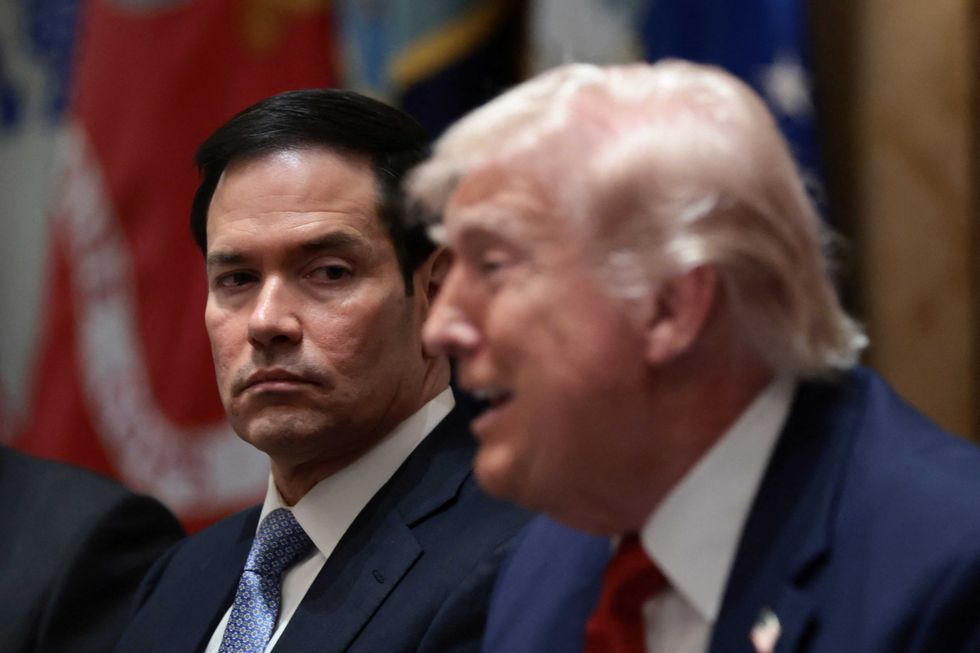
President Donald Trump on Monday was once again reminded that he lost Minnesota — three times.Trump spoke to his former FBI Deputy Director Dan Bongino Monday morningPresident Donald Trump on Monday was once again reminded that he lost Minnesota — three times.Trump spoke to his former FBI Deputy Director Dan Bongino Monday morning

Brutal fact-check reminds Trump he lost Minnesota — 3 times

President Donald Trump on Monday was once again reminded that he lost Minnesota — three times.

Trump spoke to his former FBI Deputy Director Dan Bongino Monday morning on the latter's online streaming show, which Bongino launched after hastily leaving the bureau in January. Trump was Bongino's first guest.

Speaking with Bongino, Trump mused about his desire to federalize elections in blue states.

“These people were brought to our country to vote, and they vote illegally,” Trump said to Bongino. “And it’s amazing the Republicans aren’t tougher on it. The Republicans should say, ‘We want to take over, we should take over the voting in at least 15 places.'”

“The Republicans ought to nationalize the voting," Trump added.

The comment came after the president and Bongino discussed Minnesota, where Trump has targeted immigrants for the past month and killing two protesters.

“There’s something in the water up there,” Trump told Bongino. “I love the state. I won the state three times, but got no credit for it.”

CNN fact-checker Daniel Dale explained on X that the reason "he doesn't get credit for winning three times because he lost it three times."

Trump lost Minnesota in 2016, 2020 and again in 2024. The state hasn't voted for a Republican for president since Richard Nixon in 1972.

  • george conway
  • noam chomsky
  • civil war
  • Kayleigh mcenany
  • Melania trump
  • drudge report
  • paul krugman
  • Lindsey graham
  • Lincoln project
  • al franken bill maher
  • People of praise
  • Ivanka trump
  • eric trump
Disclaimer: The articles reposted on this site are sourced from public platforms and are provided for informational purposes only. They do not necessarily reflect the views of MEXC. All rights remain with the original authors. If you believe any content infringes on third-party rights, please contact [email protected] for removal. MEXC makes no guarantees regarding the accuracy, completeness, or timeliness of the content and is not responsible for any actions taken based on the information provided. The content does not constitute financial, legal, or other professional advice, nor should it be considered a recommendation or endorsement by MEXC.

You May Also Like

XRP Price Analysis for February 2

XRP Price Analysis for February 2

The post XRP Price Analysis for February 2 appeared on BitcoinEthereumNews.com. The market might have found a local bottom by now, but the rates of some coins keep
Share
BitcoinEthereumNews2026/02/03 08:34
Cashing In On University Patents Means Giving Up On Our Innovation Future

Cashing In On University Patents Means Giving Up On Our Innovation Future

The post Cashing In On University Patents Means Giving Up On Our Innovation Future appeared on BitcoinEthereumNews.com. “It’s a raid on American innovation that would deliver pennies to the Treasury while kneecapping the very engine of our economic and medical progress,” writes Pipes. Getty Images Washington is addicted to taxing success. Now, Commerce Secretary Howard Lutnick is floating a plan to skim half the patent earnings from inventions developed at universities with federal funding. It’s being sold as a way to shore up programs like Social Security. In reality, it’s a raid on American innovation that would deliver pennies to the Treasury while kneecapping the very engine of our economic and medical progress. Yes, taxpayer dollars support early-stage research. But the real payoff comes later—in the jobs created, cures discovered, and industries launched when universities and private industry turn those discoveries into real products. By comparison, the sums at stake in patent licensing are trivial. Universities collectively earn only about $3.6 billion annually in patent income—less than the federal government spends on Social Security in a single day. Even confiscating half would barely register against a $6 trillion federal budget. And yet the damage from such a policy would be anything but trivial. The true return on taxpayer investment isn’t in licensing checks sent to Washington, but in the downstream economic activity that federally supported research unleashes. Thanks to the bipartisan Bayh-Dole Act of 1980, universities and private industry have powerful incentives to translate early-stage discoveries into real-world products. Before Bayh-Dole, the government hoarded patents from federally funded research, and fewer than 5% were ever licensed. Once universities could own and license their own inventions, innovation exploded. The result has been one of the best returns on investment in government history. Since 1996, university research has added nearly $2 trillion to U.S. industrial output, supported 6.5 million jobs, and launched more than 19,000 startups. Those companies pay…
Share
BitcoinEthereumNews2025/09/18 03:26
Vitalik sold 493.1 ETH on the blockchain, bringing the total number of authorized ETH on the CoW Swap to 5000.

Vitalik sold 493.1 ETH on the blockchain, bringing the total number of authorized ETH on the CoW Swap to 5000.

PANews reported on February 3 that, according to Ember, Ethereum founder Vitalik Buterin sold 493.1 ETH on-chain via CoW Swap today, earning $1.16 million. Furthermore
Share
PANews2026/02/03 08:37