

Carbon ROI: Why IT Directors Must Report “Energy Saved per Compute Unit”
Is your IT department still a cost center, or is it now a manager of your carbon risk?
In 2026, mandatory laws like California’s SB 253 require US companies to report emissions as AI energy demands surge. This shift makes “Carbon ROI” a critical metric for IT leaders. Have you calculated the actual work your systems perform for every watt of power they consume?
Read on to discover how to align your technical infrastructure with these new legal and environmental standards.
Key Takeaway:
- Mandatory laws like SB 253 in 2026 elevate “Carbon ROI” as a key financial-grade metric for IT, measuring $CO_2e$ avoided per dollar spent.
- Shadow Carbon Pricing of $50–$100 per tonne should be applied to all hardware purchases to stress-test TCO against future carbon tax risks.
- Workload-based metrics like ITEEsv and CER are replacing PUE to measure performance per kW and eliminate energy waste from idle (“comatose”) servers.
- AI inference, which accounts for 60–90% of total AI energy use, is expected to drive US data center power consumption to 90 TWh by the end of 2026.
Is Your IT a Cost Center or a Carbon Capital Manager?
For decades, “Green IT” was a “nice-to-have” initiative. In 2026, the paradigm has inverted. Sustainable IT is now a primary driver of profit, risk management, and legal compliance. It has moved from the marketing department to the operating system of the business.
How Do You Calculate Carbon ROI?
Carbon ROI is no longer a vague concept. It is a rigorous financial formula used to prioritize where a company spends its money. It measures decarbonization efficiency—the mass of $CO_2e$ avoided for every dollar spent.
The standard formula for 2026 is:
Carbon ROI = (Annual CO2e Savings (tonnes) / Project Cost ($)) × 1000
This allows you to compare different projects directly. For example:
- A Heat Pump Retrofit: Costs $8,000 and saves 10 tons of $CO_2e$ per year. Carbon ROI = 1.25.
- An LED Upgrade: Costs $2,500 and saves 4 tons per year. Carbon ROI = 1.6.
Even though the heat pump saves more total carbon, the LED project is more capital-efficient. To get the “full picture,” companies now include Scope 3 emissions—the carbon footprint of the hardware itself and the teams that install it. This prevents “carbon leakage,” where emissions are simply moved to a supplier’s ledger rather than being erased.
Are You Stress-Testing Projects with Shadow Carbon Pricing?
Leading enterprises now use Shadow Carbon Pricing (SCP). This assigns a theoretical dollar value to carbon emissions during the planning phase. It “stress-tests” a project to see if it will remain profitable if carbon taxes rise.
In 2026, best practices recommend shadow prices between $50 and $100 per tonne to align with the Paris Agreement. Some aggressive firms use prices as high as $150. This changes the math for data centers. A data center in a region with cheap but “dirty” coal power now carries a massive “shadow penalty” that lowers its value.
Table 1: Impact of Shadow Carbon Pricing on Project Viability
| Project Scenario | Nominal ROI | Shadow Price Impact ($100/t) | Strategic Implication |
| Coal-Powered Data Center | 18% | -6% (High Tax Risk) | High Risk: Likely to become a stranded asset. |
| Green Grid Migration | 14% | -0.5% (Low Tax Risk) | Stable: Outperforms dirty options over time. |
| On-Premise Retrofit | 12% | +3% (Avoided Liability) | Value Accretive: Directly reduces future costs. |
Can a Strong Carbon Strategy Lower Your Cost of Capital?
A strong Carbon ROI strategy lowers your cost of borrowing. By 2026, the market for Sustainability-Linked Loans (SLLs) and Transition Bonds has exploded. Moody’s predicts transition bond issuance will reach $40 billion this year—a 100% increase from 2024.
Companies that prove their carbon reductions with high-quality data can secure loans at rates 10–15 basis points lower than their competitors. For massive infrastructure projects like data centers, this difference saves millions of dollars in interest. Investors are no longer accepting “green promises”; they demand verified data before they release capital.
Are You Using the Right Metrics to Measure IT Efficiency?
As financial stakes rise, the metrics used to track IT efficiency are evolving. In 2026, relying only on Power Usage Effectiveness (PUE) is no longer enough. The industry is moving toward “work-based” metrics that measure the value of the electricity consumed, rather than just how well the building is cooled.
Is PUE Still Enough to Measure Efficiency?
PUE measures the ratio of total facility power to the power sent to IT gear. A “perfect” PUE is 1.0.
- The Flaw: PUE does not care if your servers are actually doing work. A data center could have a “green” PUE of 1.1 but run servers that sit idle 90% of the time. This results in massive energy waste that PUE simply ignores.
What is ITEEsv, and How Does It Measure Server Performance?
Standardized under ISO/IEC 30134-4, the ITEEsv (IT Equipment Energy Efficiency for Servers) is now a mandatory KPI for many US and EU data centers. It measures the maximum performance a server can deliver per kilowatt (kW).
ITEEsv = Maximum Performance (Work Units) / Energy Consumed (kW)
This allows architects to compare hardware generations directly. For example, it helps a CTO decide if moving from x86 to ARM-based processors (like Ampere or AWS Graviton) provides enough “work-per-watt” to justify the migration cost.
How Can CER Eliminate “Comatose” Servers?
The Compute Efficiency Ratio (CER) focuses on the actual operations performed. It is used to hunt down “comatose” servers—those that pull power but perform zero tasks.
CER = Useful Computation Operations / Energy Consumed by IT
For a retailer, “Useful Operations” might be the number of transactions processed or AI images generated. This links the electricity bill directly to the company’s P&L.
How Effective is Your Heat Recycling Strategy (ERE)?
As data centers become part of “Smart Cities,” waste heat is treated as a product. Energy Reuse Effectiveness (ERE) measures how well a facility recycles its heat for things like warming nearby homes or offices.
ERE = (1 – Energy Reuse Factor) × PUE
If a facility has an Energy Reuse Factor (ERF) of 0.2, it means 20% of its energy is being sent back out to heat the local community. An ERE close to 1.0 (or lower) indicates a highly “circular” and sustainable operation.
Summary of 2026 Efficiency Metrics
| Metric | Focus | Primary Goal | 2026 Context |
| PUE | Facility | Lower cooling waste | Baseline requirement; no longer enough alone. |
| ITEEsv | Hardware | Performance per kW | Used to choose the most efficient silicon chips. |
| CER | Workload | Ops per Energy | Eliminates “zombie” servers that do no work. |
| ERE | Circularity | Heat Recycling | Mandatory in regions with district heating. |
| ESCU | Social | Prevented Impact | Links “green” IT to “Eco Social Cost Units.” |
Is AI’s Efficiency Creating an Energy Paradox?
The most significant disruptor to IT energy profiles in 2026 is Artificial Intelligence. The widespread deployment of Generative AI has created a “Jevons Paradox” scenario. In economics, this occurs when an increase in efficiency for a resource actually leads to higher total consumption.
As AI becomes cheaper and more efficient to run per query, the demand for AI services is exploding. This growth is currently outpacing the technical gains in power savings.
What is the True Carbon Cost of Training AI Models?
Training frontier AI models is a massive, energy-intensive process. By 2026, the cost to train a single state-of-the-art model is projected to exceed $1 billion. While only 2% to 6% of this cost is direct electricity, the absolute scale is staggering.
- Carbon Scale: Training one large frontier model can emit over 1,000 tonnes of CO2. For perspective, generating just 1,000 AI images produces the same carbon emissions as driving a gasoline-powered car for 4.1 miles.
- Grid Impact: In the US, AI data center power consumption is expected to reach 90 terawatt-hours (TWh) by the end of 2026. This is roughly 4% of the entire country’s electricity demand.
- Embodied Carbon: The focus is shifting beyond electricity. The rapid replacement of GPUs (every 18–24 months) creates a massive “embodied carbon” footprint from manufacturing. Research shows that for high-performance AI systems, these manufacturing emissions can account for 13% to 25% of the total lifecycle footprint.
Why is AI Inference the Majority of Your Carbon Footprint?
While training captures headlines, inference—the process of answering user queries—accounts for the majority of AI emissions. As AI moves from a “tool” to an “embedded layer” in every app, query volumes have reached a constant, massive baseload.
- adoption: Google analysts estimate that while training is a one-time event, inference now accounts for 60% to 90% of total AI energy use.
- Query Intensity: A standard ChatGPT query uses approximately 0.34 Wh, which is roughly 10 times the energy of a traditional Google search. Advanced reasoning models can use up to 40 Wh per query—a 100x increase over basic models.
Can You Afford Volatile AI Energy Costs?
The “Cost-per-kW” for AI has become a volatile metric. In major data center hubs like Northern Virginia and Dublin, grid congestion has forced electricity prices up by 10% to 20%.
This volatility makes Carbon-Aware Computing a financial necessity. By shifting workloads to times when renewable energy is abundant, or to regions with cheaper, cleaner power (like Norway or Iceland), labs can cut both their carbon footprint and their operational costs.
Is Carbon Reporting a Legal Duty for Your Business?
By early 2026, IT sustainability reporting has moved from a marketing “choice” to a legal requirement. In the US and EU, accurate carbon data is now a financial-grade filing. Failure to report correctly can lead to fines of up to $500,000 per year and severe legal risks.
Does the EU’s CSRD Law Affect Your Company?
The Corporate Sustainability Reporting Directive (CSRD) affects about 50,000 companies. This includes US-based firms with significant European operations.
- Scope 3 Mandate: Companies must report emissions from their entire value chain. For IT, this means counting the carbon used to build your laptops and the energy your software uses on customer devices.
- Audit-Grade You can no longer use rough estimates based on spending. Regulators now require “activity-based” data. This must be backed by energy meters and actual hardware lifecycle logs.
- E-Waste and Circularity: Beyond carbon, IT must report on ESRS E5. This covers how you manage electronic waste and your efforts to reuse hardware.
Are You Ready for California’s Mandatory SB 253 Reporting?
In the United States, California’s climate laws have become the de facto national standard.
- SB 253 (Emissions): US companies with over $1 billion in revenue must disclose Scope 1 and 2 emissions. The first reporting deadline is August 10, 2026, for fiscal year 2025 data. Scope 3 reporting will follow in 2027.
- SB 261 (Risk): Companies with over $500 million in revenue must disclose climate-related financial risks. While a court pause delayed the original January 1, 2026, deadline for some, the state expects these reports once the legal challenges are resolved.
- SEC Update: The SEC paused its federal climate rules in late 2024, but California’s stricter laws ensure that major US tech firms must report regardless of federal action.
Is the CIO Now Your Enterprise’s “Carbon Controller”?
The CIO is now the “Carbon Controller” for the enterprise. Digital infrastructure—cloud, data centers, and devices—is the largest source of non-factory emissions.
The IT department holds the primary data needed for these filings. The CIO must now track IT Carbon Intensity with the same precision used for financial budgets. This ensures the company meets the “Greenhouse Gas Protocol” standards required by law.
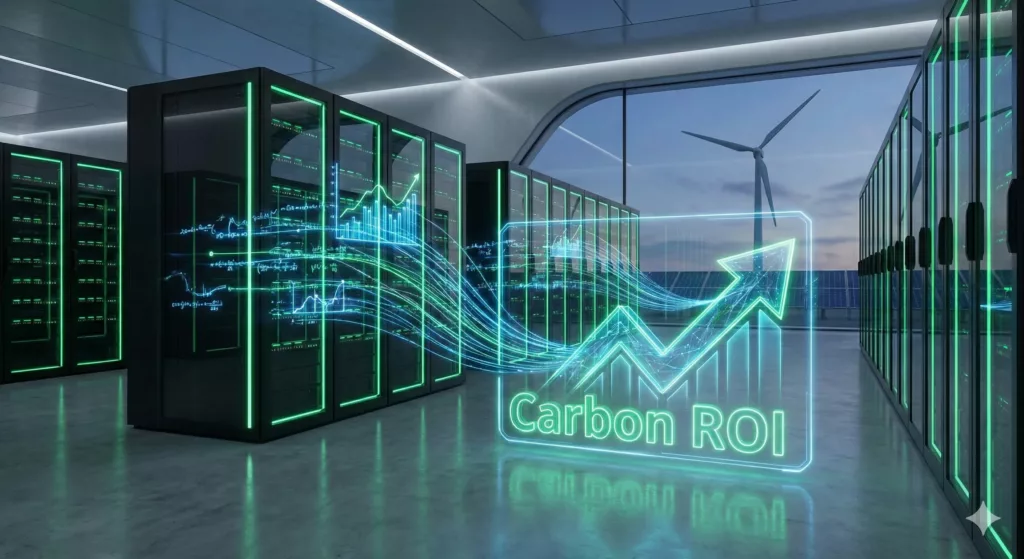 Sustainable AI chips 2026
What is the New Tech Stack for Carbon Measurement?
To meet strict 2026 regulations and calculate Carbon ROI, enterprises are moving away from manual spreadsheets. “Spreadsheet sustainability” is now a major risk for audit failure. Automated data ingestion is the new standard for the industry.
How is Microsoft Cloud for Sustainability Helping with CSRD?
Microsoft has positioned its platform as the “central ERP” for ESG data. In early 2026, it features enhanced automation for tracking Science Based Targets (SBTi).
- Scorecards and Goals: This feature allows teams to track progress in real-time. Goals update automatically via connected data streams from Azure and other business systems.
- Copilot Integration: Microsoft has added generative AI to its Sustainability Manager. It can draft preparatory reports for CSRD compliance and identify reduction opportunities in carbon and water use.
- Emissions Impact Dashboard: This tool provides a granular view of Azure usage, allowing you to see which specific services and regions are driving your footprint.
How Does Dynatrace Link CPU Use to Carbon Cost?
Dynatrace bridges the gap between IT performance and sustainability. Its Cost & Carbon Optimization app is now certified by the Sustainable Digital Infrastructure Alliance (SDIA) for accuracy.
- Hybrid Visibility: It translates CPU, memory, and disk utilization into $CO_2e$ for both cloud and on-premise servers.
- Cold Spot Detection: The app identifies “idle” resources that are pulling power but doing no work. It provides specific “right-sizing” tips that link carbon reduction directly to cost savings.
- Kubernetes Tracking: New for 2026, it features dedicated tracking for Kubernetes clusters, helping teams optimize the footprint of modern, containerized apps.
Need Audit-Ready Carbon Data? Try IBM’s Verified Calculator.
IBM’s tool is designed for the most rigorous reporting needs. It is one of the few platforms that has been independently validated by Bureau Veritas.
- Audit-Readiness: Because the methodology is third-party verified, it provides the “limited assurance” required for legal filings like the CSRD.
- Reporting Flexibility: It supports both location-based (average grid) and market-based (specific green energy contracts) reporting concurrently.
- Service-Level Detail: It tracks emissions for individual resource groups and services, allowing IT managers to see the exact carbon cost of a specific AI project or database.
How Does Nlyte DCIM Automate Compliance in Your Physical Data Center?
For the physical data center, Nlyte’s Data Center Infrastructure Management (DCIM) tools provide the ground-level data needed for high-density AI clusters.
- Sustainability Index (DCSI): Nlyte features a “Data Center Sustainability Index” that provides a composite score of energy, water, and carbon efficiency.
- Liquid Cooling Support: As of 2026, Nlyte’s dashboard includes real-time monitoring for direct-to-chip and immersion cooling loops, tracking flow rates and thermal load.
- Automated Compliance: It automates the collection of PUE and WUE (Water) for the Energy Efficiency Directive (EED) in Europe and SECR in the UK.
Comparison of Leading Carbon Tools (2026)
| Tool | Focus | Unique Value | Standard Alignment |
| Microsoft | Enterprise ESG | AI-powered “Scorecards & Goals” | CSRD, GHG Protocol, SBTi |
| Dynatrace | Hybrid IT | Translates CPU/RAM to $CO_2$ | SDIA Certified, GHG Protocol |
| IBM | Cloud Workloads | Bureau Veritas validated data | ISO 14064, Market-based |
| Nlyte | Physical Facility | PUE/WUE/CUE Automation | EED, SECR, Local Codes |
How Do You Prove the Financial Value of Green IT?
The final step for IT leaders is translating sustainability into a clear financial story for the CFO. In 2026, Green IT is no longer just about saving energy; it is about protecting the company’s bottom line from regulatory and market risks.
Are You Tracking All Three “Avoided Cost” Value Streams?
Traditional Total Cost of Ownership (TCO) models are being updated to include “internalized” carbon costs. This allows IT departments to quantify three hidden value streams:
- Direct Energy Savings: Lowering operational expenses (OpEx) through better server efficiency (measured via CER and ITEEsv).
- Avoided Carbon Taxes: Protecting the budget from rising carbon prices. In early 2026, European carbon permits are averaging €104 per tonne, and similar compliance costs are appearing in US-based markets.
- Avoided Offsets: If a company has a “Net Zero” goal, every ton of carbon reduced is a ton they don’t have to buy on the open market. High-quality carbon removal credits are currently trading between $100 and $350 per tonne depending on the technology used. Reducing emissions at the source is now cheaper than buying “removals” to fix the problem later.
Is Your Sustainable Infrastructure Creating a “Green Premium”?
Investing in sustainable infrastructure increases the actual value of your assets. This is known as the “Green Premium.” By 2026, the green data center market is valued at over $239 billion. Facilities with high-efficiency certifications (like BREEAM or Energy Star) and long-term renewable power contracts command higher resale values and higher rent in the colocation market. Conversely, “dirty” data centers are becoming “stranded assets” that are difficult to sell or lease because they carry high regulatory risk.
Case Study: How Shadow Pricing Changes a Server Refresh Decision
Consider a server refresh decision in early 2026:
- Option A: Standard servers ($1M) in a coal-heavy region ($0.10/kWh).
- Option B: High-efficiency servers ($1.2M) in a green region ($0.12/kWh).
A standard budget might favor Option A because it is $200,000 cheaper upfront. However, using a Shadow Carbon Price of $100/tonne:
- Option A produces 10,000 tonnes of $CO_2$ over five years, adding a $1M shadow cost.
- Option B produces 500 tonnes of $CO_2$ over five years, adding a $50,000 shadow cost.
When you add these shadow costs to the TCO, Option B is the clear financial winner. This strategy ensures your IT department isn’t buying assets today that will become massive financial liabilities as carbon rules tighten tomorrow.
Conclusion
In 2026, IT performance is measured by more than speed. Success now depends on your Carbon ROI. Building efficient systems is the only way to stay financially stable in a carbon-constrained world. Use real-time data tools to track energy use across your stack. Apply shadow carbon pricing to every hardware purchase to stress-test your decisions. Your engineering team must focus on reducing “energy per unit of work” for every task. High efficiency is the best path to long-term resilience.
Vinova develops MVPs for tech-driven businesses. We help you build the sustainable, high-performance systems your company needs. Our team handles the technical complexity so you can reach your net-zero goals faster. We turn energy-heavy legacy systems into modern, efficient tools.
Contact Vinova today to start your MVP development. Let us help you build a high-performance, net-zero product for the modern market.
FAQs:
1. What is ‘Energy Saved per Compute Unit’ in 2026?
The industry is moving away from basic metrics to “work-based” metrics that measure the value of the electricity consumed. The core concept is measured by the Compute Efficiency Ratio (CER) and ITEEsv (IT Equipment Energy Efficiency for Servers).
- CER is the ratio of Useful Computation Operations to the Energy Consumed by IT. It is used to identify and eliminate “comatose” servers that pull power but perform no business value.
- ITEEsv measures the Maximum Performance (Work Units) a server can deliver per kilowatt (kW). This allows architects to compare different hardware, such as x86 versus ARM-based processors, to find the most efficient chips.
2. Why should IT directors report on Carbon ROI?
In 2026, IT sustainability is a matter of legal compliance and financial risk management. IT directors must report on Carbon ROI because:
- Legal Compliance: Mandatory laws, such as California’s SB 253, require US companies to disclose emissions, making accurate carbon data a financial-grade filing.
- Risk Management: The CIO is now the “Carbon Controller,” tasked with protecting the company from financial penalties (up to $500,000 per year) and severe legal risks associated with inaccurate reporting, especially under the EU’s CSRD.
- Strategic Value: Sustainable IT is a primary driver of profit and lowers the company’s cost of borrowing by enabling access to Sustainability-Linked Loans (SLLs) at rates up to 10–15 basis points lower than competitors.
3. How does IT efficiency impact ESG scores?
A strong Carbon ROI strategy and verifiable IT efficiency directly improve a company’s ESG (Environmental, Social, and Governance) standing and financial access.
- Cost of Capital: Companies that can prove their carbon reductions with high-quality data are viewed as lower risk, which secures them a lower cost of borrowing in the exploding market for Sustainability-Linked Loans (SLLs) and Transition Bonds.
- Investor Trust: Investors demand verified, audit-grade data before releasing capital, making IT efficiency a prerequisite for securing financing.
- Regulatory Alignment: Tracking IT efficiency metrics with precision ensures the company meets the “Greenhouse Gas Protocol” standards and audit requirements for major legal filings like the CSRD and SB 253.
4. What are the best tools for tracking IT carbon metrics?
Enterprises are moving away from manual spreadsheets to automated solutions to achieve audit-grade data quality. Leading carbon tools include:
| Tool | Focus | Unique Value |
| Microsoft Cloud for Sustainability | Enterprise ESG | AI-powered “Scorecards & Goals” for real-time tracking and drafting preparatory reports. |
| Dynatrace Carbon Impact and Optimization | Hybrid IT | Translates CPU, memory, and disk utilization into $CO_2e$ for both cloud and on-premise servers. |
| IBM Cloud Carbon Calculator | Cloud Workloads | Independently validated by Bureau Veritas for audit-readiness and supports both location-based and market-based reporting. |
| Nlyte DCIM | Physical Facility | Provides ground-level data and automates the collection of PUE and WUE (Water) for regulatory compliance like the EED. |
5. How can IT departments prove the financial value of sustainability?
IT departments can prove financial value by updating their Total Cost of Ownership (TCO) models to include “internalized” carbon costs, quantifying three hidden value streams:
- Avoided Carbon Taxes & Offsets: Reducing emissions at the source is now cheaper than buying carbon removal credits (trading between $100 and $350 per tonne) or paying future carbon taxes (averaging €104 per tonne in Europe).
- Direct OpEx Savings: Lowering operational expenses through efficiency metrics like CER and ITEEsv.
- Shadow Carbon Pricing (SCP): Applying a theoretical price to carbon (e.g., $100/tonne) to a project’s TCO to stress-test it. This proves that a high-efficiency, slightly more expensive project is the “clear financial winner” over a cheaper, high-carbon option that will become a massive financial liability later.


You May Also Like

Leap Wallet to Shut Down by May 28 as Team Winds Down Apps and Validator

Crypto Sectors Reveal Striking Divergence: 5 Explosive Gainers and 5 Troubled Decliners in 2025




