Strategy (formerly MicroStrategy) announced Friday that it will sell 28 million shares of its Series A Stretch Preferred Stock at $90 each in its initial public offering. The transaction is expected to close on July 29. Strategy said it estimates net proceeds of approximately $2.474 billion after underwriting discounts and estimated offering expenses. Strategy announces pricing of its Stretch Perpetual Preferred Stock ($STRC) Offering and upsizes the deal from $500 Million to $2.521 Billion. $MSTR https://t.co/MySRU4bZSA — Strategy (@Strategy) July 25, 2025 Proceeds Will Fund Bitcoin Purchases and Operations The funds raised will go toward general business needs, including buying bitcoin and covering operating costs. The STRC Stock will pay monthly dividends at a starting rate of 9% per year on a $100 base value, beginning August 31—if approved by the board. Strategy can adjust the dividend rate based on market conditions, but within set limits. If dividends aren’t paid on time, interest will build on the unpaid amount each month. Strategy can buy back all or some of the STRC Stock at $101 per share plus any unpaid dividends once the shares are listed on a U.S. stock exchange. For partial buybacks, at least $250 million worth of shares must still be in circulation. Strategy Acquires 4,225 BTC for $472.5M, Last week, Strategy added 4,225 BTC to its treasury in a single week, spending $472.5 million at an average price of $111,827 per bitcoin. This latest acquisition, announced on July 14, brings Strategy’s total BTC holdings to 601,550, purchased at an average price of $71,268 per coin, amounting to a total investment of $42.87 billion. The Bitcoin 100 will fight to be in the Bitcoin 10. pic.twitter.com/RUlQpOQIwf — Strategy (@Strategy) July 24, 2025 Strategy is led by Executive Chairman Michael Saylor, the outspoken Bitcoin advocate and co-founder of MicroStrategy. Saylor’s strategy is bold, high-conviction, and designed to hedge against inflation, currency devaluation, and systemic financial risk. He frequently describes Bitcoin as “digital energy” and “economic immortality,” framing his acquisitions as part of a long-term mission to preserve shareholder value in an increasingly unstable monetary environment. This aggressive stance has not only reshaped MicroStrategy but has influenced a wave of corporate interest in digital assets, with Saylor becoming a prominent figurehead in the global Bitcoin movement. MSTR Price Action As of the latest close on July 25, MicroStrategy Inc. Class A (Nasdaq: MSTR) held steady at $414.92, showing no change during regular trading hours. However, pre-market data suggests a 2.30% drop, with the stock trading at $405.37, indicating potential pressure ahead of market open. So far, the stock has been volatile, with a 52-week high of $543.00 and a low of $102.40, reflecting investor sensitivity to Bitcoin price movements and MicroStrategy’s aggressive BTC accumulation strategy. With a market cap of $116.58 billion, the company remains one of the most closely watched Bitcoin proxy plays in the public markets.Strategy (formerly MicroStrategy) announced Friday that it will sell 28 million shares of its Series A Stretch Preferred Stock at $90 each in its initial public offering. The transaction is expected to close on July 29. Strategy said it estimates net proceeds of approximately $2.474 billion after underwriting discounts and estimated offering expenses. Strategy announces pricing of its Stretch Perpetual Preferred Stock ($STRC) Offering and upsizes the deal from $500 Million to $2.521 Billion. $MSTR https://t.co/MySRU4bZSA — Strategy (@Strategy) July 25, 2025 Proceeds Will Fund Bitcoin Purchases and Operations The funds raised will go toward general business needs, including buying bitcoin and covering operating costs. The STRC Stock will pay monthly dividends at a starting rate of 9% per year on a $100 base value, beginning August 31—if approved by the board. Strategy can adjust the dividend rate based on market conditions, but within set limits. If dividends aren’t paid on time, interest will build on the unpaid amount each month. Strategy can buy back all or some of the STRC Stock at $101 per share plus any unpaid dividends once the shares are listed on a U.S. stock exchange. For partial buybacks, at least $250 million worth of shares must still be in circulation. Strategy Acquires 4,225 BTC for $472.5M, Last week, Strategy added 4,225 BTC to its treasury in a single week, spending $472.5 million at an average price of $111,827 per bitcoin. This latest acquisition, announced on July 14, brings Strategy’s total BTC holdings to 601,550, purchased at an average price of $71,268 per coin, amounting to a total investment of $42.87 billion. The Bitcoin 100 will fight to be in the Bitcoin 10. pic.twitter.com/RUlQpOQIwf — Strategy (@Strategy) July 24, 2025 Strategy is led by Executive Chairman Michael Saylor, the outspoken Bitcoin advocate and co-founder of MicroStrategy. Saylor’s strategy is bold, high-conviction, and designed to hedge against inflation, currency devaluation, and systemic financial risk. He frequently describes Bitcoin as “digital energy” and “economic immortality,” framing his acquisitions as part of a long-term mission to preserve shareholder value in an increasingly unstable monetary environment. This aggressive stance has not only reshaped MicroStrategy but has influenced a wave of corporate interest in digital assets, with Saylor becoming a prominent figurehead in the global Bitcoin movement. MSTR Price Action As of the latest close on July 25, MicroStrategy Inc. Class A (Nasdaq: MSTR) held steady at $414.92, showing no change during regular trading hours. However, pre-market data suggests a 2.30% drop, with the stock trading at $405.37, indicating potential pressure ahead of market open. So far, the stock has been volatile, with a 52-week high of $543.00 and a low of $102.40, reflecting investor sensitivity to Bitcoin price movements and MicroStrategy’s aggressive BTC accumulation strategy. With a market cap of $116.58 billion, the company remains one of the most closely watched Bitcoin proxy plays in the public markets.

Strategy to Raise $2.47B Through Sale of 28M Preferred Shares Priced at $90 Each

Strategy (formerly MicroStrategy) announced Friday that it will sell 28 million shares of its Series A Stretch Preferred Stock at $90 each in its initial public offering.

The transaction is expected to close on July 29. Strategy said it estimates net proceeds of approximately $2.474 billion after underwriting discounts and estimated offering expenses.

Proceeds Will Fund Bitcoin Purchases and Operations

The funds raised will go toward general business needs, including buying bitcoin and covering operating costs. The STRC Stock will pay monthly dividends at a starting rate of 9% per year on a $100 base value, beginning August 31—if approved by the board.

Strategy can adjust the dividend rate based on market conditions, but within set limits. If dividends aren’t paid on time, interest will build on the unpaid amount each month.

Strategy can buy back all or some of the STRC Stock at $101 per share plus any unpaid dividends once the shares are listed on a U.S. stock exchange. For partial buybacks, at least $250 million worth of shares must still be in circulation.

Strategy Acquires 4,225 BTC for $472.5M,

Last week, Strategy added 4,225 BTC to its treasury in a single week, spending $472.5 million at an average price of $111,827 per bitcoin.

This latest acquisition, announced on July 14, brings Strategy’s total BTC holdings to 601,550, purchased at an average price of $71,268 per coin, amounting to a total investment of $42.87 billion.

Strategy is led by Executive Chairman Michael Saylor, the outspoken Bitcoin advocate and co-founder of MicroStrategy. Saylor’s strategy is bold, high-conviction, and designed to hedge against inflation, currency devaluation, and systemic financial risk.

He frequently describes Bitcoin as “digital energy” and “economic immortality,” framing his acquisitions as part of a long-term mission to preserve shareholder value in an increasingly unstable monetary environment.

This aggressive stance has not only reshaped MicroStrategy but has influenced a wave of corporate interest in digital assets, with Saylor becoming a prominent figurehead in the global Bitcoin movement.

MSTR Price Action

As of the latest close on July 25, MicroStrategy Inc. Class A (Nasdaq: MSTR) held steady at $414.92, showing no change during regular trading hours. However, pre-market data suggests a 2.30% drop, with the stock trading at $405.37, indicating potential pressure ahead of market open.
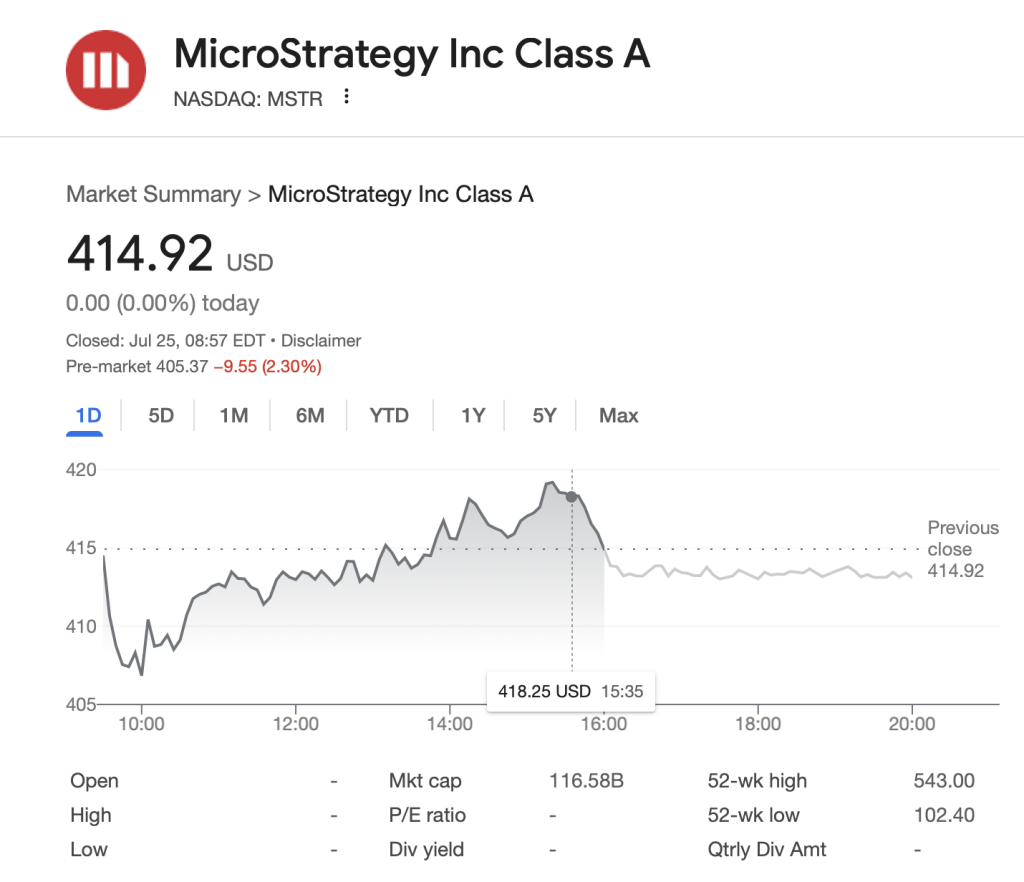
So far, the stock has been volatile, with a 52-week high of $543.00 and a low of $102.40, reflecting investor sensitivity to Bitcoin price movements and MicroStrategy’s aggressive BTC accumulation strategy. With a market cap of $116.58 billion, the company remains one of the most closely watched Bitcoin proxy plays in the public markets.


Market Opportunity
Threshold Logo
Threshold Price(T)
$0,00895
$0,00895$0,00895
+0,07%
USD
Threshold (T) Live Price Chart
Disclaimer: The articles reposted on this site are sourced from public platforms and are provided for informational purposes only. They do not necessarily reflect the views of MEXC. All rights remain with the original authors. If you believe any content infringes on third-party rights, please contact [email protected] for removal. MEXC makes no guarantees regarding the accuracy, completeness, or timeliness of the content and is not responsible for any actions taken based on the information provided. The content does not constitute financial, legal, or other professional advice, nor should it be considered a recommendation or endorsement by MEXC.

You May Also Like

Watch Out: Numerous Economic Developments and Altcoin Events This Week! Here’s the Day-by-Day, Hour-by-Hour List

Watch Out: Numerous Economic Developments and Altcoin Events This Week! Here’s the Day-by-Day, Hour-by-Hour List

The post Watch Out: Numerous Economic Developments and Altcoin Events This Week! Here’s the Day-by-Day, Hour-by-Hour List appeared on BitcoinEthereumNews.com.
Share
BitcoinEthereumNews2025/12/22 03:39
UK and US Seal $42 Billion Tech Pact Driving AI and Energy Future

UK and US Seal $42 Billion Tech Pact Driving AI and Energy Future

The post UK and US Seal $42 Billion Tech Pact Driving AI and Energy Future appeared on BitcoinEthereumNews.com. Key Highlights Microsoft and Google pledge billions as part of UK US tech partnership Nvidia to deploy 120,000 GPUs with British firm Nscale in Project Stargate Deal positions UK as an innovation hub rivaling global tech powers UK and US Seal $42 Billion Tech Pact Driving AI and Energy Future The UK and the US have signed a “Technological Prosperity Agreement” that paves the way for joint projects in artificial intelligence, quantum computing, and nuclear energy, according to Reuters. Donald Trump and King Charles review the guard of honour at Windsor Castle, 17 September 2025. Image: Kirsty Wigglesworth/Reuters The agreement was unveiled ahead of U.S. President Donald Trump’s second state visit to the UK, marking a historic moment in transatlantic technology cooperation. Billions Flow Into the UK Tech Sector As part of the deal, major American corporations pledged to invest $42 billion in the UK. Microsoft leads with a $30 billion investment to expand cloud and AI infrastructure, including the construction of a new supercomputer in Loughton. Nvidia will deploy 120,000 GPUs, including up to 60,000 Grace Blackwell Ultra chips—in partnership with the British company Nscale as part of Project Stargate. Google is contributing $6.8 billion to build a data center in Waltham Cross and expand DeepMind research. Other companies are joining as well. CoreWeave announced a $3.4 billion investment in data centers, while Salesforce, Scale AI, BlackRock, Oracle, and AWS confirmed additional investments ranging from hundreds of millions to several billion dollars. UK Positions Itself as a Global Innovation Hub British Prime Minister Keir Starmer said the deal could impact millions of lives across the Atlantic. He stressed that the UK aims to position itself as an investment hub with lighter regulations than the European Union. Nvidia spokesman David Hogan noted the significance of the agreement, saying it would…
Share
BitcoinEthereumNews2025/09/18 02:22
Aave DAO to Shut Down 50% of L2s While Doubling Down on GHO

Aave DAO to Shut Down 50% of L2s While Doubling Down on GHO

The post Aave DAO to Shut Down 50% of L2s While Doubling Down on GHO appeared on BitcoinEthereumNews.com. Aave DAO is gearing up for a significant overhaul by shutting down over 50% of underperforming L2 instances. It is also restructuring its governance framework and deploying over $100 million to boost GHO. This could be a pivotal moment that propels Aave back to the forefront of on-chain lending or sparks unprecedented controversy within the DeFi community. Sponsored Sponsored ACI Proposes Shutting Down 50% of L2s The “State of the Union” report by the Aave Chan Initiative (ACI) paints a candid picture. After a turbulent period in the DeFi market and internal challenges, Aave (AAVE) now leads in key metrics: TVL, revenue, market share, and borrowing volume. Aave’s annual revenue of $130 million surpasses the combined cash reserves of its competitors. Tokenomics improvements and the AAVE token buyback program have also contributed to the ecosystem’s growth. Aave global metrics. Source: Aave However, the ACI’s report also highlights several pain points. First, regarding the Layer-2 (L2) strategy. While Aave’s L2 strategy was once a key driver of success, it is no longer fit for purpose. Over half of Aave’s instances on L2s and alt-L1s are not economically viable. Based on year-to-date data, over 86.6% of Aave’s revenue comes from the mainnet, indicating that everything else is a side quest. On this basis, ACI proposes closing underperforming networks. The DAO should invest in key networks with significant differentiators. Second, ACI is pushing for a complete overhaul of the “friendly fork” framework, as most have been unimpressive regarding TVL and revenue. In some cases, attackers have exploited them to Aave’s detriment, as seen with Spark. Sponsored Sponsored “The friendly fork model had a good intention but bad execution where the DAO was too friendly towards these forks, allowing the DAO only little upside,” the report states. Third, the instance model, once a smart…
Share
BitcoinEthereumNews2025/09/18 02:28