Zcash is showing early signs of stabilization after a sharp downside move pushed price into a historically reactive support zone. Following an extended sequenceZcash is showing early signs of stabilization after a sharp downside move pushed price into a historically reactive support zone. Following an extended sequence

Zcash Stabilizes Near $285 Support After Deep Shakeout

2026/02/03 21:56
3 min read

Zcash is showing early signs of stabilization after a sharp downside move pushed price into a historically reactive support zone.

Following an extended sequence of breakdowns and compressions, ZEC is now attempting to hold ground after reaching the lower boundary of its broader bearish structure.

On the chart, price has declined within a clearly defined descending channel, with lower highs consistently capped by descending resistance and lower lows stepping down over time. This structure remained intact throughout the recent selloff, confirming sustained bearish control.

The latest drop drove ZEC into the $280–$285 region, where price briefly dipped before rebounding and consolidating. This area aligns with the lower boundary of the channel, a level that has repeatedly acted as a reaction zone during previous downside extensions.

At the time of the chart snapshot, ZEC is trading around $287, holding above the most recent local low and no longer accelerating to the downside.

Momentum Shifts From Breakdown to Compression

According to analysis shared by crypto trader GainMuse, the most recent flag formation resolved to the downside, confirming that sellers maintained control during the prior phase of the move. However, the current price behavior differs from earlier breakdowns.

Instead of continuing lower after tagging support, ZEC has entered a tight consolidation, with reduced volatility and smaller candle ranges. This suggests that selling momentum is cooling, and that forced liquidation pressure has largely played out near the lows.
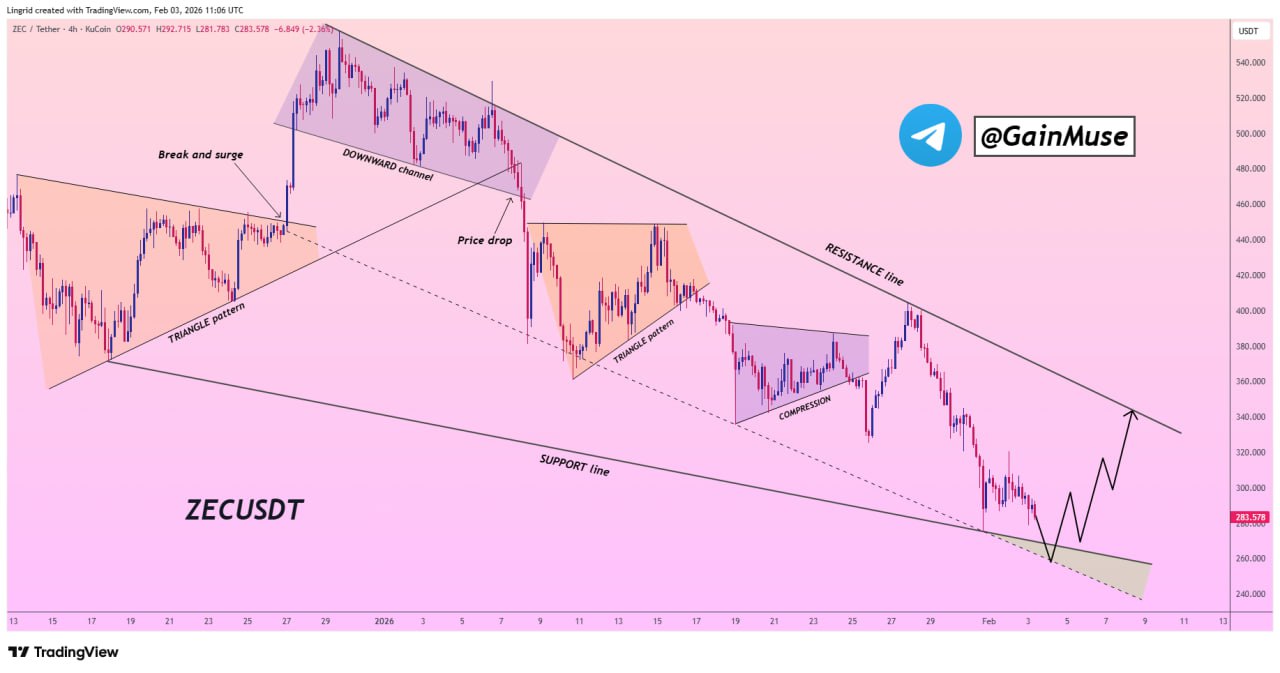
Source: https://t.me/gainmuse/1751

As long as price remains above the $280–$285 support zone, the market is transitioning away from liquidation and into short-term base building. This does not signal a trend reversal, but it does increase the probability of a technical bounce.

Any recovery attempt would likely target the descending resistance trendline, which currently sits above price and has rejected multiple rallies during the downtrend. Until that resistance is reclaimed, the broader bearish structure remains intact.

Key Levels to Watch

  • Support: $280–$285
  • Current Price Area: ~$287
  • Resistance: Descending channel resistance above $300
  • Structure Bias: Bearish, but stabilizing

Justin Sun Says Crypto-AI Lacks a “ChatGPT Moment” as Adoption Stalls

Conclusion

Zcash is no longer in free fall. After a deep shakeout that pushed price into the low-$280s, selling pressure has eased and price is beginning to stabilize near channel support. This behavior reflects a shift from liquidation to compression, increasing the likelihood of a short-term technical bounce.

However, as long as ZEC trades below descending resistance and fails to reclaim broken structure above $300, any upside remains corrective rather than trend-defining. For now, the market is stabilizing – not reversing.

The post Zcash Stabilizes Near $285 Support After Deep Shakeout appeared first on ETHNews.

Disclaimer: The articles reposted on this site are sourced from public platforms and are provided for informational purposes only. They do not necessarily reflect the views of MEXC. All rights remain with the original authors. If you believe any content infringes on third-party rights, please contact [email protected] for removal. MEXC makes no guarantees regarding the accuracy, completeness, or timeliness of the content and is not responsible for any actions taken based on the information provided. The content does not constitute financial, legal, or other professional advice, nor should it be considered a recommendation or endorsement by MEXC.

You May Also Like

FCA komt in 2026 met aangepaste cryptoregels voor Britse markt

FCA komt in 2026 met aangepaste cryptoregels voor Britse markt

De Britse financiële waakhond, de FCA, komt in 2026 met nieuwe regels speciaal voor crypto bedrijven. Wat direct opvalt: de toezichthouder laat enkele klassieke financiële verplichtingen los om beter aan te sluiten op de snelle en grillige wereld van digitale activa. Tegelijkertijd wordt er extra nadruk gelegd op digitale beveiliging,... Het bericht FCA komt in 2026 met aangepaste cryptoregels voor Britse markt verscheen het eerst op Blockchain Stories.
Share
Coinstats2025/09/18 00:33
Cashing In On University Patents Means Giving Up On Our Innovation Future

Cashing In On University Patents Means Giving Up On Our Innovation Future

The post Cashing In On University Patents Means Giving Up On Our Innovation Future appeared on BitcoinEthereumNews.com. “It’s a raid on American innovation that would deliver pennies to the Treasury while kneecapping the very engine of our economic and medical progress,” writes Pipes. Getty Images Washington is addicted to taxing success. Now, Commerce Secretary Howard Lutnick is floating a plan to skim half the patent earnings from inventions developed at universities with federal funding. It’s being sold as a way to shore up programs like Social Security. In reality, it’s a raid on American innovation that would deliver pennies to the Treasury while kneecapping the very engine of our economic and medical progress. Yes, taxpayer dollars support early-stage research. But the real payoff comes later—in the jobs created, cures discovered, and industries launched when universities and private industry turn those discoveries into real products. By comparison, the sums at stake in patent licensing are trivial. Universities collectively earn only about $3.6 billion annually in patent income—less than the federal government spends on Social Security in a single day. Even confiscating half would barely register against a $6 trillion federal budget. And yet the damage from such a policy would be anything but trivial. The true return on taxpayer investment isn’t in licensing checks sent to Washington, but in the downstream economic activity that federally supported research unleashes. Thanks to the bipartisan Bayh-Dole Act of 1980, universities and private industry have powerful incentives to translate early-stage discoveries into real-world products. Before Bayh-Dole, the government hoarded patents from federally funded research, and fewer than 5% were ever licensed. Once universities could own and license their own inventions, innovation exploded. The result has been one of the best returns on investment in government history. Since 1996, university research has added nearly $2 trillion to U.S. industrial output, supported 6.5 million jobs, and launched more than 19,000 startups. Those companies pay…
Share
BitcoinEthereumNews2025/09/18 03:26
Trump foe devises plan to starve him of what he 'craves' most

Trump foe devises plan to starve him of what he 'craves' most

A longtime adversary of President Donald Trump has a plan for a key group to take away what Trump craves the most — attention. EX-CNN journalist Jim Acosta, who
Share
Rawstory2026/02/04 01:19